


Get to know Weiyang District
- Administrative area
- District · 市辖区
- Part of
- Xi’an
- Chinese name
- 未央区
- Local areas
- District guide
Area & population
- Area
- 264.41 km²
- Population · 2020
- 733,403
Source: English Wikipedia, as of the dates shown.
A northern district with different landscapes
Weiyang (未央区) is one of Xi’an’s 11 districts; the city’s profile lists 11 districts and two counties. It is a large district, not one visitor entrance or walkable attraction. Its north is anchored by the high-speed rail interchange at Xi’an North Railway Station (西安北站). Farther west, Hancheng Lake (汉城湖) offers a long waterside park, while Han Chang’an City and the Weiyang Palace archaeological park preserve the remains of an early imperial capital. These places suit separate visits rather than a short stroll between doors.
“Weiyang” is also part of the Han palace and archaeological park’s name. The heritage name does not describe a separate present-day district. One common mix-up is Daming Palace: the Tang site belongs to Xincheng District, at 585 Ziqiang East Road (自强东路585号), not Weiyang. Its history is closely linked to Xi’an, but it is outside this district guide.
See the Han palace as archaeology
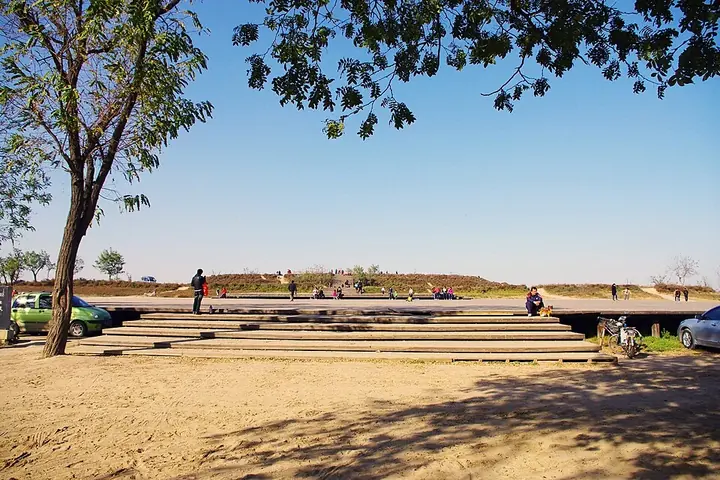
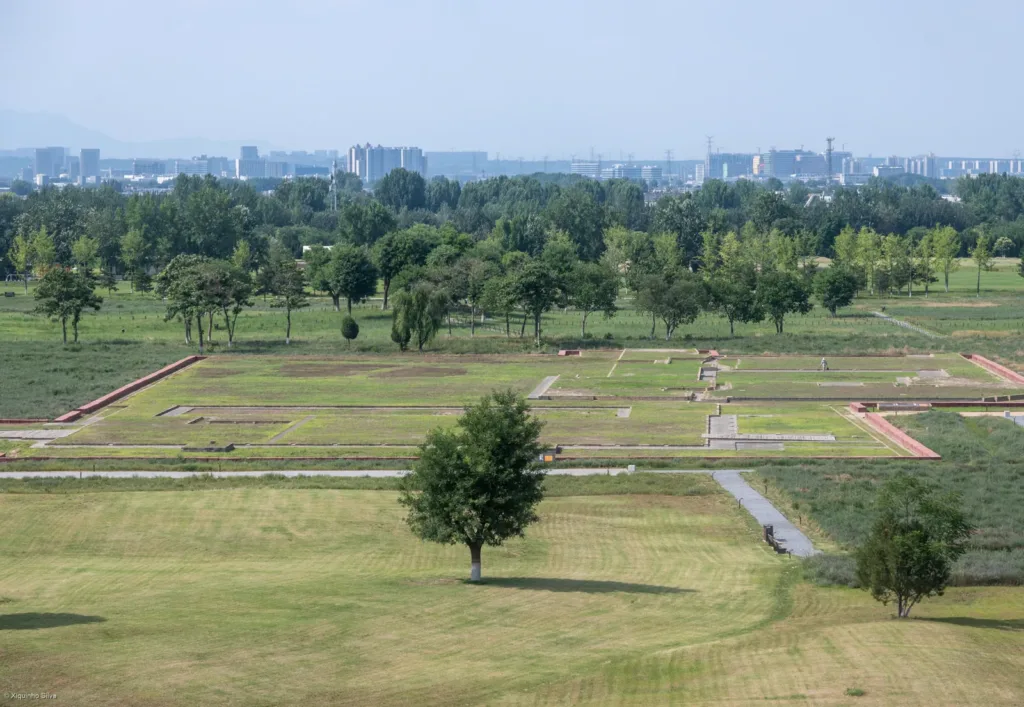
The Han Chang’an City Weiyang Palace National Archaeological Site Park (汉长安城未央宫国家考古遗址公园) is Weiyang’s most distinctive heritage walk. Weiyang Palace was a major palace of the Western Han capital. What visitors see today is the scale and layout of the remains, not restored halls: excavated building foundations remain exposed at ground level, with paths and landscape marking the archaeological footprint.
Use the site map at an open entrance, then follow marked paths to the Front Hall (前殿), Jiaofang Hall (椒房殿), central administrative compound (中央官署), ponds and channels, and city-wall and gate remains. At the Front Hall platform, read the broad, low lines in the earth against the scale of the former hall. At the administrative remains, interpretation connects inscribed bone tallies with government and production. Reconstruction images and a museum help bridge the gap between bare foundations and the old palace city.
This is a spacious outdoor heritage park at the city’s edge, with fields and landscaping alongside archaeological ground. Residents also use it for walking and exercise. Allow time to move between remains, wear comfortable shoes and stay on marked routes to protect buried archaeology. Do not assume that activities, food services, in-park vehicles or seasonal displays will be running on a particular day.
Follow the water at Hancheng Lake
Hancheng Lake is a separate urban water park beside the Han Chang’an remains. The scenic area developed around the former Tuanjie Reservoir, on a corridor tied to an old open canal. It combines flood-management infrastructure and water landscape with Han-themed displays; the lake itself is not an ancient palace pond.
A practical walk starts at the Dafengge Pavilion main entrance (大风阁主入口). From there, stroll beside the narrow lake and its bridges, and look for the Han-themed sculpture and relief displays. Dafengge is a modern, Han-style landmark named for Liu Bang’s poem “Song of the Great Wind,” not a surviving Han building. If the gate you choose is at the other end of the linear park, use the entrance that best fits your route rather than trying to walk every section. The park’s own guide describes fountains, cruises and elevator access inside Dafengge, but those services and hours are not treated here as current guarantees; check a current notice before planning around them.
Getting there
Xi’an North Railway Station. Xi’an North is an operating high-speed rail hub connected to Metro Line 2 (2号线). Follow station signs between the rail concourse and metro interchange; departures are on the elevated level and arrivals flow below. The metro operator maintains a live route planner.
Weiyang Palace site. A local visitor guide gives the address as Dengliu Road, Weiyang District (西安市未央区邓六路) and identifies Line 1’s Zaohe Station (皂河站) as a nearby rail reference. It lists bus routes 865, 234, 186, 193 and 211 for the park’s gate areas, including Xianmen (西安门), Zhangcheng Gate (章城门), Dengliu Road and Fengjing Road. The guide does not reliably match each route to a particular gate; verify the current stop display before boarding.
Hancheng Lake. Metro Line 8 (8号线) stops at Dafengge Station (大风阁站). The 2026 visitor directions also list bus 900, 235 or 509 to Fengchanmen (封禅门) for the Fengchan Plaza main entrance, or bus 211, 727 interval service or 901 interval service to the Hancheng Lake Dafengge stop (汉城湖大风阁站) for the Dafengge entrance. Those 2026 directions give the stop names but no subway exit number; follow current station signs toward the park rather than assuming an exit.
For a taxi or ride-hail to the lake, enter 汉城湖景区大风阁主入口 Hànchéng Hú Jǐngqū Dàfēng Gé Zhǔ Rùkǒu as the destination; the published location is by the northwest corner of North Second Ring Road and Zhuhong Road (西安市未央区北二环与朱宏路西北角). A currently designated legal vehicle set-down point has not been independently confirmed, so do not direct a driver into a bus-only stop or onto a park path. For the archaeological site, use 汉长安城未央宫国家考古遗址公园, 西安市未央区邓六路; its currently permitted vehicle set-down entrance has not been confirmed either. Weiyang District itself has no single district-wide taxi drop-off.
Guide sources
- Xi’an Municipal People’s Government, city profile and administrative divisions
- Xi’an Release, October opening for Han Chang’an City site improvements
- Shaanxi Broadcasting, The story of Han Chang’an City’s Weiyang Palace
- Xi’an Local Treasure, Weiyang Palace site park address and transport guide
- Xi’an Rail Transit Group, official passenger information
- China State Railway Group, Xi’an North Station
- Xi’an Local Treasure, Daming Palace address and visitor access
- Hancheng Lake Scenic Area, visitor guide and scenic-area description
- Xi’an Local Treasure, 2026 Hancheng Lake Mid-Autumn visitor guide
- Xi’an Release, Xi’an Metro Line 8 transfer and station guide
- Trip.com, Hancheng Lake Scenic Area location and visitor overview
Explore Weiyang District
Core places to explore, with English and Chinese names.
Places to explore around Weiyang District
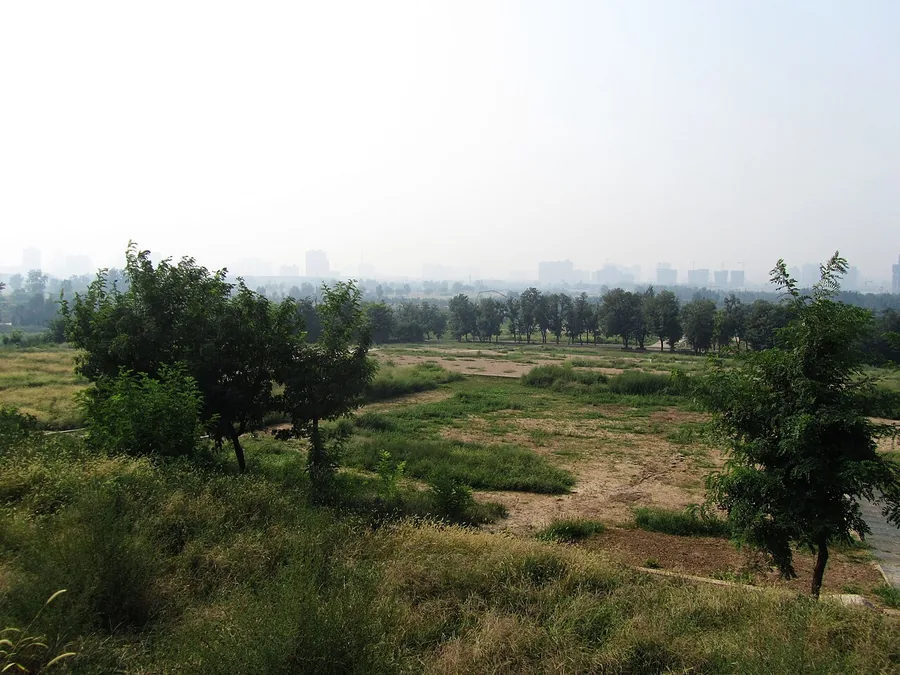 Grounds of the Han Chang'an city ruins, looking north from the Weiyang Palace Front Hall site; 1 September 2013.
Han Chang'an City Ruins汉长安城遗址
Explore the scale of Western Han Chang'an through the surviving earth platforms and open landscape of Weiyang Palace, the capital's principal palace precinct in northwest Xi'an.
Read the place guide →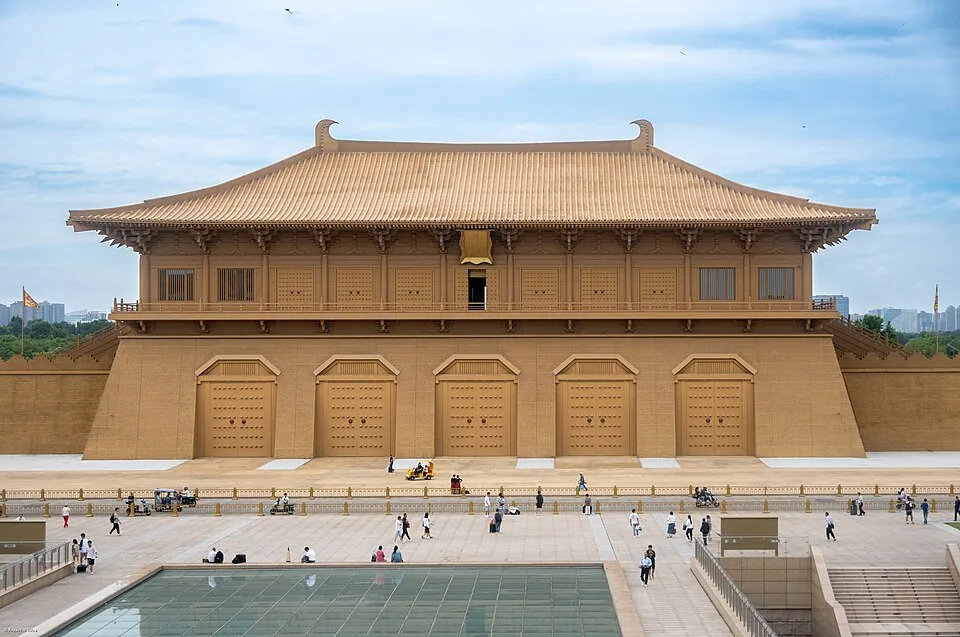 The reconstructed Danfeng Gate display building at the Daming Palace site; this is not a surviving Tang wooden hall. Photo: 2024-06-08 16:15:56.
Daming Palace大明宫遗址
Walk the north–south axis of Tang Chang’an’s former imperial palace, from Danfeng Gate and the Hanyuan Hall platform to the quieter landscape around Taiye Pond.
Read the place guide →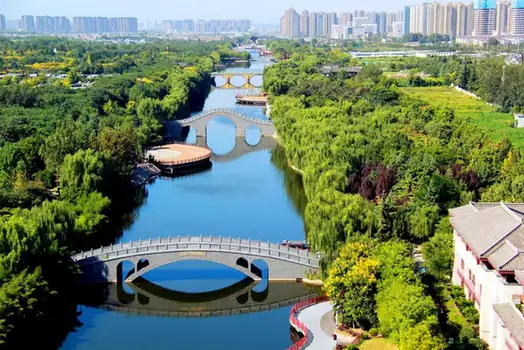 Hancheng Lake Park · 汉城湖
Hancheng Lake Park汉城湖
A long lakeside park in Xi’an’s Weiyang District follows the former Tuanjie Reservoir corridor, pairing urban water-management landscape with modern Han-inspired architecture and interpretation.
Read the place guide →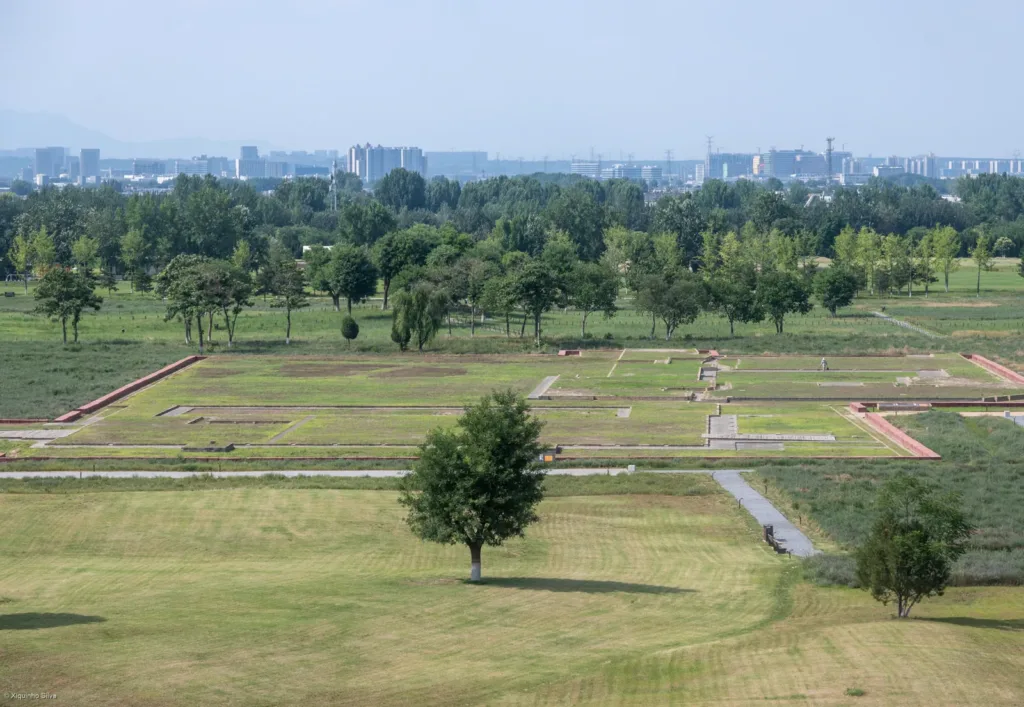 View across the marked foundations and landscaped grounds at Weiyang Palace, with modern Xi'an beyond. JPEG re-encoded and metadata removed; no cropping or visual retouching. Photo: Xiquinho Silva (xiquinhosilva) · CC BY 2.0
Weiyang Palace Site of Han Chang'an City汉长安城未央宫遗址
Walk among the broad, grass-framed foundations of the Western Han capital’s principal palace, then read its halls, offices, gates and water features as parts of a once-enormous imperial landscape.
Read the place guide →The Great Qin赳赳大秦
A moving-seat, immersive theatre production in Fengdong New City that follows the Qin-era soldier Black Fu from an archaeological dig into palace, battlefield and riverside scenes. Its unusually large, technology-led staging makes Qin history a live performance experience rather than a museum visit.
Read the place guide →Plan your visit
Getting there
Weiyang District is about 4 km (straight-line distance) from central Xi’an. Search for 未央区 in a map app to find stations and your accommodation.
Where to stay →Build your route
Han Chang'an City Ruins and Daming Palace are about 9 km apart (straight-line distance). The linked place guides have entrance and visit details.
Continue with Xi’an →More in Xi’an
Sources & geographic information
Administrative names and parent areas: Official geographic directory (dmfw.mca.gov.cn) · Reference date 2026-09-06.
Background text adapted from Weiyang, Xi'an — Wikipedia contributors, under CC BY-SA 4.0. Text has been shortened and reorganized; source revision 1364227161.
Photo: Han Chang'an City Ruins · 猫猫的日记本 · CC BY-SA 3.0. Resized for the web; the photo itself has not been edited.

Photo: Daming Palace · xiquinhosilva · CC BY 2.0. Resized for the web; the photo itself has not been edited.

Photo: Hancheng Lake Park · sn.cri.cn. Resized for the web; the photo itself has not been edited.
Map data © OpenStreetMap contributors. Pins mark approximate centres, not entrances or boundaries.
Image credits & notes (2)
- The remains of the Weiyang Palace front hall in Weiyang District, Xi'an. Photograph date recorded by the source: 2012-11-11 14:57:03.Photo: 时雨 · CC BY-SA 3.0Resized for the web; the photo itself has not been edited. Thumbnails may show a cropped view.
- Exposed archaeological footprint and low remains at Weiyang Palace, with present-day Xi’an beyond the park. Photo: Xiquinho SilvaPhoto: CC BY 2.0
