

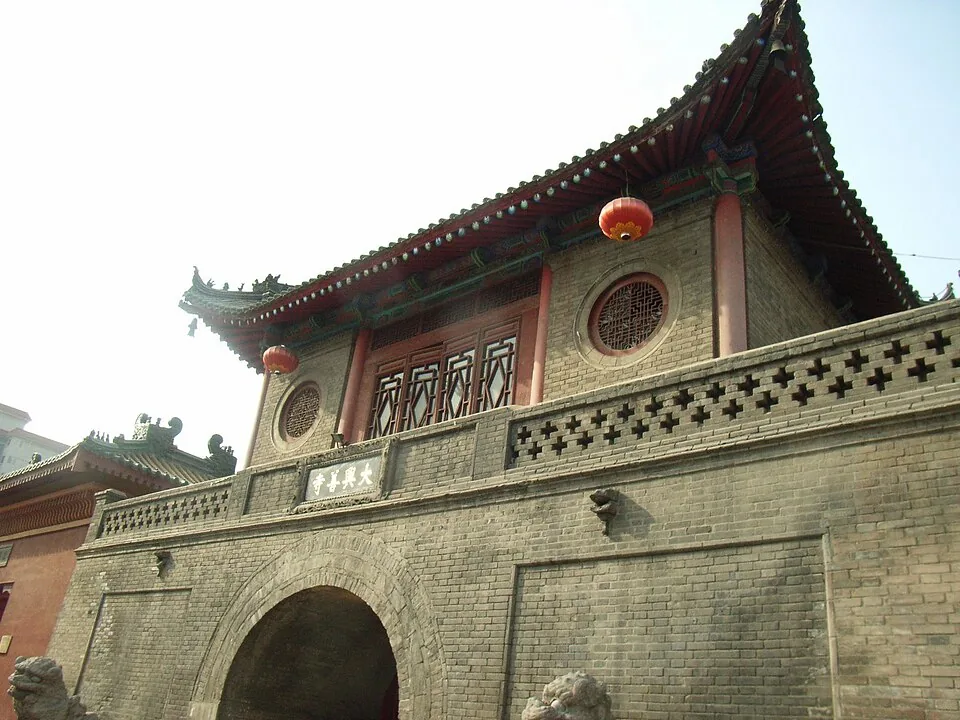
Photo adjustments
Converted to WebP and resized without changing the subject or cropping the source frame.
Explore the region
About Daxingshan Temple
Its courtyards contain much later halls as well as the remains of a Tang scripture-repository building. The main hall’s Five Buddhas and the Guanyin Hall’s many-armed image provide clear visual links to its religious tradition. Moving north along the axis reveals a progressively quieter series of spaces.
Its antecedents included temples established in 266 and 539. Between 716 and 720, Śubhakarasiṃha (善无畏), Vajrabodhi (金刚智) and Amoghavajra (不空) resided here, translating scriptures and teaching Esoteric Buddhism. The temple became a Shaanxi Provincial Cultural Relics Protection Unit in 1956. In 1983 it also received designation as a National Key Buddhist Temple in Han Chinese Areas.
In the Heavenly Kings Hall (天王殿), a Maitreya (弥勒佛) image occupies the centre, with the four guardian kings arranged on its eastern and western sides. Weituo (韦驮尊天菩萨) stands behind it. Subsidiary halls occupy the two sides of the next courtyard, while the bell and drum towers stand farther north.
What to look for
- The Five Buddhas in the Mahavira Hall and the many-armed Guanyin image farther along the axis.
- The column-base remains of the Tang revolving scripture-repository hall.
Location & getting there
Getting to Daxingshan Temple
Go to 55 Xingshansi West Street in Yanta District.
- Xiaozhai station on Metro Lines 2 and 3 provides an approach southeast of the temple.
Combine your visit
Suggested order within this visit:
-
Mahavira Hall
Begin with the Five Buddhas and the temple’s Esoteric Buddhist identity.
-
Tang scripture-hall remains
Compare the surviving foundations with the later buildings.
-
Guanyin Hall
Continue north to the carved devotional image.
This sequence is an editorial suggestion based on the features described in the sources. Access to individual buildings or areas should be checked locally; no travel time or shared admission is implied.
Find Daxingshan Temple
大兴善寺 · 雁塔区
The pin marks the area, not the entrance.
More places nearby
Approximate straight-line distances between map pins, not travel distances.
Xi’an Museum 西安博物院
1 km awayXi’an Museum places the city’s changing form at the center of its collection. Models of successive capitals help explain why Han Chang’an, Tang Chang’an and the later walled city occupy different footprints. Bronze vessels…
View guide →Shaanxi History Museum 陕西历史博物馆
1 km awayShaanxi History Museum follows the region’s long role as a centre of Zhou, Qin, Han and Tang civilisation. The main Xiaozhai venue combines bronze ritual vessels, pottery figures and Tang-period objects in a building whose…
View guide →Small Wild Goose Pagoda 小雁塔
1 km awayThe Small Wild Goose Pagoda survives within the Jianfu Temple grounds administered by Xi’an Museum. Its closely spaced brick eaves give it a very different outline from the Giant Wild Goose Pagoda. Built in the early eighth…
View guide →Sources & visit information
The sources below support the place-specific description and arrival information. Suggested combinations are editorial planning ideas; confirm current opening, entry arrangements and transport services for your date.
- Wikipedia: 大兴善寺 ↗
- Wikivoyage: Xi'an ↗
- English Wikipedia: Daxingshan Temple (revision 1367476959, 2026-08-03) ↗
Visitor information adapted and edited from Wikipedia contributors · CC BY-SA 4.0. Source revision 93619785.
Visitor information adapted and edited from Wikivoyage contributors · CC BY-SA 4.0. Source revision 5329865.
Background paragraphs translated and condensed from Wikipedia contributors, "大兴善寺", Chinese Wikipedia · CC BY-SA 4.0. Source revision 93619785.
Background paragraphs condensed from Wikipedia contributors, "Daxingshan Temple", English Wikipedia · CC BY-SA 4.0. Source revision 1367476959.