

Explore the region
Tap any red Chinese text to hear it in Mandarin.
Xianyou Temple (仙游寺) is in Mazhao Town, Zhouzhi County, on the north ridge above the Jinpen Reservoir. This is the relocated site, not the temple’s former riverside position: the original grounds now lie beneath the reservoir. The temple and its Fawang Pagoda (法王塔) were moved during the Heihe water-project works, with State Council approval for the pagoda’s relocation in 1998.
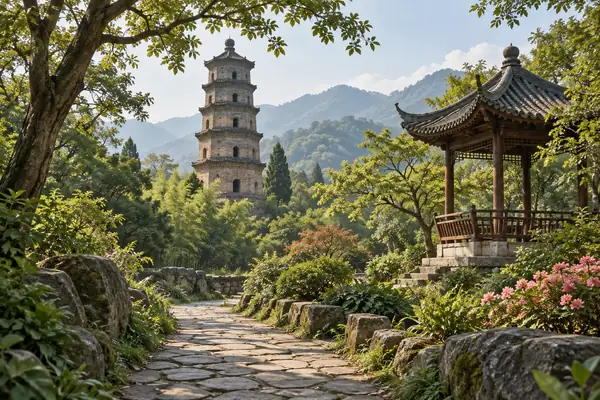
The pagoda is the visual anchor of the visit. Look for its square brick body and seven closely spaced, projecting eaves; take time to view it from more than one side rather than treating it as a quick roadside stop. Archaeologists documented a small relic chamber in the tower and excavated both upper and underground deposits during the move. The finds included stone containers, gilded copper coffins, glass vessels and relics; the museum’s relic displays connect those discoveries to the building you can see outside.
Begin at Xianyou Temple Museum (仙游寺博物馆), whose core displays are the Xianyou relic exhibition and Xianyou calligraphy courtyard. Inside, explore the temple’s history and objects recovered from the pagoda; then walk through the courtyard, where inscribed stones and calligraphy make the site’s literary association tangible. Local tradition links the temple with Bai Juyi’s composition of “Song of Everlasting Sorrow” (《长恨歌》) in 806, when he was serving in Zhouzhi. Read that as the site’s remembered literary heritage, not as a surviving room or writing desk from the poem’s composition.
The museum was reported open to the public free of charge in February 2023. Current opening hours, admission arrangements, and any reservation requirement have not been confirmed; check with the museum or Zhouzhi cultural authorities before setting out.
Getting there: There is no verified metro connection to the site. A museum directory lists bus 106 from Zhouzhi County Bus Station or Louguantai to Mazhao, followed by about 2 km south, but the listing does not establish that this route and stop pattern are current; confirm locally before relying on it. For a more direct trip, arrange a taxi or ride-hail to 周至县马召镇金盆水库北山梁仙游寺博物馆 Zhōuzhì Xiàn Mǎzhào Zhèn Jīnpén Shuǐkù Běi Shānliáng Xiānyóu Sì Bówùguǎn. The published location is beside the 108 National Road and north of the reservoir; from Zhouzhi, the directory describes the approach via the 108, while the 107 mountain-ring road is another approach. Ask the driver to use the museum’s visitor access and stop only where permitted. The exact visitor gate and lawful roadside drop-off point are not documented in the sources checked, so confirm the final turn locally rather than asking to be left on a highway shoulder.
Combine your visit
Suggested order within this visit:
-
Relocated temple grounds
Establish the new setting and the reservoir-construction story.
-
Fawang Pagoda
Examine the rebuilt tower’s Sui-derived brick form from outside.
-
Local interpretation
Look for the account of the relocation and relic-chamber discoveries; current artifact display is not assumed.
This sequence is an editorial suggestion based on the features described in the sources. Access to individual buildings or areas should be checked locally; no travel time or shared admission is implied.
Find Xianyou Temple
仙游寺 · 周至县
The pin marks the area, not the entrance.
More places nearby
Approximate straight-line distances between map pins, not travel distances.
Qinling Four Treasures Science Park 秦岭四宝科学公园
11 km awayQinling Four Treasures Science Park grew from a wildlife rescue and research base near Louguantai. Its central subjects are the giant panda, crested ibis, golden snub-nosed monkey and takin. The visit works best as a comparison…
View guide →Louguantai 楼观台
12 km awayLouguantai is a Daoist mountain-foot site in Zhouzhi, traditionally associated with Laozi’s transmission of the Daodejing. Its principal visit rises toward Shuojing Terrace, where later temple buildings occupy a wooded elevation…
View guide →Caotang Temple 草堂寺
51 km awayCaotang Temple lies below Guifeng on the northern edge of the Qinling. It is associated with Kumārajīva’s early fifth-century Buddhist translation work. The small, elaborately carved relic stupa attributed to him contrasts with…
View guide →Sources & visit information
Sources checked on 21 October 2026. Hours, tickets, reservations and transport can change; confirm with the operator before you go.