

Explore the region
A temple and a school
The site was established in 1294 and, after several moves, was rebuilt at its present location in the 1850s. Shanghai Wenmiao is a Confucian temple as well as a former centre of local learning. The Huangpu District government describes it as a municipal-level protected cultural relic and records the long-running role of its halls and adjoining buildings in rites, teaching and public education.
Its architecture was organised around two complementary functions: a western temple axis for ritual and an eastern school axis for learning. A 2022 Shanghai government update said the restoration project aimed to recover this traditional arrangement and connect the compound with the surrounding old-city streets. Rather than treating the buildings as interchangeable halls, read the complex as a sequence of ceremonial, educational and garden spaces.
What the historic spaces represent
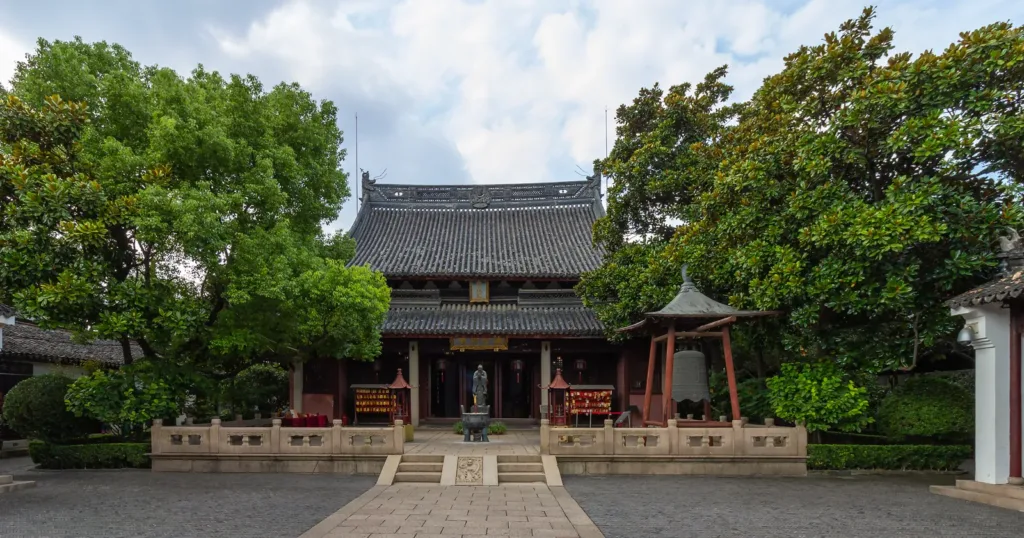
Dacheng Hall (大成殿) was the principal hall for Confucian worship. The district’s 2021 notice describes it as a protected building and recounts several reconstructions; its present condition and public access should not be inferred from that historical record.
Minglun Hall (明伦堂) was a place for teaching Confucian students. It was destroyed during the fighting around the Small Swords Society uprising and rebuilt in the nineteenth century, according to the same district notice. Zunjing Pavilion (尊经阁) served as a library; in 1931 it became Shanghai’s first municipal public library, a reminder that the compound’s story extends beyond ritual.
Kuixing Pavilion (魁星阁) was associated with the deity of literary achievement. The historic east garden—with its pavilion, pond and planted grounds—added a Jiangnan garden setting to the temple-school. These buildings and spaces were listed in the district’s account of the protected site, but that 2021 notice is not a current floor plan or guarantee of access.
How to plan a visit
Check access before setting out
Shanghai Wenmiao closed to the public on 8 October 2021 for restoration and expansion. In a 2024 project application, the Huangpu District Culture and Tourism Bureau proposed phase-two restoration, exhibition and visitor facilities, with work scheduled to start in February 2025 and completion/acceptance planned for the end of February 2026. Those were projected dates, not proof that work finished or visitors were readmitted. A 2025 report said phase one was basically complete by February 2025 and phase two was about to begin; it did not announce a public reopening or give visitor rules.
As of 21 October 2026, the official and news sources checked for this guide do not confirm that the temple has reopened. Current hours, ticket price, reservation requirements, visitor entrance and exit arrangements are therefore unverified. Do not assume that the pre-restoration ticket prices or opening hours still apply, and do not make a dedicated trip for an interior visit until an up-to-date notice from the Huangpu authorities confirms access. The nearby streets may also be affected by the surrounding renewal project; public access to the compound’s perimeter is not guaranteed by the address alone.
Finding the site
The verified address is 215 Wenmiao Road, Laoximen, Huangpu District, Shanghai. The nearest documented Metro options are Laoximen (Lines 8 and 10) and Lujiabang Road (Lines 8 and 9); transit mapping places both near the site. No current, reliable exit-to-gate walking direction could be verified, so an exit number is not recommended. Moovit lists nearby bus stops Dananmen (大南门) and Henan South Road–Penglai Road (河南南路蓬莱路) and nearby routes 66, 920, 929, 955 and Xuchuan Special Line, but does not establish a dependable route-to-stop pairing. Check current service and street restrictions before travelling. For a taxi or ride-hail, the usable Chinese destination is 上海文庙(黄浦区文庙路215号); this is the verified address, not confirmation of a legal curbside drop-off or an open visitor gate. The mapped main entrance is not confirmed as an operating visitor entrance.
When the site is confirmed open, allow time to understand the relationship between its ritual and teaching spaces rather than judging it only by a photograph of the main hall. For now, treat any visit plan or duration as conditional on the latest access notice; no visit duration or route is promised here.
If both sides of the historic compound are open, an editorial way to read it is to compare the western ritual axis with the eastern teaching axis, then pause in the garden to see how the scholarly buildings relate to the planted grounds. This is a way of interpreting the documented layout, not a currently published visitor route; follow the operator’s map and any barriers on the day.
Combine your visit
A suggested sequence linking the specific features of this visit.
-
Wenmiao Road exterior
Locate the former county temple-school within the old-city street network.
-
Dacheng Hall and Minglun Hall, if reopened
Compare the documented ceremonial and educational spaces when public access permits.
-
Old City Wall大境阁及古城墙
Use a separate surviving old-city landmark as an alternative or additional stop.
This order is editorial. Confirm access and any transfers between stops; it does not establish a walking route, same-day connection or common admission ticket.
Find Wenmiao Temple
上海文庙 · 黄浦区
The pin marks the area, not the entrance.
More places nearby
Approximate straight-line distances between map pins, not travel distances.
Baiyun Guan Temple 上海白云观
Less than 1 km awayBaiyun Guan is a Taoist temple on Dajing Road in Shanghai’s old city. It offers another religious layer in an area better known to many visitors for Yuyuan and the City God Temple.
View guide →Xiaotayuan Mosque 小桃园清真寺
Less than 1 km awayXiaotayuan Mosque stands in the southern part of Shanghai’s old-city area. Its architecture combines Chinese and Islamic elements, giving it a different visual character from the Buddhist and Taoist sites nearby.
View guide →Old City Wall 大境阁及古城墙
Less than 1 km awayThe Old City Wall site preserves a short surviving section of Shanghai’s former urban defences. Dajing Tower is the most visible feature of the remaining ensemble.
View guide →Sources & visit information
Sources checked on 21 October 2026. Hours, tickets, reservations and transport can change; confirm with the operator before you go.
- Huangpu District government notice on Wenmiao closure and restoration ↗
- Shanghai government update on Wenmiao restoration and expansion ↗
- Huangpu District Culture and Tourism Bureau phase-two project application ↗
- The Paper report on Wenmiao and its changing neighbourhood, 25 April 2025 ↗
- Moovit public-transport listings for Shanghai Wenmiao ↗
- OpenStreetMap Shanghai Confucian Temple feature and mapped geometry ↗
- Laoximen Metro station lines and service information ↗
- Lujiabang Road Metro station lines and service information ↗
- OpenStreetMap mapped main entrance node ↗
Image credits & notes (1)
- Shanghai Wenmiao before its restoration and expansion project; photographed 20 September 2016. Does not show the present-day site or visitor conditions. Photo: Stefan Fussan / DerFussiPhoto: CC BY-SA 3.0