

Photo adjustments
Converted to WebP and resized without changing the subject or cropping the source frame.
Explore the region
About Guyi Garden
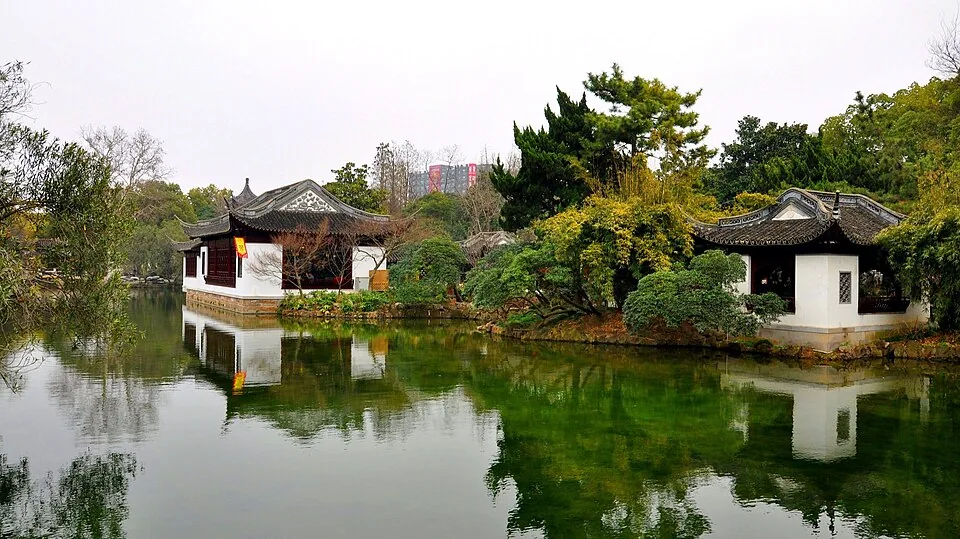
Its layout uses bamboo, ponds, pavilions and winding bridges to create a succession of enclosed scenes.
The Goose Pond and stone boat provide a useful central route, with the Plum Hall adding another architectural focus. The garden has passed through private and communal use, so the present grounds reflect several phases of rebuilding. Look at how water and buildings frame one another as you move between these features.
The garden, originally called Yi Garden (猗园), was built during the Jiajing era (1522-1566) of the Ming dynasty by the Henan official Min Shiji (闵士藉) and designed by the bamboo-carving master Zhu Sansong (朱三松); its name came from a Book of Songs phrase describing lush bamboo. After passing through several private owners, it was purchased and rebuilt between 1746 and 1748 by Ye Jin (叶锦) of Dongtingshan, who renamed it Guyi Garden to mark the change of dynasty. In 1789 local residents bought the garden to serve as the spirit garden of the prefecture's City God Temple.
Yiye Hall (逸野堂), in the garden's northwest and dating to the Ming dynasty, was occupied by Japanese forces for over two months during the January 28 Incident (一二八事变) and was badly damaged; it was not rebuilt until 1979. Quejiao Pavilion (缺角亭), built in 1933 atop Zhuzhi Hill within the garden, commemorates the loss of northeastern Chinese territory following the September 18th Incident (九一八事变). After 1949 the garden underwent repeated expansion, and in 2014 it was listed as a Shanghai Cultural Relic Protection Unit (上海市文物保护单位).
What to look for
- Goose Pond and the stone boat provide a central waterside composition.
- Bamboo planting and Plum Hall create a different garden scene.
Background & history
Guyi Garden (Chinese: 古猗园; pinyin: Gǔyī Yuán) is a classical Chinese garden in the town of Nanxiang in the suburban Jiading District of Shanghai, China. The garden is located about 21 kilometres (13 mi) from the city centre. Designed in the typical style of a Jiangnan classical garden, Guyi Garden is regarded as one of the five most important classical gardens of Shanghai.
Excerpt from Wikipedia: Guyi Garden · Wikipedia contributors · CC BY-SA 4.0. Selected introductory sentences; formatting simplified. Background information, not current visitor-service advice.
Location & getting there
Getting to Guyi Garden
Approach 218 Huyi Highway in Nanxiang, southwest of Nanxiang station.
Combine your visit
A suggested sequence linking the specific features of this visit.
-
Goose Pond
Begin with a principal water feature of the garden.
-
Stone boat
Examine the fixed boat-shaped garden structure beside the water.
-
Plum Hall
Compare another named building and its planted setting.
This order is editorial. Confirm access and any transfers between stops; it does not establish a walking route, same-day connection or common admission ticket.
Find Guyi Garden
古猗园 · 嘉定区
The pin marks the area, not the entrance.
More places nearby
Approximate straight-line distances between map pins, not travel distances.
Tanyuan 檀园
1 km awayTanyuan is a reconstructed garden associated with the Ming scholar and artist Li Liufang. The present garden was rebuilt in 2011 after the earlier property had long been lost.
View guide →Yunxiang Temple 云翔寺
1 km awayYunxiang Temple is a Buddhist precinct in Nanxiang with a long religious history and a substantially reconstructed present complex. Repeated destruction and rebuilding make it important to distinguish the continuing institution…
View guide →Zhenru Temple 真如寺
9 km awayZhenru Temple is a historic Buddhist precinct in Putuo, with origins traced to the Yuan period. A pagoda, prayer wheels, stele and a riverside colonnade give the visit several distinct visual elements.
View guide →Sources & visit information
The sources below support the place-specific description and arrival information. Suggested combinations are editorial planning ideas; confirm current opening, entry arrangements and transport services for your date.
- Guyi Garden ↗
- Shanghai/Jiading ↗
- Chinese Wikipedia: 古猗园 (revision 92089246, 2026-03-29) ↗
- English Wikipedia: Guyi Garden (revision 1342743179, 2026-03-10) ↗
Visitor information adapted and edited from Wikipedia contributors, “Guyi Garden” · CC BY-SA 4.0. Source revision 1342743179.
Visitor information adapted and edited from Wikivoyage contributors, listing “Guyi Garden” · CC BY-SA 4.0.
Background paragraphs translated and condensed from Wikipedia contributors, "古猗园", Chinese Wikipedia · CC BY-SA 4.0. Source revision 92089246.
Background paragraphs condensed from Wikipedia contributors, "Guyi Garden", English Wikipedia · CC BY-SA 4.0. Source revision 1342743179.