

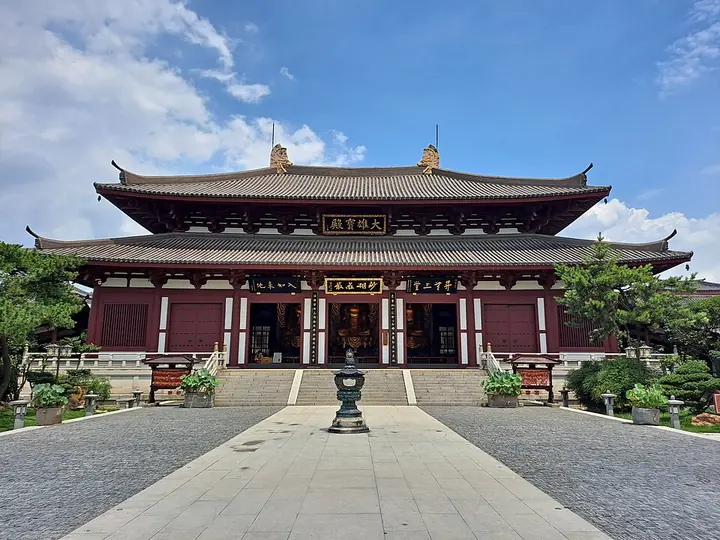
Photo adjustments
Full frame retained; proportionally resized and converted to WebP. No retouching or changes to the photographed subject. Card displays may crop the view.
Explore the region
About Yunxiang Temple
Repeated destruction and rebuilding make it important to distinguish the continuing institution from the age of the visible buildings.
The halls are dedicated to several Buddhist figures, including Guanyin, Manjushri and Samantabhadra. Bell and drum towers give the complex additional vertical features, while older stone towers stand outside in the surrounding square. A visit can compare the reconstructed worship spaces with this older architectural setting without assuming that every hall is open to tourists.
The temple was originally named Baihe Yunxiang Temple (白鹤云翔寺), also known as Liuyun Chan Temple (留云禅寺). Accounts differ on its founding: Yuan dynasty sources dated it to the fourth year of the Tianjian era of the Southern Liang dynasty (505), while the Wudizhi Houji records construction in the fourth year of the Kaicheng era of the Tang dynasty (839). During the Kaicheng era, Emperor Wenzong of Tang granted the temple a plaque reading Nanxiang Temple (南翔寺), a name reconfirmed by Song Emperor Lizong in the Shaoding era; in 1700, in the Qing dynasty, Emperor Kangxi granted the temple its present name.
A fire damaged the temple in the thirty-first year of the Qianlong era (1766), and it suffered further destruction during the Taiping Rebellion's advance on Shanghai and during the Anti-Japanese War, leaving little standing. In February 2000 the Nanxiang town government decided to rebuild it 70 meters west of the original site, and the reconstruction was completed on 19 November 2004.
The present complex has a total floor area of 9,318 square meters and includes the Hall of the Mountain Gate (山门殿), the Sangharama Hall (伽蓝殿) and the Mahasthamaprapta Hall (大势至殿), along with underground structures housing the Ten Thousand Buddhas Hall (万佛堂) and the Hall of Merit (功德堂).
What to look for
- Separate halls are dedicated to Guanyin, Manjushri and Samantabhadra.
- Bell and drum towers form prominent elements of the reconstructed precinct.
- Older stone towers survive outside in the surrounding square.
Location & getting there
Getting to Yunxiang Temple
Approach 100 Renmin Street in Nanxiang, Jiading, and distinguish the temple entrance from the public square and stone towers outside.
Combine your visit
A suggested sequence linking the specific features of this visit.
-
Stone towers outside the temple
Begin with older architectural remains in the public square.
-
Bell and drum tower setting
Compare the vertical features of the reconstructed temple.
-
Accessible Buddhist halls
Explore the separate devotional spaces permitted to visitors.
This order is editorial. Confirm access and any transfers between stops; it does not establish a walking route, same-day connection or common admission ticket.
Find Yunxiang Temple
云翔寺 · 嘉定区
The pin marks the area, not the entrance.
More places nearby
Approximate straight-line distances between map pins, not travel distances.
Tanyuan 檀园
Less than 1 km awayTanyuan is a reconstructed garden associated with the Ming scholar and artist Li Liufang. The present garden was rebuilt in 2011 after the earlier property had long been lost.
View guide →Guyi Garden 古猗园
1 km awayGuyi Garden in Nanxiang combines a classical Jiangnan garden with a larger public-park setting. Its layout uses bamboo, ponds, pavilions and winding bridges to create a succession of enclosed scenes.
View guide →Zhenru Temple 真如寺
10 km awayZhenru Temple is a historic Buddhist precinct in Putuo, with origins traced to the Yuan period. A pagoda, prayer wheels, stele and a riverside colonnade give the visit several distinct visual elements.
View guide →Sources & visit information
The sources below support the place-specific description and arrival information. Suggested combinations are editorial planning ideas; confirm current opening, entry arrangements and transport services for your date.
Visitor information adapted and edited from Wikipedia contributors, “云翔寺” · CC BY-SA 4.0. Source revision 90993846.
Visitor information adapted and edited from Wikivoyage contributors, listing “Yunxiang Temple” · CC BY-SA 4.0.
Background paragraphs translated and condensed from Wikipedia contributors, "云翔寺", Chinese Wikipedia · CC BY-SA 4.0. Source revision 90993846.