

Explore the region
Service facts checked: 21 October 2026. Opening, admission and entrance arrangements below are limited to what could be verified from dated public sources; confirm the temple’s current arrangements before setting out.
Read the main hall, not just the skyline
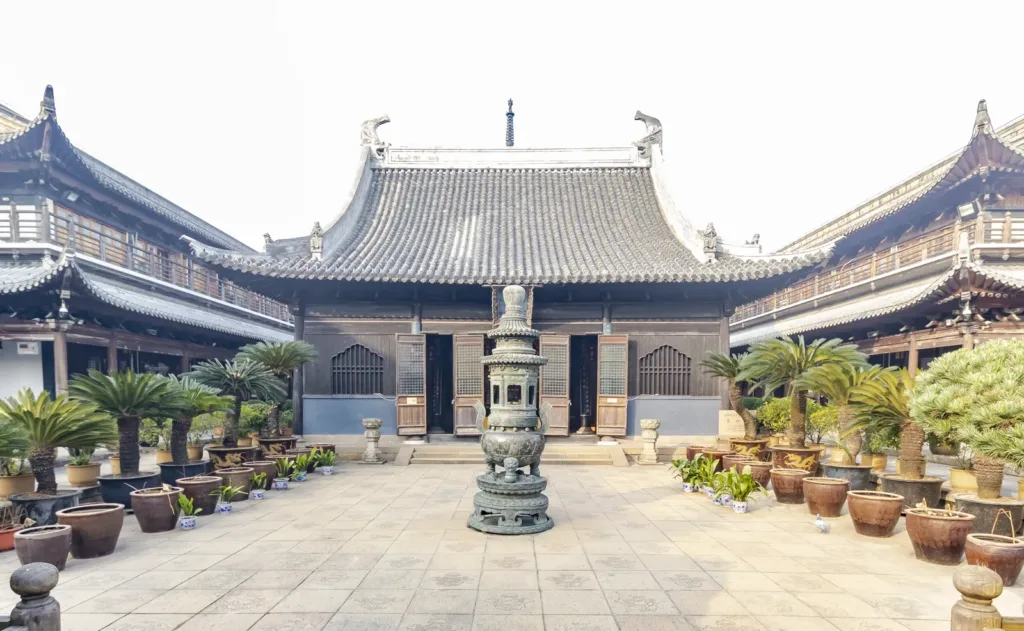
The best reason to come is the contrast between a real place of Buddhist practice and a rare historic building. Shanghai’s government identifies the main hall as the city’s only surviving Yuan-dynasty timber structure. Its date is associated with the Yuan-era inscription preserved on an interior beam. The hall has a single-eaved hip-and-gable roof; during a 1963 restoration, later-added lower eaves were removed to restore the earlier appearance. These are features of the main hall, not a claim that every building in today’s expanded temple compound is medieval.
From the courtyard, compare the hall’s restrained, low roof line with the deep, layered brackets beneath its eaves. A 2025 municipal account reports that ten of its sixteen columns remain Yuan-period cypress originals and that six Yuan-period stone column bases survive. If the hall is open to visitors, look up from a respectful distance rather than touching the historic timber. The same account identifies an old ginkgo in front of the hall; together, tree and roof make a useful visual frame, especially when the leaves turn in autumn.
The compound is larger than the historic hall. A district feature describes later temple buildings, including the nine-storey, roughly 50-metre Zhenru Pagoda, added during the modern revival of the temple. Treat the pagoda and other halls as part of a living religious site: their access can differ from the courtyard’s, and no source checked for this guide establishes that the tower is currently open for climbing.
A simple way to explore
Allow about 45–90 minutes as an editorial estimate, depending on which spaces are open and how long you pause. Begin at the current public entrance and orient yourself in the main courtyard. Visit the historic main hall first; take time to read the roof silhouette, brackets and surviving timber rather than rushing from one building to the next. Then look back toward the ginkgo in front of the hall and notice how the tree, the older hall and the later pagoda occupy different visual layers of the compound. If open, continue to the other public halls or the pagoda only in the order permitted by signs and temple staff. This is a suggested sequence, not an official route or promise of interior access.
Zhenru Temple continues to serve Buddhist worship as well as heritage interest. Keep voices low, avoid interrupting services, and follow notices about photography, restricted rooms and incense. The 2026 sources describe a quiet temple setting, but worship activity and access rules on the day take precedence over a sightseeing plan.
Getting there and checking entry
The address reported by Shanghai municipal sources is 399 Lanxi Road, Putuo District, Shanghai (普陀区兰溪路399号). The Shanghai government identifies Zhenru station (真如站) on Metro Lines 11 and 14. No reliable source checked here establishes which station exit currently gives the best route, the final walking distance, or the temple gate open to visitors. From the station, follow current street directions to the numbered address and confirm the public gate on site; do not treat a map pin as an entrance.
A local transit directory lists bus 724 at Tongchuan Road–Lanxi Road stop (铜川路兰溪路), near the temple address. Route and stop information comes from a local area directory rather than a bus-operator timetable, so check the direction and live service before boarding. A transit mapping service also lists other bus services in the wider vicinity, but does not reliably pair them with the closest stop; they are not listed here as direct temple buses.
For a taxi or ride-hail destination, enter 真如寺,普陀区兰溪路399号. The exact visitor gate and authorized curbside drop-off point could not be verified. Ask to be let out only at a lawful public stopping place by the temple approach, then follow on-site signs; do not ask a driver to enter a restricted compound or assume a particular gate is open.
As of 21 October 2026, I could not verify a current official ticket price, advance-booking requirement, daily opening schedule, or named visitor entrance and exit. A municipal page dated 3 December 2025 printed hours of 06:00–16:00, but that dated feature is not a live operations notice, so those hours are not presented here as confirmed for 2026. Check directly with the temple or current on-site notices before travelling, especially near a religious festival or if hoping to enter a particular hall.
Combine your visit
A suggested sequence linking the specific features of this visit.
-
Temple courtyards and pagoda
Begin with the central religious and architectural arrangement.
-
Riverside colonnade
Look for the bell collection beside the river.
-
Stele and pond setting
Finish with the smaller commemorative and landscape details.
This order is editorial. Confirm access and any transfers between stops; it does not establish a walking route, same-day connection or common admission ticket.
Find Zhenru Temple
真如寺 · 普陀区
The pin marks the area, not the entrance.
More places nearby
Approximate straight-line distances between map pins, not travel distances.
Yuan-Dynasty Sluice Gate Museum 上海元代水闸遗址博物馆
3 km awayThe Yuan-Dynasty Sluice Gate Museum preserves an excavated water-control structure from medieval Shanghai. Sluices along the Wusong River, now known as Suzhou Creek, formed part of the effort to manage flooding.
View guide →Changfeng Park 长风公园
3 km awayChangfeng Park is organized around the artificial Yinchu Lake and Tiebi Hill in western Shanghai. The landscaped park was developed in the 1950s as a substantial public green space in Putuo.
View guide →Zhongshan Park 中山公园
4 km awayZhongshan Park in Changning developed from the former Jessfield Park. Its landscape combines English naturalistic design with elements of Chinese garden art.
View guide →Sources & visit information
Sources checked on 21 October 2026. Hours, tickets, reservations and transport can change; confirm with the operator before you go.
- Shanghai government English guide to Zhenru Ancient Town ↗
- Putuo’s nearly 700-year-old hall and ginkgo ↗
- Putuo one-day route published by Shanghai government ↗
- Shanghai Observer feature on Zhenru Temple and its restoration ↗
- Zhenru Temple attraction listing ↗
- Shanghai cultural tourism listing for Zhenru Temple main hall ↗
- Moovit public transport directions to Zhenru Temple ↗
- Gaoshanglingyu area transport directory ↗
Image credits & notes (1)
- The broad grey-tiled roof and timber façade of Zhenru Temple’s main hall frame a stone incense burner in the courtyard. Photo: ScareCriterion12 (Wikimedia Commons account name)Photo: CC BY-SA 4.0