


Get to know Putuo District
- Administrative area
- District · 市辖区
- Part of
- Shanghai
- Chinese name
- 普陀区
- Local areas
- District guide
Area & population
- Area
- 55.47 km²
- Population · 2020 Census
- 1,239,800
Source: English Wikipedia, as of the dates shown.
Putuo is a large urban district in northwest Shanghai, not a single attraction or a walkable city-centre loop. Its identity comes partly from Suzhou Creek, once a working industrial waterway and now a sequence of riverside paths, former factories, cultural venues and parks. Shanghai’s 2026 administrative list records Putuo as code 310107, comprising eight subdistricts and two towns; the city’s tourism feature gives the district’s area as 55.53 square kilometres and describes nearly 21 kilometres of creek shoreline.
The most useful way to explore is by cluster. Choose the creek’s former industrial quarter for galleries and adaptive reuse, Changfeng for parkland and a waterside walk, or the temple-and-archaeology sites for older history. These are separate outings: do not plan to walk the district from end to end just because its riverfront is described as a continuous cultural landscape.

Moganshan Road and the industrial creek
Start at M50 Creative Park (M50创意园), 50 Moganshan Road if you want to see how an industrial site has been reused. The former textile-factory complex retains workshops and other factory buildings from several decades of the twentieth century; galleries, artist studios and exhibition spaces now occupy that industrial setting. It is a place to look at the changing uses of the buildings as well as the art on view, so check which galleries are open before travelling for a particular exhibition.
From there, make a separate stop at Tian An 1000Trees (天安千树), 600 Moganshan Road. The stepped architecture, planted terraces and riverside walkway give a contemporary counterpoint to M50’s older brick-and-factory fabric. The city’s district feature describes more than 20,000 plants on its façade and a 900-metre walkway by the creek. Treat the mall as a place to look at the architecture and river edge, not as a substitute for the galleries.
For wayfinding, enter the exact Chinese name and street address of the venue in a current map app. M50 and 1000Trees are both on Moganshan Road, but use the venue pins rather than assuming a particular metro exit or that every internal path is open. Add one riverside stretch if you have time; the creek bends and crossings make the broader waterfront a sequence of shorter walks rather than a straight promenade.
Changfeng Park and the public waterfront
Give Changfeng Park (长风公园) its own unhurried visit. The park is organized around Yinchu Lake and Tiebi Mountain, with paths through planted slopes, water views and garden features. Shanghai’s official park profile gives the park address as 189 Daduhe Road and describes more than 20 garden attractions. The adjoining Shanghai Changfeng Ocean World has its own entrance at Gate 4, 451 Daduhe Road. A Shanghai tourism listing dated 12 October 2026 gives its hours as 09:30–18:00, with last ticket sales at 17:00 and last entry at 17:15; it warns that hours may change on special dates. The listing does not provide a confirmed current ticket price, so check the venue before going. These are aquarium hours, not park-wide hours.
A creek-side outing can continue beyond the park, but select a short section instead of trying to cover the whole shoreline. In October 2026, the district reported a walk linking Suzhou River Image Space, Half Masu River Park and the Suzhou Creek Industrial Civilization Exhibition Hall. That makes a useful culture-and-landscape sequence: enter the exact venue pins in a map app and follow the connected route between them, finishing at the industrial-history exhibition if it is open. A separate Shanghai tourism listing describes Half Masu River Park as a roughly three-kilometre waterfront path within a larger public green space. The listings do not establish current hours for every entrance or venue, so check each operator before setting out.
Suzhou Creek cruises also leave from different piers and change by season. For example, the Shanghai tourism authority reported 30- and 90-minute products from Changfeng Park Pier in September 2026, but those were dated festival offers, not a standing timetable or current October fare. Confirm the departure pier, sailing time and ticket directly with the operator on the day you plan to go.
Temples and a much older water-control site
For a quieter architectural visit, Jade Buddha Temple (玉佛禅寺) stands at 170 Anyuan Road. Its name refers to the jade Buddha images associated with the temple, and its main buildings follow a formal, symmetrical layout. It remains a religious place as well as a heritage stop; keep voices low, observe signs about photography, and avoid interrupting worship.
Zhenru Temple (真如寺), 399 Lanxi Road, is a separate trip to the district’s northwestern side. Its Yuan-dynasty timber main hall is a rare survival in Shanghai, and the temple grounds include a pagoda and a mature ginkgo. Treat the temple precinct as an active place of worship, not just a photo stop.
The Shanghai Yuan Dynasty Water Gate Museum (上海元代水闸遗址博物馆), at 619 West Yanchang Road, is another distinct inland stop. The museum preserves an excavated Yuan-period water-control structure below ground; the city feature describes a site more than seven metres deep, with thousands of wooden piles visible in the archaeological remains. Pair it with nearby interests only after checking the museum’s current opening arrangements, rather than adding it as a casual detour from the creek.
Getting around Putuo
Putuo is a transport gateway for northwest Shanghai and the Yangtze River Delta, but that does not make its visitor sites close together. Pick one anchor—M50, Changfeng Park, Jade Buddha Temple, Zhenru Temple or the Water Gate Museum—then build a walk around that address. For a second cluster, plan a separate trip and recheck travel time across the district.
Use each destination’s Chinese name and verified street address in your map app. The sources checked for this guide do not establish a dependable metro exit, current bus route, live museum opening time or universal admission price for all these sites. Verify those details with the specific venue or transport operator before departure; do not infer them from a district-wide listing. Current as of 21 October 2026 for the district-level sources cited here.
Guide sources
- Shanghai Administrative Division Codes, 2026
- Explore Industrial Heritage and Innovation in Putuo
- Changfeng Park
- Sixth Half Masu River Culture and Tourism Festival Concludes
- Half Masu River Park
- Suzhou Creek Cruise Offers During Shanghai Tourism Festival
- Shanghai Changfeng Park and Changfeng Ocean World Scenic Area
Explore Putuo District
Core places to explore, with English and Chinese names.
Places to explore around Putuo District
 The seated jade Buddha, photographed at the temple. Photo: Hans Bernhard (Schnobby) · CC BY-SA 3.0
Jade Buddha Temple玉佛禅寺
Jade Buddha Temple is an active Buddhist monastery in Putuo, known for a seated jade Buddha and two very different reclining figures: a small Burmese-jade image and a later, much larger white-marble one. Walk from the screen wall and mountain gate through the Heavenly King Hall, then explore the Grand Hall and side halls at a respectful pace; check worship-area access, current entry arrangements and holiday hours with the temple before setting out.
Read the place guide → The stepped 1000 Trees complex in Putuo, with planter-topped columns rising above its facades; photographed in October 2024. Photo: Codas · CC BY-SA 4.0
1000 Trees天安千树
Designed by Thomas Heatherwick Studio, 1000 Trees is a mixed-use landmark in Putuo whose stepped volumes and tree-filled columns rise beside Suzhou Creek. See how its planted terraces build an artificial hillside from different angles, then continue along the riverside promenade or browse the shops and cafés; it is a working commercial complex, not a single-ticket museum.
Read the place guide → An M50 courtyard during the “M50 White Night” event in March 2017. The view shows surrounding factory-style buildings and a temporary event installation. This is an archival view, not a record of today’s event layout. Photo: MNXANL · CC BY-SA 4.0
M50 Arts CommunityM50创意园
M50 is a contemporary-art community in a former textile-mill complex on the south bank of Suzhou Creek. Its appeal is the contrast between industrial-era buildings and the changing galleries, studios and creative spaces inside them. Treat it as a cluster of independent venues rather than one museum: check which spaces and exhibitions are open before setting out.
Read the place guide → Exterior of the Shanghai Yuan Dynasty Water Gate Museum. Photo: Szalai.laci · CC BY-SA 4.0
Yuan-Dynasty Sluice Gate Museum上海元代水闸遗址博物馆
At 619 West Yanchang Road, this Putuo site museum places you above a Yuan-dynasty sluice gate preserved below the modern city. Look down from the glass walkway at its dense timber piles and stonework, then follow the exhibits from archaeological discovery to construction and use. It is a focused visit to Shanghai's water-engineering past, not a conventional gallery of portable objects.
Read the place guide →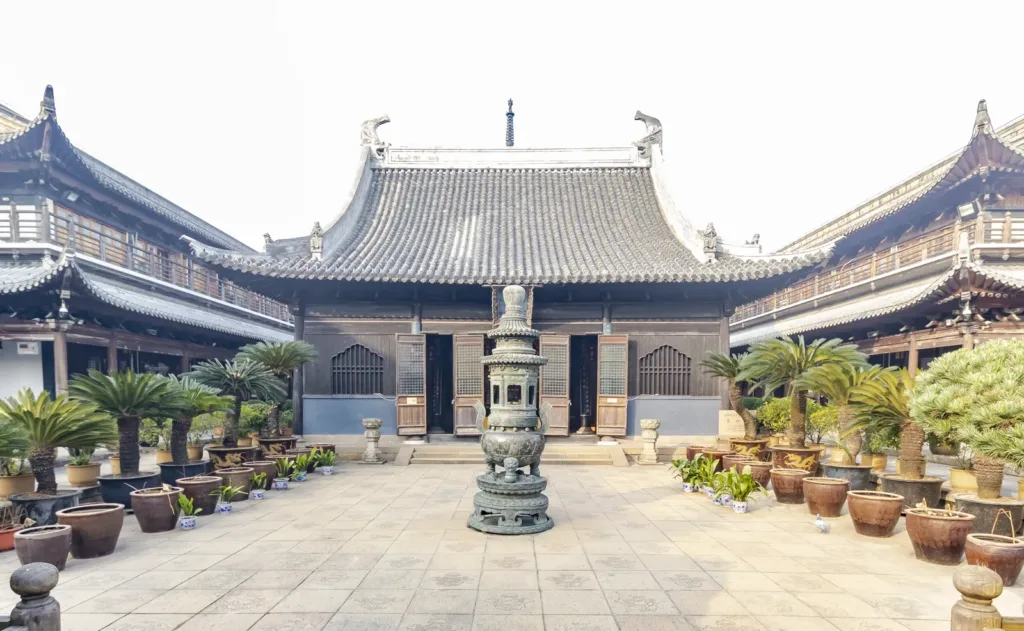 The broad grey-tiled roof and timber façade of Zhenru Temple’s main hall frame a stone incense burner in the courtyard. Photo: ScareCriterion12 (Wikimedia Commons account name) · CC BY-SA 4.0
Zhenru Temple真如寺
In Putuo, Zhenru Temple is both a functioning Buddhist site and the setting for one of Shanghai’s most important surviving timber buildings: its main hall dates to the Yuan dynasty and was restored in 1963 to recover its earlier single-eaved roof profile. Look up at the hall’s bracket sets, then notice the old ginkgo in front and the newer temple buildings around it; this is a layered religious compound, not a freestanding museum monument. Zhenru Metro station is served by Lines 11 and 14, but the exact current public gate and admission arrangements should be checked locally before travel.
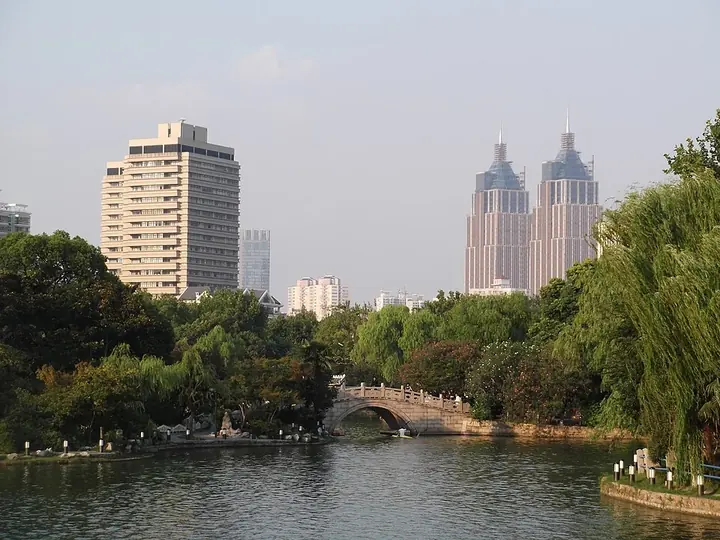
Read the place guide →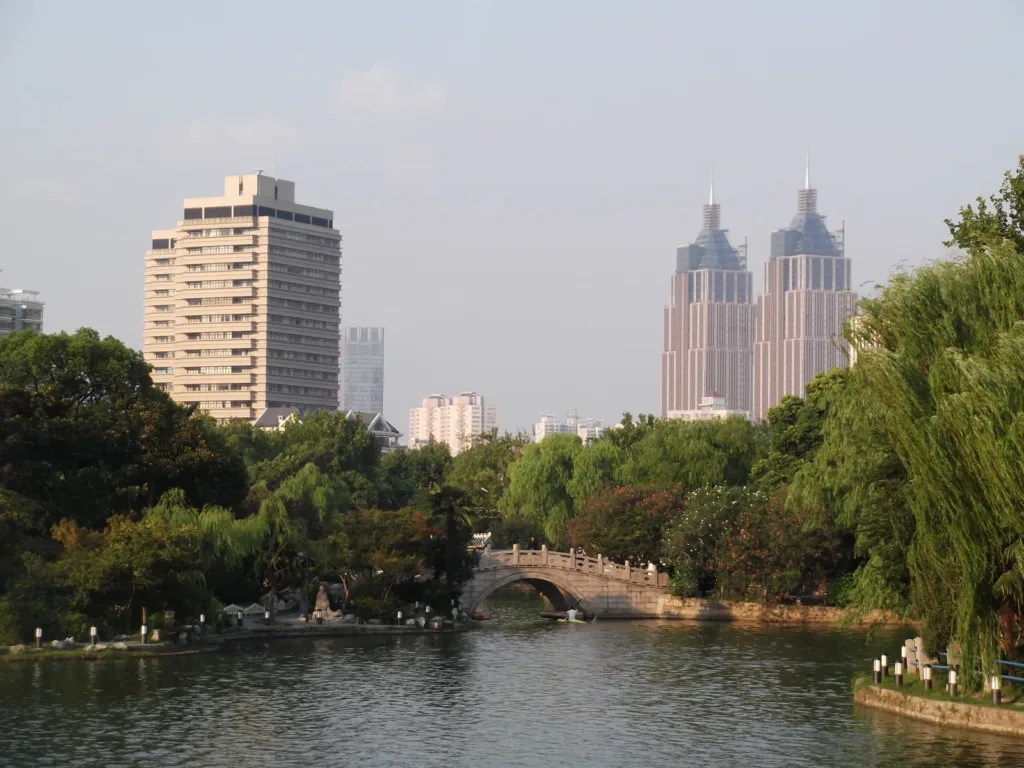 Yinchu Lake at Changfeng Park, with a stone bridge, tree-lined banks and Shanghai buildings beyond. Photo: Jpbowen · CC BY-SA 4.0
Changfeng Park长风公园
In Putuo, Changfeng Park makes Shanghai’s western neighbourhood history visible in a man-made landscape: Yinchu Lake was excavated from a former river bend, and the soil was piled into tree-covered Tiebi Hill. The north section reopened on 1 October 2026, with lake walks, boating and a rebuilt forest challenge course; most of the south section is also open by day, but closes at night. The park is woven into nearby streets rather than being a stand-alone paid attraction.
Read the place guide →Plan your visit
Getting there
Putuo District is about 7 km (straight-line distance) from central Shanghai. Search for 普陀区 in a map app to find stations and your accommodation.
Where to stay →Build your route
Jade Buddha Temple and 1000 Trees are less than 1 km apart. The linked place guides have entrance and visit details.
Continue with Shanghai →More in Shanghai
Sources & geographic information
Administrative names and parent areas: Official geographic directory (dmfw.mca.gov.cn) · Reference date 2026-09-06.
Background text adapted from Putuo, Shanghai — Wikipedia contributors, under CC BY-SA 4.0. Text has been shortened and reorganized; source revision 1355885081.
Map data © OpenStreetMap contributors. Pins mark approximate centres, not entrances or boundaries.
Image credits & notes (2)
- The lake at Changfeng Park in Putuo District, Shanghai. Photograph date recorded by the source: 2013-09-03 13:04:49.Photo: Jpbowen · CC BY-SA 4.0Resized for the web; the photo itself has not been edited. Thumbnails may show a cropped view.
- Changfeng Park’s lake, bridge and city backdrop. Photo: JpbowenPhoto: CC BY-SA 4.0
