

Photo adjustments
Converted to WebP and resized without changing the subject or cropping the source frame.
Explore the region
About Longhua Temple
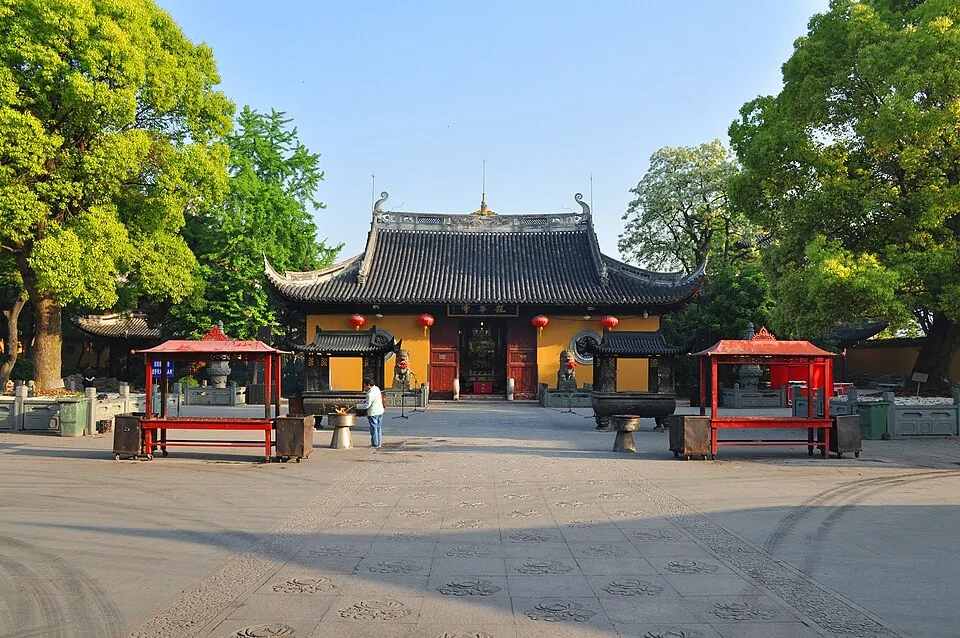
Maitreya Hall introduces the sequence of worship spaces, followed by the main Mahavira Hall and other halls along the central axis.
Outside, the seven-level octagonal pagoda retains an early brick core beneath reconstructed wooden exterior details. Compare the pagoda from the public viewing area with the temple’s courtyards; the fragile tower is not a climbing attraction.
According to local tradition, the temple was founded in 242, during the Three Kingdoms period, after Sun Quan, king of Wu, obtained sharira relics of the Buddha and ordered the construction of thirteen pagodas, of which the Longhua Pagoda (龍華塔) is said to have been one. The pagoda's core survives from the Song dynasty, but most of the temple's other buildings were rebuilt during the reigns of the Tongzhi Emperor (1862-1874) and the Guangxu Emperor (1875-1908) in the Qing dynasty, and the whole complex was restored again in 1954. The grounds were also used for public executions during the twentieth century, including a 1927 purge of suspected communists, and are commemorated today by the adjacent Longhua Martyrs' Cemetery.
The temple complex occupies an area of more than 20,000 square meters, with a main axis 194 meters long, and its tallest structure, the Longhua Pagoda, stands 40.4 meters high. It and its monastery were originally surrounded by extensive gardens and orchards, and viewing the peach blossoms there was an annual attraction for people from nearby cities; most of these gardens have since been absorbed into the neighbouring cemetery and rebuilt in a monumental style, though a small traditional garden remains next to the temple buildings.
What to look for
- Maitreya Hall and Mahavira Hall organize the central Buddhist axis.
- The octagonal Longhua Pagoda combines an early brick core with reconstructed exterior details.
Background & history
The Longhua Temple (simplified Chinese: 龙华寺; traditional Chinese: 龍華寺; pinyin: Lónghuá Sì; Shanghainese: Lon-ngu-zy; alternatively Lunghwa Temple; literally "Dragon Flower Temple") is a Buddhist temple dedicated to the Maitreya Buddha in Shanghai. Although most of the present day buildings date from later reconstructions, the temple preserves the architectural design of a Song dynasty (960–1279) monastery of the Chan School. It is the largest ancient temple complex in the city of Shanghai.
Excerpt from Wikipedia: Longhua Temple · Wikipedia contributors · CC BY-SA 4.0. Selected introductory sentences; formatting simplified. Background information, not current visitor-service advice.
Location & getting there
Getting to Longhua Temple
Approach 2853 Longhua Road in the Longhua area of Xuhui and identify the temple gate separately from the pagoda viewing area.
Combine your visit
A suggested sequence linking the specific features of this visit.
-
Longhua Pagoda exterior
Examine the seven-level tower and its octagonal form.
-
Maitreya Hall
Begin the sequence of Buddhist halls on the temple axis.
-
Mahavira Hall
Continue to the principal worship hall and its devotional sculpture.
This order is editorial. Confirm access and any transfers between stops; it does not establish a walking route, same-day connection or common admission ticket.
Find Longhua Temple
龙华寺 · 徐汇区
The pin marks the area, not the entrance.
More places nearby
Approximate straight-line distances between map pins, not travel distances.
West Bund Museum 西岸美术馆
1 km awayWest Bund Museum occupies a triangular riverfront site designed by David Chipperfield. Three main galleries and additional project spaces accommodate changing art exhibitions.
View guide →St. Ignatius Cathedral, Shanghai 徐家汇天主教堂
3 km awaySt. Ignatius Cathedral is the Catholic cathedral in Xujiahui. Its dedication and history reflect the Jesuit presence in this part of Shanghai.
View guide →Shanghai Botanical Garden 上海植物园
3 km awayShanghai Botanical Garden lies in the southwestern part of Xuhui. Its collections are divided into specialist planted areas, including penjing, magnolias, peonies, bamboo and other woody and flowering plants.
View guide →Sources & visit information
The linked encyclopedia sources support background and place descriptions. Current opening hours, ticket prices, booking rules and transport schedules have not been independently verified for this guide. Confirm them with the venue or operator before travelling.
Visitor information adapted and edited from Wikipedia contributors, “Longhua Temple” · CC BY-SA 4.0. Source revision 1368031700.
Background paragraphs condensed from Wikipedia contributors, "Longhua Temple", English Wikipedia · CC BY-SA 4.0. Source revision 1368031700.