

Explore the region
A cathedral rooted in Xujiahui
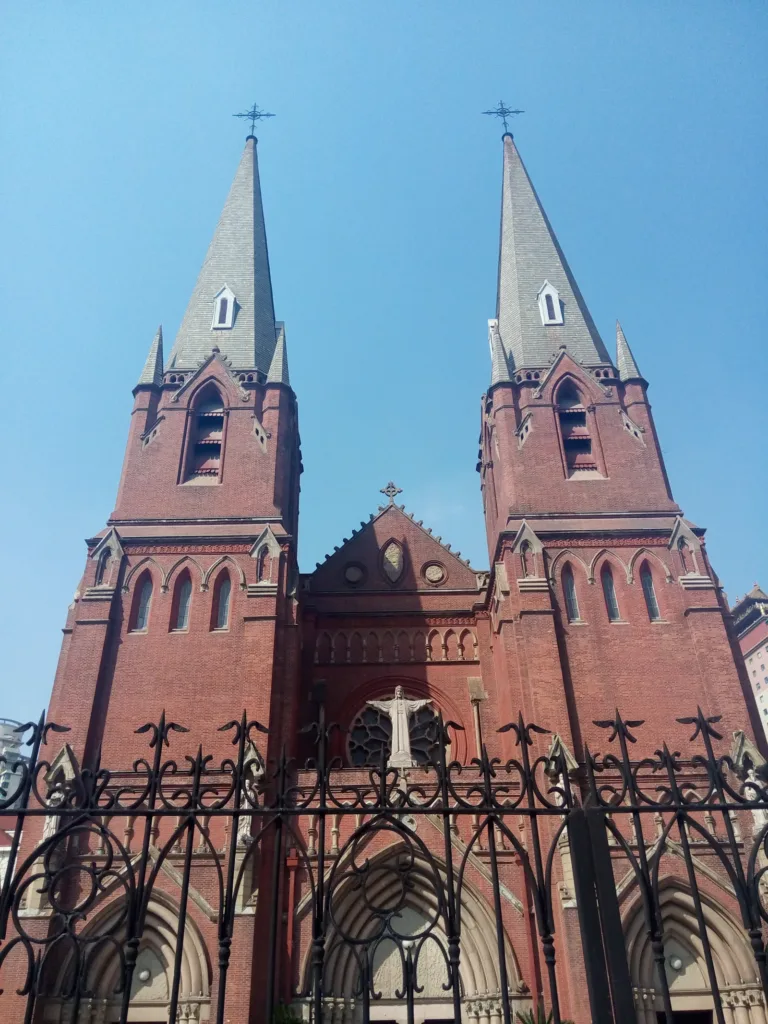
Known in Chinese as Xujiahui Catholic Church (徐家汇天主堂), the building is the Cathedral of the Diocese of Shanghai and is dedicated to St. Ignatius of Loyola. Designed by W. M. Dowdall and built from 1906 to 1910, it became a conspicuous landmark in a district shaped by Shanghai’s Catholic and Jesuit institutions. Its municipal heritage protection dates to 1989; it was designated a Major Historical and Cultural Site Protected at the National Level in 2013.
This is a place of worship as well as a protected historic building. Keep voices low, respect barriers and any service in progress, and follow staff directions rather than treating the sanctuary as an exhibition hall.
Read the building from outside in
Start with the east-facing front. Its paired towers give the façade a strong vertical outline, while pointed entrances and pale stone trim break up the red brick. Look for the round rose windows set into the front and side elevations; their stained glass makes the Gothic-revival detailing legible even from outside. Use the public courtyard and viewpoints that are open on the day, and do not cross marked boundaries to get a photograph.
If the church is admitting visitors, the interior is worth a slower look. The plan follows a Latin cross, so the long central nave and side wings make the building’s layout easier to understand from the entrance. Rose windows and other coloured glazing bring patches of colour into the otherwise tall, stone-and-brick interior. The nave’s repeated supports draw the eye toward the sanctuary; pause to notice how the window patterns and structural rhythm work together rather than trying to photograph every detail at once.
Allow time for the change in scale between the open façade and the enclosed nave. The cathedral is the main object of this visit; nearby institutions belong to the wider Xujiahui area and should not be assumed to share the same entrance, ticket or visitor schedule.
Hours, entry and current checks
On 21 October 2026, the Xujiahui Origin official listing showed free admission, Tuesday through Saturday, 09:00–16:00, with last entry at 15:30. The municipal tourism entry publishes the same days and hours. These listings do not establish that every interior space is accessible at all times, and the scenic-area page does not provide current reservation instructions. Check for service-related limits or temporary closure before setting out; the Xujiahui Origin visitor-centre number published on its site is 021-54259260.
The address given by the official listings is 158 Puxi Road, Xuhui District. Use the posted public entrance on arrival and follow any on-site instructions; the listings do not identify a separate guaranteed tourist gate or one-way visitor route. A 2017 reopening report said that no reservation was required then, but that announcement describes the arrangements at that time, not a rule for 2026.
Getting here
Take Metro Line 1, 9 or 11 to Xujiahui station (徐家汇站). A travel guide describes the cathedral as about 400 metres south of the station, but this is an approximate guide figure rather than a verified exit-to-door route. Follow current pedestrian signs toward 158 Puxi Road; no dependable cathedral-specific station exit was confirmed, so do not plan around an exit number.
No useful bus route-and-stop pair could be confirmed against a current operator source, so this guide does not recommend a bus itinerary. For a taxi or ride-hailing car, give 徐家汇天主堂(圣依纳爵主教座堂),上海市徐汇区蒲西路158号. This is the published visitor address, not confirmation of a designated legal curbside drop-off or a specific vehicle-access gate. Use the public entrance open and signed on arrival.
A practical visit plan
For an exterior-only stop, allow about 20–30 minutes to take in the paired towers, brickwork and windows from public viewpoints. If the church is open for visitors, 45–75 minutes leaves time to look through the nave and stained glass without rushing. These are editorial planning estimates, not venue timings; services, access limits and crowds may change what can be seen.
Combine your visit
A suggested sequence linking the specific features of this visit.
-
Cathedral exterior
Begin with the church’s presence in the Xujiahui neighbourhood.
-
Sanctuary, when open to visitors
Observe the altar and devotional setting respectfully during permitted access.
This order is editorial. Confirm access and any transfers between stops; it does not establish a walking route, same-day connection or common admission ticket.
Find St. Ignatius Cathedral, Shanghai
徐家汇天主教堂 · 徐汇区
The pin marks the area, not the entrance.
More places nearby
Approximate straight-line distances between map pins, not travel distances.
Wukang Mansion 武康大楼
1 km awayWukang Mansion occupies a wedge-shaped corner where Wukang Road meets Middle Huaihai Road. Designed by László Hudec and completed in 1924, it was originally known as the Normandie Apartments.
View guide →Wukang Road 武康路
2 km awayWukang Road runs through the western part of Shanghai’s former French Concession in Xuhui. Formerly Route Ferguson, it is lined with historic residential and institutional buildings under plane trees.
View guide →Longhua Temple 龙华寺
3 km awayLonghua Temple follows the axial arrangement of a Song-period Chan monastery, although most halls are later reconstructions. Maitreya Hall introduces the sequence of worship spaces, followed by the main Mahavira Hall and other…
View guide →Sources & visit information
Sources checked on 21 October 2026. Hours, tickets, reservations and transport can change; confirm with the operator before you go.
Image credits & notes (1)
- The cathedral’s twin towers rise above its brick façade; this 2014 photograph includes the iron fence in the foreground. Photo: Qa003qa003Photo: CC BY-SA 4.0