

Photo adjustments
Wikimedia thumbnail; fitted to the ranking-card frame.
Explore the region
About Hanging Temple
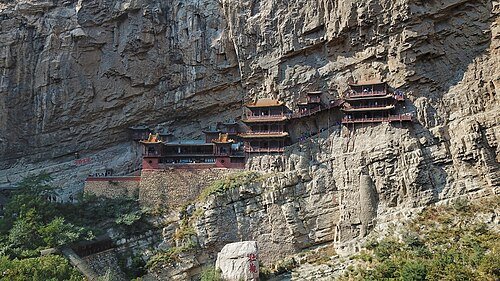
Its standing buildings largely reflect Ming and Qing rebuilding, despite the much older foundation story. The Three Teachings Hall brings Confucius, Laozi and the Buddha into one small religious setting. Seeing the whole structure from below explains its engineering; entering the galleries, when permitted, gives a much closer but confined encounter with the way the buildings fit the rock.
According to one account, the temple was founded in 491, during the Northern Wei dynasty, by order of Emperor Xiaowen (拓跋宏), intended to relocate the Daoist site of Celestial Master Kou Qianzhi (寇谦之) there; it was first named Xuankong Ge (玄空阁) and later became known as Xuankong Si, or 'Hanging Temple', both because hanging (悬) is a homophone of the xuan in Xuankong Ge (玄) and because of its cliffside position.
The temple sits in a hollow partway up a cliff in Hunyuan County, with its highest point more than 90 meters above the valley floor; a cleft was cut into the rock above it to keep falling stones from higher on the mountain from striking the buildings. The complex covers 152.5 square meters and holds 40 rooms in a timber-frame structure, arranged north-south and facing east. The main hall's stone base rises in two storeys, the lower originally used for monks' lodging and sutra recitation, the upper divided into the Three Buddhas Hall, the Taiyi Hall and a Guandi shrine.
The Hanging Temple was designated a Shanxi provincial cultural-protection unit in 1957 and listed as a Major Historical and Cultural Site Protected at the National Level (全国重点文物保护单位) in 1982; a major 1978 renovation replaced several main load-bearing crossbeams and rediscovered the mortise-and-tenon construction that keeps the temple in place.
What to look for
- The cliff-mounted galleries and timber support system, best understood first from the valley viewpoint.
- The Three Teachings Hall and the linked north and south building groups, where the visitor circuit is open.
Location & getting there
Getting to Hanging Temple
Go to Xuankong Temple at Cuiping Mountain in Hunyuan County, rather than to the separate Hengshan summit entrance.
- Confirm whether your admission includes the elevated galleries; their narrow stairs and passages require the site's controlled visitor flow.
Combine your visit
Suggested order within this visit:
-
Valley viewpoint
Read the full structure and its relationship with the cliff.
-
Open gallery circuit
Follow the designated sequence through the linked rooms, if included and suitable.
This sequence is an editorial suggestion based on the features described in the sources. Access to individual buildings or areas should be checked locally; no travel time or shared admission is implied.
Find Hanging Temple
悬空寺 · 大同市
The pin marks the area, not the entrance.
More places nearby
Approximate straight-line distances between map pins, not travel distances.
Mount Heng (Shanxi) 恒山
3 km awayNorthern Hengshan rises south of Hunyuan, with Tianfengling Peak above a group of mountain temples. Its religious buildings exploit the steep slopes and cliff recesses, so the approach and changes in level are part of their…
View guide →Pagoda of Fogong Temple 应县木塔
46 km awayThe wooden pagoda at Fogong Temple rises from a stone platform in Yingxian, its layered eaves supported by a dense system of timber brackets. Built in the Liao period, it is best understood by looking carefully at how the…
View guide →Shanhua Temple 善化寺
58 km awayShanhua Temple is a clear lesson in the progression of a northern Buddhist monastery: a substantial gate, the Sansheng Hall and the raised Daxiongbao Hall follow one axis. The main hall preserves Liao-period architecture around…
View guide →Sources & visit information
The linked encyclopedia sources support background and place descriptions. Current opening hours, ticket prices, booking rules and transport schedules have not been independently verified for this guide. Confirm them with the venue or operator before travelling.
Visitor information adapted and edited from Wikipedia contributors · CC BY-SA 4.0. Source revision 92622300.
Background paragraphs translated and condensed from Wikipedia contributors, "悬空寺", Chinese Wikipedia · CC BY-SA 4.0. Source revision 92622300.
Background paragraphs condensed from Wikipedia contributors, "Hanging Temple", English Wikipedia · CC BY-SA 4.0. Source revision 1370834151.