

Explore the region
Tap any red Chinese text to hear it in Mandarin.
Why visit
This is Shanxi’s Beiyue, not Hunan’s Nanyue Hengshan. The Datong municipal guide places Tianfengling, the main summit, south of Hunyuan County’s seat. The mountain is worth visiting for the way religious buildings sit against steep rock and changing ridgelines, not only for the summit number. The scenic-area operator describes the mountain as both a northern Taoist centre and a landscape of temples, inscriptions and mountain views.
Make the temple group your first question: what can be entered today, which approach is open, and whether the ropeway is running. Then decide whether the Tianfengling ascent suits your time, footwear and weather. The two experiences ask for different amounts of walking and should not be treated as one guaranteed route. The separate Hanging Temple below the mountain is a different listed attraction with its own admission; being close to it does not make it part of the Mount Heng visit.
What to look for
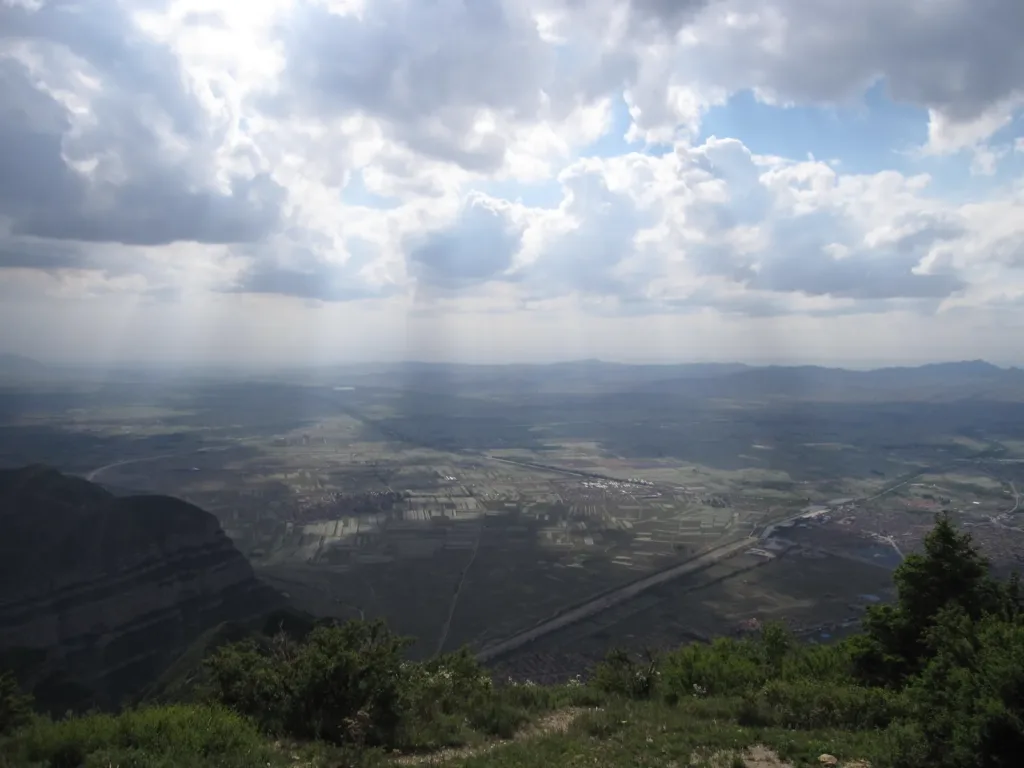
Look for the temple group associated with Beiyue and for the way buildings, stairs and retaining structures negotiate the mountain’s steep terrain. From the open high points, the ridges give the visit its scale; Tianfengling is the named summit at 2,016.1 metres. The operator also presents the mountain as a long cultural landscape rather than a single viewpoint, so leave room for pauses at the buildings as well as the climb.
The scene changes quickly with weather and elevation. The official operator warns that strong wind, thunderstorms or other severe conditions can suspend the ropeway, restrict the temple-group area or impose crowd controls. Stay on open routes, do not climb cliffs or enter closed areas, and use shoes with a reliable grip. Pets are not allowed in the scenic area.
Entry and transport
The named visitor entrance for this visit is 恒山游客中心 (Hengshan Visitor Center) in Hunyuan County, at the southeast corner of 玄武大道 Xuanwu Avenue and 恒宗大道 Hengzong Avenue. The center is the area’s ticketing and transfer hub. Since 1 January 2025, the operator says visitors must buy tickets there rather than at internal supplementary or group-sales points, leave cars at the visitor-center parking area, and take the shuttle onward. The shuttle is a separate ticket; the operator’s guide currently lists it at CNY 20 per person. A shuttle ticket alone does not grant access to the walking-trail or Hengshan sacred-peak areas, which require the Mount Heng admission.
The same official guide lists two useful direct bus services. Route 901-1 runs between 魏都大道振兴街口 Weidu Avenue–Zhenxing Street intersection in Datong and 恒山游客中心; it lists Datong departures from 06:00 to 18:30, Hunyuan-to-Datong returns from 05:50 to 18:30, and a 15-minute interval. Route 901-2 runs between 公交六公司 Bus Company No. 6 and 恒山游客中心; it lists 06:20–17:00 in both directions at 30-minute intervals. The operator states about two hours for these direct services. Recheck the day’s timetable before setting out, then return to 恒山游客中心 for the reverse journey rather than assuming a mountain trail is a bus stop.
For rail arrivals, the scenic-area guide names both 大同南站 Datong South Railway Station and 大同站 Datong Railway Station as road gateways to the visitor center. Its interconnection list specifically includes 大同南站 ↔ 恒山游客中心 Dàtóng Nán Zhàn ↔ Héng Shān Yóukè Zhōngxīn. Neither station is the mountain entrance, and the pages read here do not give a metro line, station exit or a rail-to-trail transfer that should be guessed. If you arrive by train or at 大同云冈国际机场 Datong Yungang International Airport, use the Chinese destination 恒山游客中心 Héng Shān Yóukè Zhōngxīn for the final road leg and keep the return plan tied to the visitor center.
The operator publishes seasonal baseline hours for the Mount Heng temple-group visit: 08:00–16:30 in March, April and October; 08:00–17:30 from May to September; and 08:30–16:00 from November to February. Ropeway hours are listed separately, and holidays or peak periods can change ticket sales and suspension times. Mount Heng admission, the shuttle, the ropeway and the separate Hanging Temple products are not interchangeable. The official ticket page lists online channels and a visitor-center ticket window, but the pages read here do not explain a passport-specific booking or inspection procedure. International visitors should carry the passport used for travel and confirm the current process with the ticket office before paying; do not assume that a domestic-ID discount or booking workflow applies.
Combine your visit
Suggested order within this visit:
-
Hengshan temple group
Make the religious architecture the main stop.
-
Tianfengling ascent
Continue toward the summit only if conditions, time and ability suit the open route.
This sequence is an editorial suggestion based on the features described in the sources. Access to individual buildings or areas should be checked locally; no travel time or shared admission is implied.
Find Mount Heng (Shanxi)
恒山 · 大同市
The pin marks the area, not the entrance.
More places nearby
Approximate straight-line distances between map pins, not travel distances.
Hanging Temple 悬空寺
3 km awayThe Hanging Temple uses beams inserted into the cliff to support a narrow chain of rooms and galleries above the valley. Its standing buildings largely reflect Ming and Qing rebuilding, despite the much older foundation story…
View guide →Pagoda of Fogong Temple 应县木塔
49 km awayThe wooden pagoda at Fogong Temple rises from a stone platform in Yingxian, its layered eaves supported by a dense system of timber brackets. Built in the Liao period, it is best understood by looking carefully at how the…
View guide →Shanhua Temple 善化寺
59 km awayShanhua Temple is a clear lesson in the progression of a northern Buddhist monastery: a substantial gate, the Sansheng Hall and the raised Daxiongbao Hall follow one axis. The main hall preserves Liao-period architecture around…
View guide →Sources & visit information
Sources checked on 25 October 2026. Hours, tickets, reservations and transport can change; confirm with the operator before you go.
Image credits & notes (1)
- View from the summit of Mount Heng (Shanxi) across the Hunyuan landscape. Photo: Terence7Photo: CC BY-SA 3.0