

Photo adjustments
Resized and WebP compressed; subject not altered.
Explore the region
About Pagoda of Fogong Temple
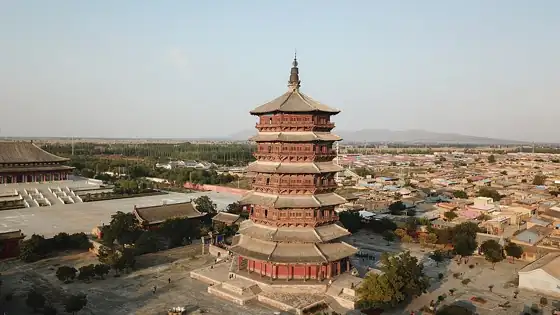
Built in the Liao period, it is best understood by looking carefully at how the octagonal structure narrows upward and how the supports repeat without making every level identical. The ground-floor Buddha provides a second, interior focus where admission allows. Plan an exterior-and-ground-level visit; the monument's fame does not imply that its upper floors are open.
The pagoda's construction date is not confirmed by contemporary sources; Ming-dynasty gazetteers identify it as built in the second year of the Liao Qingning era (1056), and later plaques record further repairs during the Jin, Yuan and Ming dynasties. It was raised by Emperor Daozong of Liao at the site of his grandmother's family home, about 85 kilometres south of the Liao capital at Datong. The pagoda has survived several major earthquakes, and in 1926 it was struck by more than two hundred artillery shells during fighting between rival warlords without collapsing.
The pagoda stands 67.31 metres tall on a stone platform, with an octagonal plan 30.27 metres in diameter. It appears from the outside to have five storeys, but the first four each conceal an additional internal level serving as the base for the storey above. Its timber frame uses fifty-four different types of dougong brackets. Each storey's interior houses Buddhist images; the ground floor's inner chamber contains a Sakyamuni statue about 10 metres tall. The pagoda was listed as a Major Historical and Cultural Site Protected at the National Level (全国重点文物保护单位) in 1961, and in September 2016 Guinness World Records certified it as the world's tallest wooden pagoda.
What to look for
- The octagonal timber tower, repeated bracket sets and projecting eaves.
- The ground-floor Buddha and the relationship between the statue, surrounding columns and high interior.
Location & getting there
Getting to Pagoda of Fogong Temple
Go to Yingxian Wooden Pagoda in Ying County's town centre, the widely used name for the Fogong Temple pagoda.
- Check current access restrictions at the entrance and plan to appreciate the upper structure from the ground.
Combine your visit
Suggested order within this visit:
-
Pagoda exterior
Compare the timber structure from more than one permitted angle.
-
Ground-floor Buddha hall
See the interior scale where access is allowed.
This sequence is an editorial suggestion based on the features described in the sources. Access to individual buildings or areas should be checked locally; no travel time or shared admission is implied.
Find Pagoda of Fogong Temple
应县木塔 · 朔州市
The pin marks the area, not the entrance.
More places nearby
Approximate straight-line distances between map pins, not travel distances.
Hanging Temple 悬空寺
46 km awayThe Hanging Temple uses beams inserted into the cliff to support a narrow chain of rooms and galleries above the valley. Its standing buildings largely reflect Ming and Qing rebuilding, despite the much older foundation story…
View guide →Mount Heng (Shanxi) 恒山
49 km awayNorthern Hengshan rises south of Hunyuan, with Tianfengling Peak above a group of mountain temples. Its religious buildings exploit the steep slopes and cliff recesses, so the approach and changes in level are part of their…
View guide →Yanmen Pass 雁门关
50 km awayYanmen Pass guards a mountain crossing north of Dai County. Its walls and gatehouses explain how a pass worked as a defended settlement, with a trading street below the military buildings. The Dili and Tianxian gates give the…
View guide →Sources & visit information
The sources below support the place-specific description and arrival information. Suggested combinations are editorial planning ideas; confirm current opening, entry arrangements and transport services for your date.
- Wikipedia: Pagoda of Fogong Temple ↗
- Wikivoyage: Datong ↗
- Chinese Wikipedia: 應縣木塔 (revision 93052581, 2026-06-13) ↗
Visitor information adapted and edited from Wikipedia contributors · CC BY-SA 4.0. Source revision 1370924170.
Visitor information adapted and edited from Wikivoyage contributors · CC BY-SA 4.0. Source revision 5297122.
Background paragraphs translated and condensed from Wikipedia contributors, "應縣木塔", Chinese Wikipedia · CC BY-SA 4.0. Source revision 93052581.
Background paragraphs condensed from Wikipedia contributors, "Pagoda of Fogong Temple", English Wikipedia · CC BY-SA 4.0. Source revision 1370924170.