

Explore the region
Tap any red Chinese text to hear it in Mandarin.
Why this temple is different
Shuanglin Temple stands in Qiaotou Village, about 6 kilometres southwest of Pingyao County’s seat. It is a separate countryside stop, not a building inside the walled old town. UNESCO lists it as one of the three parts of the Ancient City of Ping Yao World Heritage property, alongside the walled city and Zhenguo Temple.
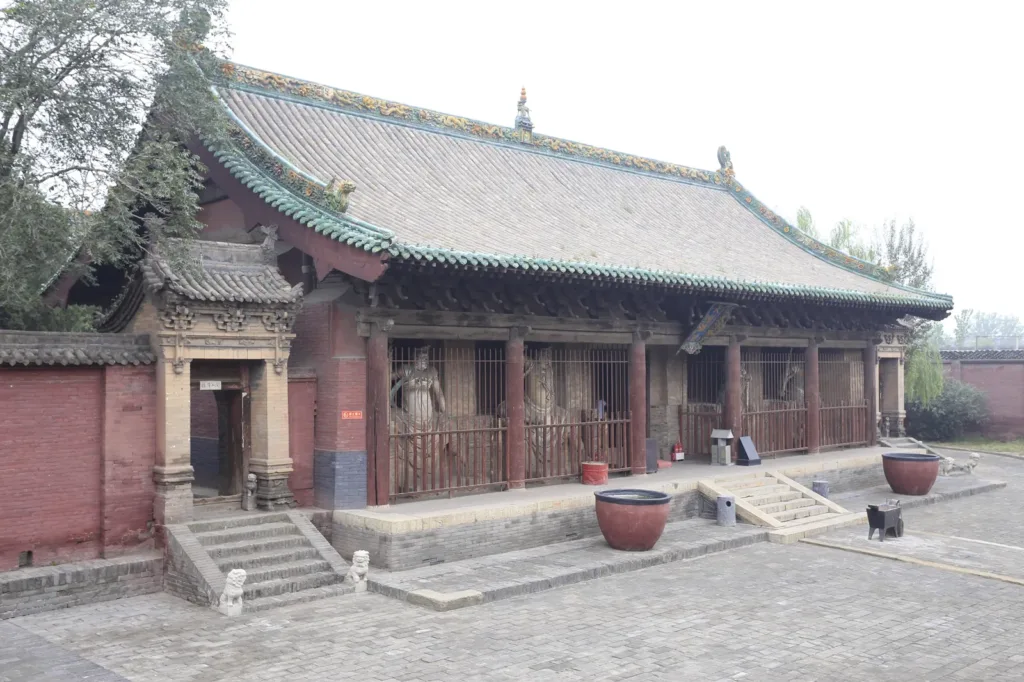
A high, fortress-like wall and a single gate enclose three courtyards and ten halls. The buildings you see today are mainly Ming- and Qing-period structures, while a stone inscription records a rebuilding in 571 during the Northern Qi’s Wuping era. The site’s importance is not just its age: more than two thousand painted clay figures survive in the halls, making the temple one of the most concentrated sculpture experiences around Pingyao.
What to look for
Start by slowing down inside the halls. The figures are arranged as groups rather than isolated souvenirs, and the changes in posture, gaze and clothing become clearer when you look from a little distance before moving closer.
- Weituo in the Thousand Buddha Hall: the small, S-shaped Ming figure is only about 50 centimetres high, but its bent stance, armour and flying ribbons create a strong sense of movement.
- The Bodhisattva Hall: look for the many-armed Guanyin and the way repeated arms and gestures fill the space without making every figure identical.
- The Arhat Hall: individual faces and poses reward a slower look than a quick checklist visit.
- The building-and-sculpture relationship: the three-courtyard sequence lets you see how painted clay figures, wall paintings and timber halls work as an ensemble. Many sculptures use suspended or projecting techniques, with figures leaning forward to meet the viewer’s sightline.
The interiors are dim and the figures are fragile. Follow the signs and staff instructions in each hall; do not touch the sculptures, and do not use flash or a tripod where they are prohibited.
Plan the visit
Location and arrival. Keep the Chinese name 双林寺 Shuānglín Sì ready for a map or driver. From Pingyao Gucheng Railway Station (平遥古城站), current travel guidance describes Bus 108 North Line to Shuanglin Temple Bus Station (双林寺站). Published guidance lists roughly 20–22 minutes and a CNY 1 fare, but these are secondary transport pages rather than a bus-operator timetable. Confirm the direction, the day’s service and the return bus locally before entering the temple.
From the walled centre, a taxi or ride-hailing car is the simpler door-to-door option. Give the driver 双林寺,平遥县中都乡桥头村 Shuānglín Sì, Píngyáo Xiàn Zhōngdū Xiāng Qiáotóu Cūn and arrange how you will return; do not treat this as an old-city street stop with a guaranteed taxi queue. There is no useful metro leg for this rural visit.
Tickets and opening. The temple is described in current travel information as a separately ticketed visit rather than an automatic part of the old city’s street experience. Public listings disagree on the live schedule: one map listing shows 08:00–18:00 with ticket sales ending at 17:30 and admission at 17:45, while Trip.com displays 08:00–18:30 with admission ending at 18:15. A recent Qunar guide lists CNY 35 and 08:00–18:00. These are not a single venue notice, so do not plan around one fixed price or closing time. Check the official Pingyao scenic-area ticket channel or the entrance on the day you go.
For visitors using a foreign passport, carry the passport used for any booking. I did not find a current venue notice that clearly states how passport details, reservations or foreign-visitor admission are handled; do not assume that a domestic ID rule automatically answers those questions. Confirm before payment through the official ticket channel or by calling the attraction. Trip.com lists ticket-enquiry numbers +86-354-5779023 and +86-354-5673200, but these are platform-published contacts and should be checked before relying on them.
Combine your visit
Suggested order within this visit:
-
Arhat Hall
Begin with the varied expressions of the individual figures.
-
Thousand Buddha Hall
Look closely at Weituo and the surrounding sculpture.
-
Bodhisattva Hall
Finish with the many-armed Guanyin.
This sequence is an editorial suggestion based on the features described in the sources. Access to individual buildings or areas should be checked locally; no travel time or shared admission is implied.
Find Shuanglin Temple
双林寺 · 平遥县
The pin marks the area, not the entrance.
More places nearby
Approximate straight-line distances between map pins, not travel distances.
Pingyao Ancient City 平遥古城
4 km awayPingyao's walled centre preserves a merchant city whose courtyard houses, shops and financial institutions grew around long-distance trade. The city walls establish its compact outline, while South Street and the Rishengchang…
View guide →Mount Mian 绵山
15 km awayMount Mian combines precipitous scenery with temples fitted into cliffs and enormous rock recesses. Daluo Palace supplies a dramatic, vertically stacked Daoist ensemble, while Yunfeng Temple sits beneath the great Baofu Rock…
View guide →Zhenguo Temple 镇国寺
18 km awayZhenguo Temple at Hadong Village is unusually valuable for the relationship between its early timber architecture and sculpture. Wanfo Hall survives from the Northern Han period, with a deep bracket system that carries the broad…
View guide →Sources & visit information
Sources checked on 23 October 2026. Hours, tickets, reservations and transport can change; confirm with the operator before you go.
Image credits & notes (1)
- The Tianwang Hall within Shuanglin Temple, Pingyao, photographed from the courtyard. Photo: ZhangzhugangPhoto: CC BY-SA 3.0