

Explore the region
Tap any red Chinese text to hear it in Mandarin.
Why come
Pingyao is more than a picturesque old street. UNESCO describes the walled town as an exceptionally well-preserved traditional Han Chinese city founded in the 14th century, with five centuries of architectural and town-planning change still readable in its streets, shops, dwellings and temples. The result is a place where a short walk can move from a working lane to a merchant courtyard, then into a former financial institution or a county government compound.
Start with the old town itself rather than treating every courtyard as a separate photo stop. South Street (Nanda Jie), also called Ming–Qing Street, was a commercial street and still concentrates shops, snack stalls and historic façades. The city wall gives the compact town its clearest outline; its gates, parapets and defensive setting are easier to understand after you have walked a few lanes inside.
The World Heritage property is larger than this single walled-town visit: UNESCO lists the entire area within Pingyao’s walls together with Shuanglin Temple and Zhenguo Temple as three parts of the serial property. Those two temples are separate destinations outside the old town, not extra courtyards on the same walk.
What to look for
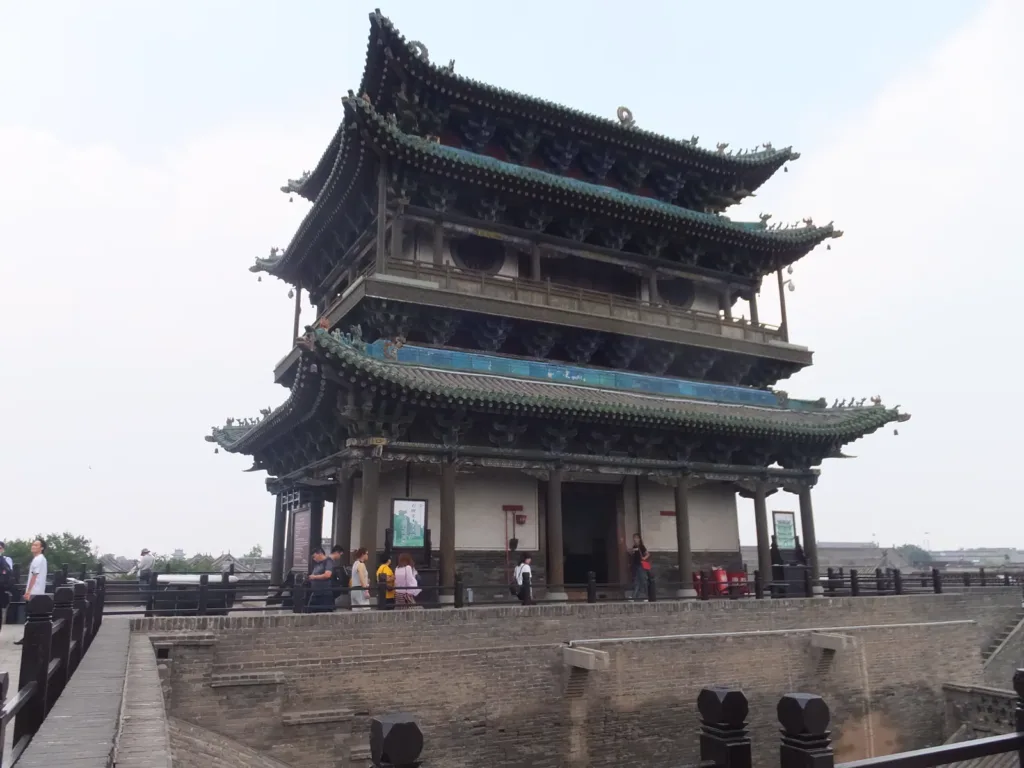
- The wall and gates. Walk a section of the wall where you can see the relationship between the gate complex, the lanes below and the surrounding county town. The wall is a place to read the town’s defensive structure, not only a high viewpoint. Check which sections are open on your date.
- South Street / Ming–Qing Street. Follow the street slowly and look for the commercial logic behind the façades: former banks, pawnshops, pharmacies, food shops and residences once shared this narrow urban spine.
- Rishengchang Former Bank. At No. 38 West Street, the former exchange house is now the China Former Bank Museum. Its surviving materials and rooms introduce the remittance business that connected Pingyao to a much wider trading network.
- Pingyao County Government Office. On Yamen Street, the county office provides a useful contrast to the merchant compounds. Its sequence of official halls, offices, supporting spaces and rear residential areas shows how administration occupied the same compact town.
A practical first visit is to enter through a named gate, walk South Street, then choose one financial-history stop and the county office rather than trying to check every ticketed courtyard. The individual museums and the wall are separate visitor facilities even though they sit within the same historic town.
Tickets and access
Entering the historic town through its gates and entering its ticketed historic buildings are different things. A 2025 Shanxi visitor guide says the gates are free and that the 22 city sights are covered by a combined ticket sold at the visitor centre or through the Pingyao Ancient City official service platform; a 2026 traveller page repeats a three-day pass and the same 125-yuan adult price. Treat those prices and the validity period as planning references, not a guarantee for your travel date. Confirm the current pass, included venues, opening hours and passport process in the official service channel before paying.
The walled town is in Pingyao County, Jinzhong City, Shanxi Province. The ordinary Pingyao Railway Station (平遥站) is the station on the conventional railway and is on the west side of the old town; a recent traveller guide describes a walk of about ten minutes to Lower West Gate, but luggage and road works can change the most convenient route. The separate Pingyao Gucheng Railway Station (平遥古城站) serves high-speed trains outside the walled town. From there, TravelChinaGuide records bus 108 variants to the South or North Gate, or a taxi to the North Gate; check the current route, direction and fare at the station.
For a taxi or ride-hailing drop-off, keep the Chinese destination 平遥古城南门(迎薰门) or 平遥古城北门 Píngyáo Gǔchéng Běimén ready rather than saying only “Pingyao station.” Once inside, plan to walk. There is no metro serving this county town, and the gate is not the same thing as admission to the wall or museums. Return to the same named gate or station with time to spare, especially after an evening performance or during a busy holiday period.
Combine your visit
Suggested order within this visit:
-
South Street
Read the commercial street and city-tower setting.
-
Rishengchang Exchange House
Explore the town's remittance history.
-
Pingyao County Yamen
Compare a government compound with the merchant buildings.
This sequence is an editorial suggestion based on the features described in the sources. Access to individual buildings or areas should be checked locally; no travel time or shared admission is implied.
Find Pingyao Ancient City
平遥古城 · 平遥县
The pin marks the area, not the entrance.
More places nearby
Approximate straight-line distances between map pins, not travel distances.
Shuanglin Temple 双林寺
4 km awayShuanglin Temple in Qiaotou Village is best approached as a sculpture visit. Its halls contain painted clay figures whose postures, clothing and expressions reward slow looking. The forceful guardian Weituo in the Thousand…
View guide →Zhenguo Temple 镇国寺
14 km awayZhenguo Temple at Hadong Village is unusually valuable for the relationship between its early timber architecture and sculpture. Wanfo Hall survives from the Northern Han period, with a deep bracket system that carries the broad…
View guide →Mount Mian 绵山
19 km awayMount Mian combines precipitous scenery with temples fitted into cliffs and enormous rock recesses. Daluo Palace supplies a dramatic, vertically stacked Daoist ensemble, while Yunfeng Temple sits beneath the great Baofu Rock…
View guide →Sources & visit information
Sources checked on 23 October 2026. Hours, tickets, reservations and transport can change; confirm with the operator before you go.
- Ancient City of Ping Yao, UNESCO World Heritage Centre ↗
- Pingyao Ancient City: 2,800 Years Young, Ministry of Culture and Tourism ↗
- Shanxi holiday visitor guide for Pingyao Ancient City ↗
- Pingyao Ancient City three-day pass and arrival notes, Qunar ↗
- Pingyao Ancient City Railway Station, TravelChinaGuide ↗
- Pingyao Ancient City Wall, Trip.com ↗
- Rishengchang Former Bank, Trip.com ↗
- Pingyao Ancient Government Office, Trip.com ↗
- Ming and Qing Dynasty Ancient Street, Trip.com ↗
Image credits & notes (1)
- Pingyao Ancient City's North Gate gate tower viewed from the city wall. Photo: lienyuan leePhoto: CC BY 3.0