

Explore the region
What it is
The name is easy to misread on a map. Official county material treats the area as a joined tourism brand built from three separate components—Yingxiu, Shuimo and Sanjiang—rather than as three entrances to one enclosed park. A 2025 management plan gives them different rhythms: red-history travel in Yingxiu, leisure and relaxation in Shuimo, and health-oriented summer visits in Sanjiang.
That division is the reason to visit. A trip here can connect earthquake memory and post-disaster reconstruction with a rebuilt riverside town and a quieter mountain-and-river setting, without pretending that these are the same experience. Wenchuan lies on the upper Min River in the southeastern part of the Qinghai–Tibet Plateau; the county is also a meeting place of Tibetan, Qiang, Hui and Han communities.
What to look for
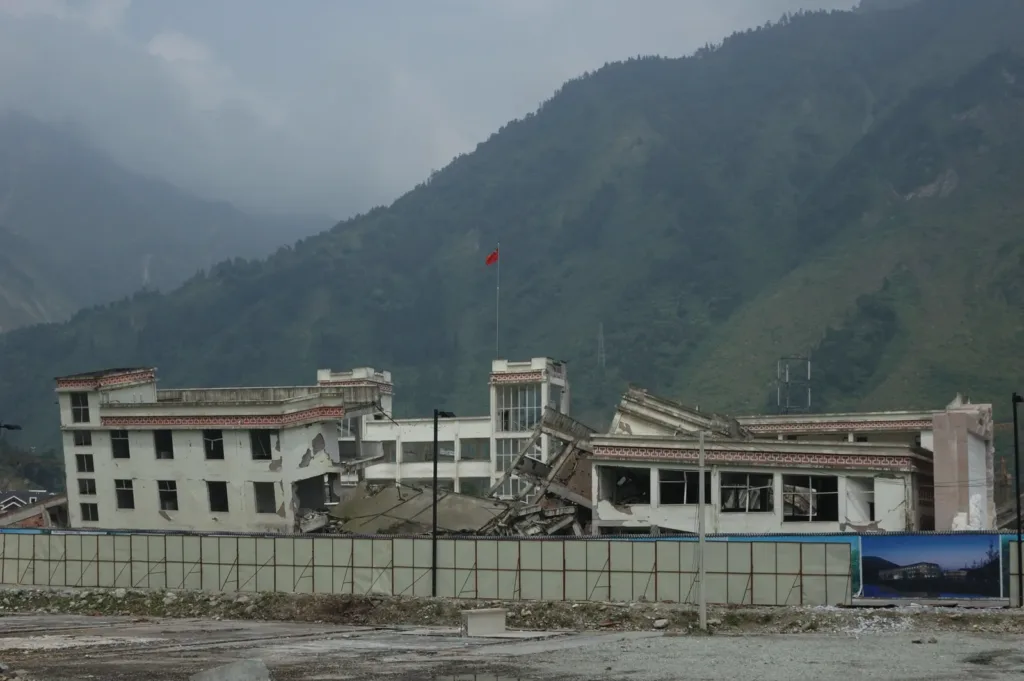
In Yingxiu, allow time for the remembrance strand and read the interpretation carefully. The earthquake ruins and the memorial hall are places of commemoration and education, not a backdrop for loud group scenes or insensitive photographs. The memorial hall was built through paired reconstruction assistance from Dongguan and presents the earthquake, rescue work and reconstruction through displays and multimedia.
Shuimo is the most immediately walkable part of the grouping. Follow the Shouxi River and the stone lanes of Chanshou Old Street, then notice how the rebuilt town combines Qiang-themed buildings, a cultural plaza and ordinary shops. Recent county reporting describes visitors walking the old street, tasting local Tibetan–Qiang food, buying farm products and crafts, and watching everyday town life rather than a single staged attraction. Ask before photographing residents, shop interiors or religious spaces.
Sanjiang is the component to choose for a slower river-and-mountain outing. The county’s tourism management description presents it as a cool-season and health-retreat setting, but I did not find a current official source that establishes one universal trail, entrance, ticket or activity schedule for the whole Sanjiang component. Confirm the specific destination before setting out and stay on signed, managed routes.
How to plan the visit
Treat the composite name as a planning umbrella, not as a single arrival point. Choose Yingxiu, Shuimo or Sanjiang as the day’s actual destination; combining all three requires separate road transfers and a return plan. There is no verified area-wide admission product or single reservation system in the sources checked. Component-level opening, ticketing and activity rules should be confirmed separately.
Road travel is the practical approach. The county government lists the G4217 Rongchang Expressway’s Du-Wen section together with National Highways G213, G317 and G350 as the main roads through Wenchuan. A March 2026 traffic notice identifies Dujiangyan West and Yingxiu North as named interchanges on the Du-Wen section and used G213 as the temporary detour during works; that notice is route evidence, not a permanent closure timetable. Check live road notices before departure, especially after heavy rain.
For a car, taxi or hired driver, give the Chinese name of the chosen component—映秀镇, 水磨古镇 or 三江镇—rather than relying on “Wenchuan Special Tourism Area” alone. No current inter-town shuttle timetable was verified in the sources read, and no rail or airport transfer terminus belongs to this composite attraction. Arrange the outward and return legs with the specific town or venue before leaving. Visitors using a non-mainland passport should also confirm component-level booking and admission requirements directly; domestic ID instructions cannot be assumed to cover passport holders.
Find Wenchuan Special Tourism Area
汶川特别旅游区 · 四川 · 汶川县
No reliable map pin yet: search by the Chinese name.
Sources & visit information
Sources checked on 24 October 2026. Hours, tickets, reservations and transport can change; confirm with the operator before you go.
Image credits & notes (1)
- Relics of Xuankou Secondary School in Yingxiu Town, Wenchuan County (historic photograph, 2010). Photo: BcnofPhoto: CC BY-SA 3.0