

Photo adjustments
Wikimedia thumbnail; fitted to the ranking-card frame.
Explore the region
About Anshun Bridge
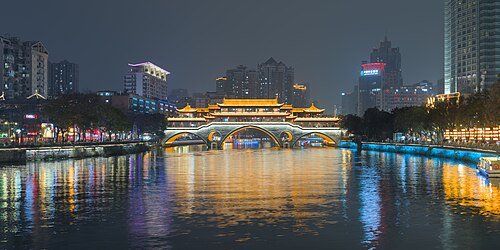
The present bridge is a reconstruction following the loss of earlier versions to floods, so its value for a visitor lies in the riverside composition and its connection with Chengdu’s long river-crossing history. View it from the bank first to see the roof and arches together; restaurant access is a separate commercial visit.
In the 13th century, Marco Polo wrote about the bridge, then called Anshun Bridge, as one of several bridges he described in China. Later known as Changhong Bridge (长虹桥), it was renovated in 1677 and connected Da'an Street to Wannianqiao Street across the Jin River as a two-level wooden structure, with statues of deities on the upper level and a pedestrian and goods route below; it was rebuilt repeatedly after flood damage, including major reconstructions in 1744 and 1746. After 1949 the new Chengdu municipal government rebuilt it as a simpler one-level wooden pedestrian bridge; a further reconstruction in 1974 produced a bridge completed in 1978, which collapsed in a flood in 1981.
In 1978 the government built a separate vehicle-accessible New Anshun Bridge at Shierbei Street to meet growing traffic needs. As part of a 1996 restoration project along the Fu and Nan rivers, the damaged old bridge was dismantled and redesigned as a three-arch replica combining historical and commercial features; the rebuilt structure, renamed Anshun Langqiao (安顺廊桥) to reflect its covered-bridge and building form, was constructed between 2000 and completed in August 2003.
What to look for
- The covered roof and arches form a distinctive profile across the Jin River.
- The riverbank reveals the bridge’s relationship with the surrounding waterfront.
Location & getting there
Getting to Anshun Bridge
The named address is 66 Binjiang East Road in Jinjiang district, near Hejiang Pavilion. Arrive at the riverside public path for an exterior view before deciding whether to enter the restaurant.
Combine your visit
Suggested order for the visit:
-
Binjiang East Road riverbank
See the complete bridge profile.
-
Hejiang Pavilion area
Compare the adjacent river setting.
-
Bridge frontage
Look at the covered structure at closer range.
This is an editorial sequence of named spaces or places. It does not imply a verified walking connection or promise opening, ticket availability or a journey time.
Find Anshun Bridge
安顺廊桥 · 锦江区
The pin marks the area, not the entrance.
More places nearby
Approximate straight-line distances between map pins, not travel distances.
Shuijingfang Museum 水井坊博物馆
Less than 1 km awayShuijingfang Museum centres on excavated remains of a historic baijiu distillery. The archaeological site and the production interpretation show how a working industry became a heritage subject, while the modern distillery…
View guide →Sichuan University Museum 四川大学博物馆
Less than 1 km awaySichuan University Museum combines natural history, archaeology, everyday life and art in its rebuilt riverside museum. Specimens and recreated environments follow southwest China from the Sichuan Basin into the highlands…
View guide →Sino-Ocean Taikoo Li Chengdu 成都太古里
1 km awayTaikoo Li Chengdu is an open-air retail district built around preserved heritage buildings and Daci Temple. Low-rise lanes and courtyards keep the shopping area at a different scale from the surrounding towers. Temple Plaza…
View guide →Sources & visit information
The sources below support the place-specific description and arrival information. Suggested combinations are editorial planning ideas; confirm current opening, entry arrangements and transport services for your date.
- Anshun Bridge ↗
- Wikivoyage: Chengdu ↗
- Chinese Wikipedia: 安顺廊桥 (revision 93942848, 2026-08-18) ↗
- English Wikipedia: Anshun Bridge (revision 1356905736, 2026-05-30) ↗
Visitor information adapted and edited from Wikipedia contributors, “Anshun Bridge” · CC BY-SA 4.0. Source revision 1356905736.
Visitor information adapted and edited from Wikivoyage contributors, Chengdu · CC BY-SA 4.0. Source revision 5341133.
Background paragraphs translated and condensed from Wikipedia contributors, "安顺廊桥", Chinese Wikipedia · CC BY-SA 4.0. Source revision 93942848.
Background paragraphs condensed from Wikipedia contributors, "Anshun Bridge", English Wikipedia · CC BY-SA 4.0. Source revision 1356905736.