


Get to know Jinjiang District
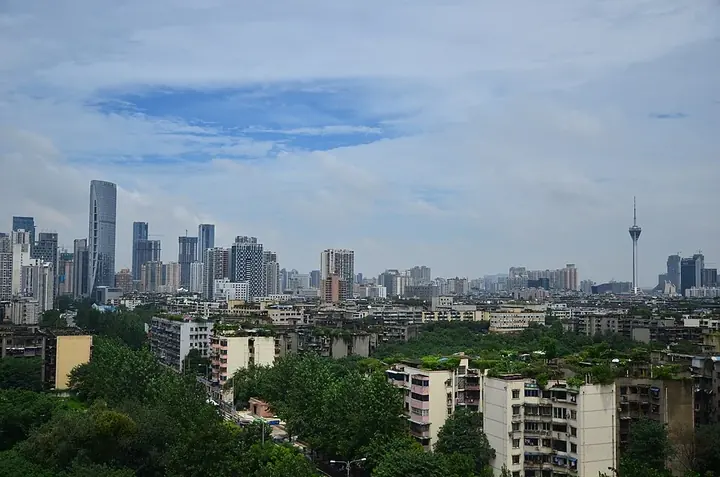
Photo adjustments
Full frame retained; proportionally resized and converted to WebP. No retouching or changes to the photographed subject. Card displays may crop the view.
- Administrative area
- District · 市辖区
- Part of
- Chengdu
- Chinese name
- 锦江区
- Local areas
- District guide
Area & population
- Area in the source
- 62.12 km²
- Population · 2020 census
- 902,933
- Administrative seat
- Chenglonglu Subdistrict
Source: cited geographic source, as of the dates shown.
Setting and landscape
According to the district government, Jinjiang lies in the belt where the eastern Chengdu Plain meets the western edge of the Longquan Mountains (龙泉山脉): higher in the east, lower in the southwest and flat in the northwest, with an average elevation of about 500 metres. It belongs to the Min River (岷江) system; the Fu River (府河), Nan River (南河) and Sha River (沙河) flow through it, and in the west the Jin and Fu rivers separate it from Wuhou District (武侯区).
History
The district government traces the area's administration to 314 BC, when it was the seat county of the Shu commandery. Chengdu county was split in 643 to create Shu county, renamed Huayang (华阳) in 758. In 1950 Huayang became Chengdu's First District, renamed Dongcheng (东城区) in 1953. Jinjiang District was formed at the end of 1990 from most of Dongcheng plus the Sansheng and Liulichang (琉璃场) townships taken from Jinniu, and its government was set up in January 1991.
What to see
The district's shopping areas centre on Chunxi Road–Yanshikou (盐市口) and Hongxing Road (红星路)–Daci Temple, with the Chunxi Road and Hongxing Road pedestrian streets and Taikoo Li (太古里). Daci Temple stands inside the Taikoo Li quarter. Its recorded history begins in 756–758, when Emperor Xuanzong (唐玄宗), who had fled to Chengdu, granted the monk Yinggan (英干) land to build the Da Sheng Ci Si (大圣慈寺). A Song-dynasty account of the temple lists 96 courtyards. The central part of today's temple comes from a rebuilding finished in 1878, and the temple was listed as a Sichuan provincial protected site in 2007.
At Nos. 17–23 Shuijing Street (水井街), a liquor factory rebuilding its workshops in 1998 uncovered the Shuijingjie distillery site (水井街酒坊遗址), a Ming and Qing baijiu workshop with drying floors, eight cellar pits and stoves. It became a national protected site in 2001 and is on China's tentative World Heritage list under the old baijiu workshops entry. Other sights in the district include the Anshun Covered Bridge (安顺廊桥) and Hejiang Pavilion (合江亭), Tazishan Park (塔子山公园), Donghu Park (东湖公园) and Bailuwan Wetland Park (白鹭湾湿地公园). Sansheng's Five Golden Flowers are five named spots, among them a lotus pond, a chrysanthemum garden and a plum grove.
Highlights
- Daci Temple 大慈寺: Temple built on land Emperor Xuanzong granted in 756–758; its central part rebuilt by 1878; provincial protected site since 2007.
- Shuijingjie Distillery Site 水井街酒坊遗址: Ming–Qing baijiu workshop found in 1998; national protected site since 2001.
- Chunxi Road and Taikoo Li 春熙路与太古里: Shopping streets of the district, with Daci Temple inside Taikoo Li.
- Sansheng Five Golden Flowers 三圣乡五朵金花: Five named spots, including a lotus pond, a chrysanthemum garden and a plum grove.
Sources for this guide
锦江区 - 维基百科,自由的百科全书 · Chinese Wikipedia · CC BY-SA 4.0
锦江概览 · Jinjiang District People's Government, Chengdu
大慈寺 (成都) - 维基百科,自由的百科全书 · Chinese Wikipedia · CC BY-SA 4.0
水井街酒坊遗址 - 维基百科,自由的百科全书 · Chinese Wikipedia · CC BY-SA 4.0
Original English written from the listed sources and checked sentence by sentence against quoted extracts by a separate reviewer. Updated 2026-09-25.
Explore Jinjiang District
Core places to explore, with English and Chinese names.
Daci Temple 大慈寺
Chunxi Road 春熙路
Sino-Ocean Taikoo Li Chengdu 成都太古里
Anshun Bridge 安顺廊桥
Sansheng Flower Village 三圣花乡
Shuijingfang Museum 水井坊博物馆
Bailuwan Wetland Park 白鹭湾湿地公园
Xu Liaoyuan Museum of Modern Design and Art 许燎源现代设计艺术博物馆
Jiuyan Bridge and Anshun Covered Bridge 九眼桥与安顺廊桥
Chunxi Road and Taikoo Li 春熙路与太古里
Places to explore around Jinjiang District
 Daci Temple · 大慈寺. Photo: 2018-11-05 14:43:57.
Daci Temple大慈寺
Daci Temple sits within the busy Taikoo Li shopping district, where its courtyards and Buddhist halls create a striking change of pace. The temple’s history is associated with the monk Xuanzang, and a dedicated hall recalls that…
Read the place guide →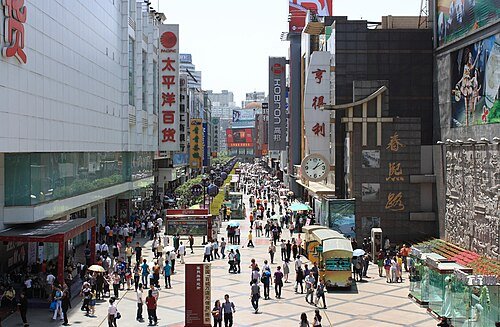 Chunxi Road Pedestrian Street · 春熙路
Chunxi Road春熙路
Chunxi Road’s four original streets meet around Zhongshan Square, where a seated Sun Yat-sen statue anchors the older shopping district. The wider area now extends towards IFS and Taikoo Li, creating a mix of pedestrian streets…
Read the place guide →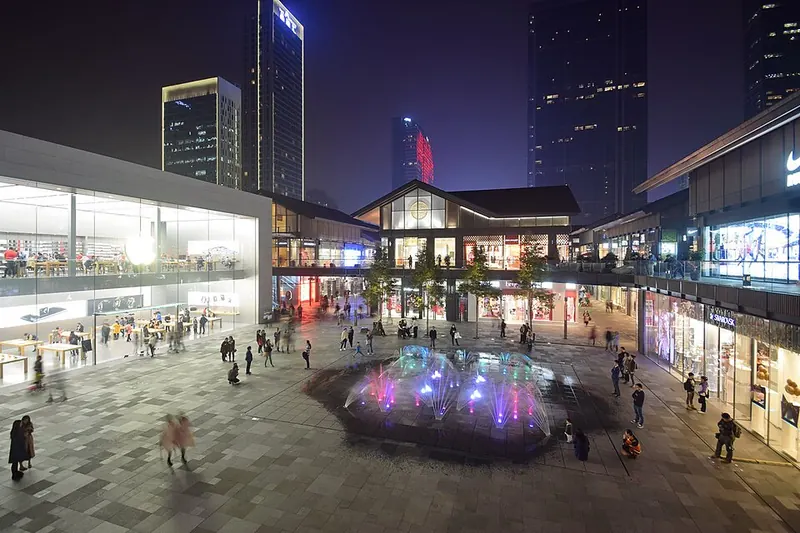 East Plaza at Taikoo Li Chengdu at night · 成都太古里 Photograph date recorded by the source: 2016.
Sino-Ocean Taikoo Li Chengdu成都太古里
Taikoo Li Chengdu is an open-air retail district built around preserved heritage buildings and Daci Temple. Low-rise lanes and courtyards keep the shopping area at a different scale from the surrounding towers. Temple Plaza…
Read the place guide →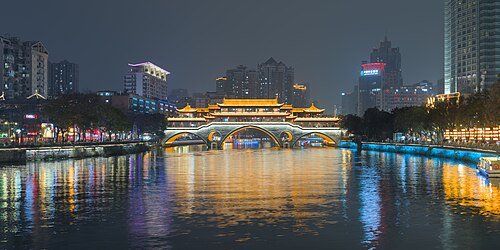 Anshun Bridge · 安顺廊桥
Anshun Bridge安顺廊桥
Anshun Bridge is a covered structure crossing the Jin River, with a restaurant occupying the space above the arches. The present bridge is a reconstruction following the loss of earlier versions to floods, so its value for a…
Read the place guide →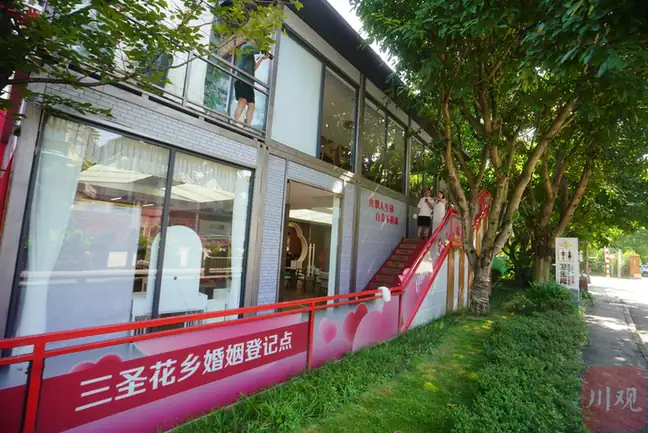 Sansheng Flower Village · 三圣花乡
Sansheng Flower Village三圣花乡
Sansheng Flower Village is a collection of flower-growing and leisure neighbourhoods on Chengdu’s southeastern edge. Its development grew from local horticulture: Hongsha is associated with flower-farm stays, Xingfu Meilin with…
Read the place guide →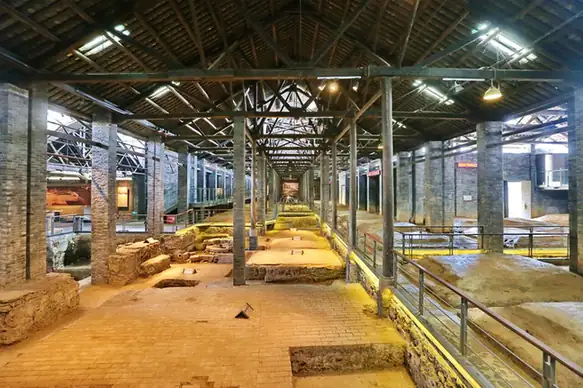 Shuijingfang Museum · 水井坊博物馆
Shuijingfang Museum水井坊博物馆
Shuijingfang Museum centres on excavated remains of a historic baijiu distillery. The archaeological site and the production interpretation show how a working industry became a heritage subject, while the modern distillery…
Read the place guide →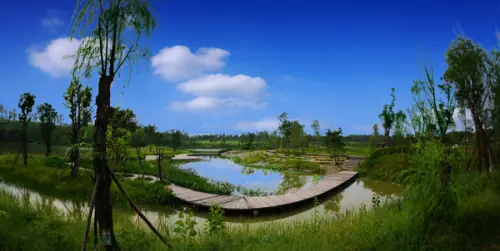 Bailuwan Wetland Park · 白鹭湾湿地公园
Bailuwan Wetland Park白鹭湾湿地公园
Bailuwan provides a wetland walk on Chengdu’s southeastern edge, with water, reeds and planted woodland linked by visitor paths. Seasonal gardens and nature-interpretation areas add detail to the landscape. It works best as a…
Read the place guide →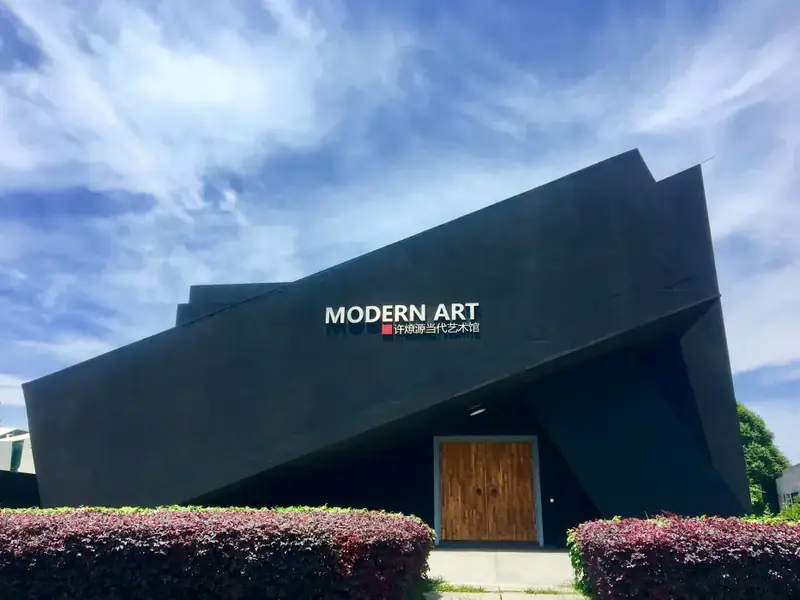 Xu Liaoyuan Museum of Modern Design and Art · 许燎源现代设计艺术博物馆
Xu Liaoyuan Museum of Modern Design and Art许燎源现代设计艺术博物馆
Xu Liaoyuan Modern Design Art Museum brings painting, bronze sculpture, ceramics and experimental furniture into a complex designed by the artist himself. Grey brick, red rails and bronze stairs make the building part of the…
Read the place guide → The 安顺廊桥 at night: a three-arch covered bridge with golden illuminated roofs and lit arcades spanning the Jin River, its reflection streaking the water, with a skyline of towers including a blue-lit skyscraper behind.
Jiuyan Bridge and Anshun Covered Bridge九眼桥与安顺廊桥
Jiuyanqiao and Anshun Corridor Bridge are two separate river crossings in Chengdu, on the Jin river; visitors and long-time residents alike often confuse them, along with a third, newer bridge that also carries the Jiuyanqiao name.
Read the place guide →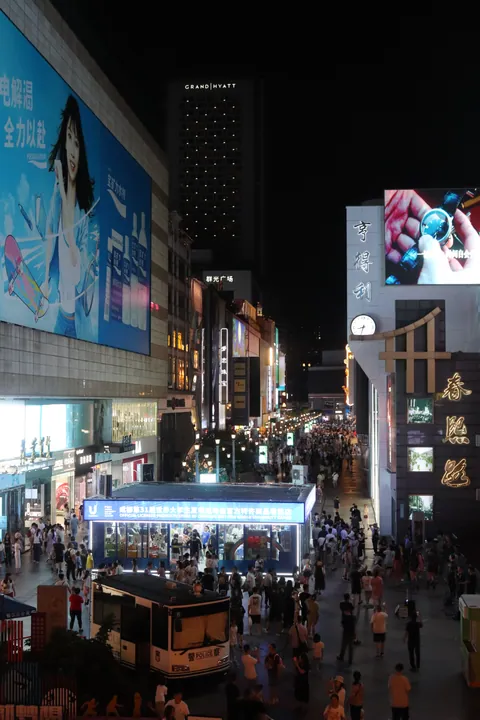 A night view down 春熙路: a packed pedestrian street between tall buildings hung with huge illuminated advertising screens, the 亨得利 clock sign and 春熙路 lettering at the right, the Grand Hyatt tower beyond, and crowds and a police van on the paving.
Chunxi Road and Taikoo Li春熙路与太古里
Chunxi Road and Taikoo Li form the commercial heart of Jinjiang District, Chengdu: a shopping street built in 1924 next to an open-air retail district built in 2015 beside Daci Temple, a temple with a traditional founding date in the 3rd or 4th century AD.
Read the place guide →Plan your visit
Getting there
Jinjiang District is about 8 km in a straight line from central Chengdu. Search for 锦江区 in a map app to find stations and your accommodation.
Where to stay →Build your route
Daci Temple and Chunxi Road are less than 1 km apart. The linked place guides have entrance and visit details.
Continue with Chengdu →More in Chengdu
Sources & geographic information
Administrative names and parent areas: Official geographic directory · Reference date 2026-09-06.
Some facts checked against 锦江区 — Wikipedia contributors, CC BY-SA 4.0.
Some facts checked against 大慈寺 (成都) — Wikipedia contributors, CC BY-SA 4.0.
Some facts checked against 水井街酒坊遗址 — Wikipedia contributors, CC BY-SA 4.0.
Photo: Daci Temple · 来斤小仓鼠吧 · CC BY-SA 4.0. Converted to WebP and resized without changing the subject or cropping the source frame.

Photo: Chunxi Road · Gong Chen, Mlogic · CC BY-SA 4.0. Wikimedia thumbnail; fitted to the ranking-card frame.

Photo: Sino-Ocean Taikoo Li Chengdu · Baycrest · CC BY-SA 2.5. Full frame retained; proportionally resized and converted to WebP. No retouching or changes to the photographed subject. Card displays may crop the view.

Photo: Anshun Bridge · Daniel Lu ( User:dllu ) · CC BY-SA 4.0. Wikimedia thumbnail; fitted to the ranking-card frame.

Photo: Sansheng Flower Village · Source photographer · License not provided. EXIF orientation normalized; resized without changing aspect ratio; converted to WebP. No subject edits.
Photo: Shuijingfang Museum · Source photographer · License not provided. EXIF orientation normalized; resized without changing aspect ratio; converted to WebP. No subject edits.
Photo: Bailuwan Wetland Park · Source photographer · License not provided. EXIF orientation normalized; resized without changing aspect ratio; converted to WebP. No subject edits.
Photo: Xu Liaoyuan Museum of Modern Design and Art · Source photographer · License not provided. EXIF orientation normalized; resized without changing aspect ratio; converted to WebP. No subject edits.
Photo: Jiuyan Bridge and Anshun Covered Bridge · Prcmise · CC BY-SA 4.0. Full frame retained; proportionally resized and converted to WebP. No retouching or changes to the photographed subject. Card displays may crop the view.

Photo: Chunxi Road and Taikoo Li · Liuxingy · CC BY-SA 4.0. Full frame retained; proportionally resized and converted to WebP. No retouching or changes to the photographed subject. Card displays may crop the view.

Map data © OpenStreetMap contributors. Pins mark approximate centres, not entrances or boundaries.