

Explore the region
Tap any red Chinese text to hear it in Mandarin.
Current visitor status
The museum is closed to the public from 5 December 2025 through 30 April 2027 while it carries out a comprehensive upgrade. The closure covers the grounds and visitor centre, the archaeological remains hall, the exhibition hall, the shop and the 4D cinema. Do not travel there expecting to enter during this period. The published end date is not confirmation that the museum will reopen on the following day; check the official site for an opening announcement, new hours, admission and reservation arrangements before making a future visit.
What the site interprets
The archaeological site was discovered in Chengdu in 2001. The museum describes it as a large settlement and ritual landscape with architectural remains, habitation areas and burials; excavations have yielded gold, bronze, jade, stone, lacquer and ivory objects. The evidence points to Jinsha as a major centre of ancient Shu society in the late Shang and Western Zhou periods, although the museum presents that political interpretation as a likelihood rather than a settled certainty.
Before the closure, the visit joined an in-situ archaeological display with object galleries and an outdoor landscape. The remains hall protected and exposed the excavation area, helping visitors read the archaeological context rather than seeing finds only as isolated cases. The exhibition hall organized objects and interpretation around ancient environment and settlement, political life, ritual, burial and craft. The museum also identified the Sun-and-Immortal-Birds emblem, the ebony grove, a jade-and-stone route and the Xishan landscape as outdoor features. These descriptions explain the museum’s pre-upgrade layout; displays and visitor circulation may change when it reopens.
A useful future visit would begin with the remains hall to understand where objects were found, then move to the galleries for material and cultural context, and finish with any outdoor features that have reopened. Allow time to compare the in-situ archaeological setting with the smaller portable objects; the purpose is to connect place, ritual and craft rather than to treat one celebrated object as the whole site. This is an editorial route suggestion, not a current route through a closed museum.
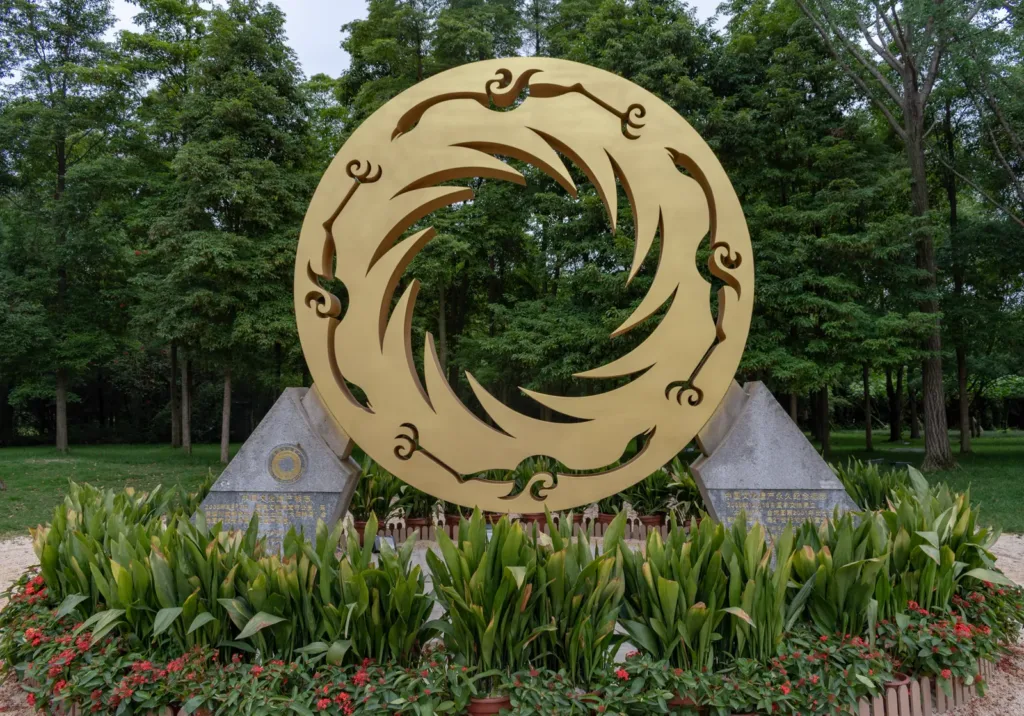
The Sun-and-Immortal-Birds gold ornament is a circular openwork design with a ring of twelve inward-facing arc forms and four birds flying around the outside. The museum’s English collection description notes that this pattern was selected as China’s cultural-heritage emblem in 2005. The photograph above shows the outdoor emblem monument, not the archaeological gold ornament itself.
Getting there after reopening
The museum gives its address as No. 2 Jinsha Site Road, Qingyang District, Chengdu (成都市青羊区金沙遗址路2号). Its transport page recommends Chengdu Metro Line 7 to Jinsha Site Museum Station (金沙博物馆站), Exit C, or Line 2 to Yipintianxia Station (一品天下站), Exit B. The museum does not publish a verified walking distance or turn-by-turn final approach on that page, so follow current public signs toward an entrance and check updated access notices after reopening; no precise walking time is asserted here.
The museum lists three gates: south gate, No. 2 Jinsha Site Road (金沙遗址路2号); east gate, No. 227 Qingyang Avenue (青羊大道227号); and north gate, No. 3 Jinbo Road (金博路3号). For a taxi or ride-hail after reopening, give the driver the Chinese name 成都金沙遗址博物馆 Chéngdū Jīnshā Yízhǐ Bówùguǎn and the intended gate’s address. No specific legal vehicle drop-off bay is confirmed in the cited transport information: use only a signed, permitted stopping place and do not ask a driver to stop in a traffic lane. Gate access and any designated drop-off arrangements should be rechecked when reopening is announced.
The museum’s official transport page lists bus routes 82, 83, 111, 163, G175, 209, 1029, 1043 and 1123, but does not identify the stops serving each gate. Since the museum is currently closed and the stop-to-gate details are not established there, this article does not recommend a bus route as a visitor itinerary.
Admission and planning
No public visit, ticket purchase or reservation is available during the closure. The museum says visitors with unused bookings may seek refunds through the original booking platform or its ticket office; that notice concerns existing bookings, not a current admission offer. Check the official website for confirmed reopening, new operating hours, ticket prices and reservation rules before travelling. Online digital-tour content is also identified by the museum as an alternative way to explore Jinsha while the site is closed.
Combine your visit
A possible sequence after the museum reopens; these are not currently available entry stops:
-
Excavated ritual area, after reopening
Begin with the archaeological setting once access resumes.
-
Collections galleries, after reopening
Compare the gold ornaments, masks and stone figures.
This is an editorial sequence of named spaces or places. It does not imply a verified walking connection or promise opening, ticket availability or a journey time.
Find Jinsha Site Museum
金沙遗址 · 青羊区
The pin marks the area, not the entrance.
More places nearby
Approximate straight-line distances between map pins, not travel distances.
Du Fu Thatched Cottage 杜甫草堂
2 km awayDu Fu Thatched Cottage is a garden and memorial museum dedicated to the Tang poet’s Chengdu years. The original hut has gone; a reconstruction divides the imagined domestic space into study, bedroom and kitchen. Gongbu Shrine…
View guide →Sichuan Museum 四川博物院
3 km awaySichuan Museum presents the province’s art and archaeology near Huanhuaxi Park. Ba–Shu bronzes, Han pictorial bricks and Buddhist stone sculpture give the ancient galleries varied materials and forms. A separate collection…
View guide →Huanhuaxi Park 浣花溪公园
3 km awayHuanhuaxi Park provides a green link between the Du Fu Thatched Cottage area and Sichuan Museum. Wanshu Hill, Canglang Lake and Bailuzhou give the park a mix of wooded paths, water and wetland edges. Poetry-themed features…
View guide →Sources & visit information
Sources checked on 21 October 2026. Hours, tickets, reservations and transport can change; confirm with the operator before you go.
Image credits & notes (1)
- Outdoor monument of the Sun-and-Immortal-Birds cultural-heritage emblem in the museum grounds, photographed in 2018; it is not the excavated gold ornament. Photo: Xiquinho SilvaPhoto: CC BY 2.0