


Get to know Qingyang District
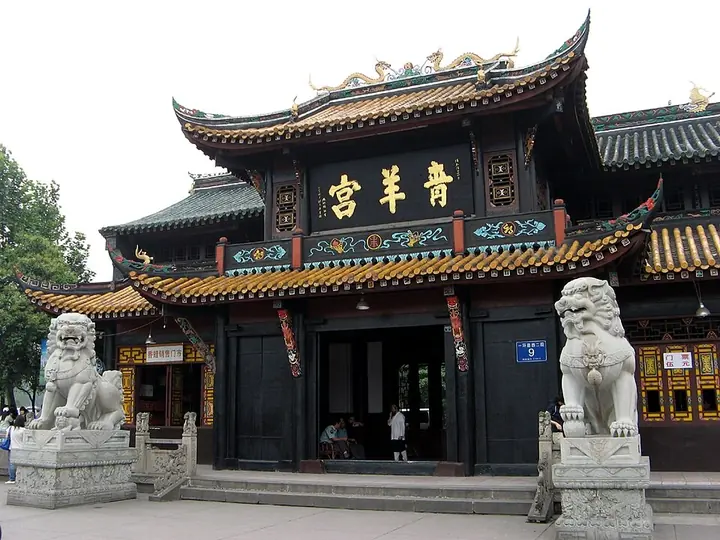
- Administrative area
- District · 市辖区
- Part of
- Chengdu
- Chinese name
- 青羊区
- Local areas
- District guide
Area & population
- Area
- 67.78 km²
- Population · 2020 census
- 955,954
- Administrative seat
- Caoshijie Subdistrict
Source: English Wikipedia, as of the dates shown.
Explore Qingyang by area
Tianfu Square and the city-centre museum
Chengdu Museum stands at the west side of Tianfu Square, at No. 1 Xiaohe Street. Its permanent displays cover Chengdu’s history and culture, Chinese shadow puppetry, and collections on people and nature, making this a useful indoor counterpoint to the district’s temples, gardens and old streets. The museum’s English visitor guide lists Metro Lines 1 and 2 to Tianfu Square; follow the signs for West 1 (north or south) exit and continue toward the museum. Buses 13, 30, 43, 47, 64 and 78 serve Xiyujie stop.
For a taxi or ride-hail, enter 成都博物馆,成都市青羊区小河街1号 as the destination. Ask for a legal passenger drop-off on the street by the museum; do not ask the driver to stop in a restricted square or traffic lane. The English visitor guide lists hours as Tuesday–Thursday and Sunday, 9:00–17:00 (last entry 16:30), Friday and Saturday, 9:00–20:30 (last entry 20:00), and Monday closure except public holidays. The same guide does not state a current general ticket or reservation rule, so check the museum’s live visitor notice before going.
People’s Park: public space, tea and social observation
People’s Park, formerly Shaocheng Park, is a historic urban park rather than a scheduled show. The park’s own site describes Heming Teahouse as part of the park’s built heritage; Sichuan Daily’s 2025 report observed people drinking tea there on a weekday morning and describes its open-air seating, bamboo chairs and gaiwan tea service. A visit can be as simple as walking the paths, watching how locals use the park, or choosing to sit at the teahouse and order directly from its menu. The teahouse is a commercial venue inside the public park, not a free park service. Prices and any performances are subject to the operator’s current offer; the report’s dated promotions are not a standing price list.
The park’s matchmaking corner is a living social practice, not a performance or guaranteed daily attraction. A 2026 report documents it as a current point of interest, but no dependable timetable is established here. If you encounter displayed matchmaking notices or conversations, observe quietly, do not interrupt, and never photograph identifiable people, personal profiles or contact details without their explicit consent. Its presence and activity can vary from visit to visit.
Use People’s Park Station (人民公园站) on Metro Lines 2 or 17 and leave via Exit A, the park’s own visitor page’s recommended exit. Follow the park entrance signs on foot. The park’s Chinese address is 成都市青羊区祠堂街9号. For a taxi, enter 成都市人民公园,祠堂街9号; use a lawful roadside passenger drop-off outside the park and enter on foot rather than asking to drive into the grounds. The park lists buses 4, 5, 7, 13, 43, 47, 58, 64, 81 and 85, but confirm the route and stop in the current bus service before setting out.
The western heritage area: Du Fu Thatched Cottage
At 成都杜甫草堂博物馆,成都市青羊区青华路37号, the museum grounds bring together the poet Du Fu’s remembered thatched home, gardens and museum buildings. The site gives a sense of how a major Tang poet’s Chengdu residence has been preserved and commemorated; allow time to walk through the garden spaces as well as the exhibits. The museum’s route guide identifies the North Gate as the direct visitor entry from Metro Line 13’s Du Fu Thatched Cottage Station, Exit C2. It also lists Line 4 to Caotang North Road Station and Line 5 to Qingyang Palace Station as approaches to the North Gate. Bus 35 stops at Du Fu Thatched Cottage and continues to Songxian Bridge and Qingyang Palace.
For a taxi, use the official address and specify 杜甫草堂博物馆北门 Dù Fǔ Cǎotáng Bówùguǎn Běimén if that is your intended entrance. The museum lists South and North gates; its route guide places the North Gate at Qinghua Road 37. Ask for a permitted roadside drop-off and walk to the gate—do not stop in a bus lane or obstruct traffic. The museum’s October 2026 notice says visitors can choose online booking, staffed counters or self-service ticket machines, with real-name and timed-entry controls used during the National Day holiday period. Check its live notice for the date of your visit; the accessible current notice does not establish a year-round ticket price.

Jinsha and the district’s ancient Shu story
Jinsha Site Museum is an important archaeological site and museum in Qingyang, associated with the ancient Shu culture and the Sun-and-Immortal-Birds gold ornament. However, the museum’s official homepage currently announces closure from 5 December 2025 through 30 April 2027 for a comprehensive upgrade. Do not plan an indoor visit during that interval; check the official site again before travelling after the stated reopening date, as the notice may change.
When it is open, the museum lists its address as 成都市青羊区金沙遗址路2号 and identifies three entrances: South Gate at that address, East Gate at 青羊大道227号, and North Gate at 金博路3号. Its official transport page gives Metro Line 7 to Jinsha Site Museum Station, Exit C, or Line 2 to Yipintianxia Station, Exit B. The page does not map those station exits to a particular museum gate or describe the final walk, so verify the route and which gate is open after reopening rather than assume one. Use the South Gate address for a taxi only after confirming the museum has reopened, and use a legal passenger drop-off outside the gate.
Getting around a district, not a single venue
Qingyang is a large central district with multiple independent destinations and no single visitor entrance. Choose the specific place name and Chinese address above for taxis. For other attractions named by the district, including Qingyang Palace, Kuanzhai Alley and Wenshu Monastery, verify the attraction’s own operating status, entrance and current station exit before departure rather than assuming that the district-wide directions apply.
Guide sources
- Qingyang District official overview
- Chengdu Museum visitor guide
- Du Fu Thatched Cottage Museum transport guide
- Du Fu Thatched Cottage Museum October 2026 visitor update
- Jinsha Site Museum official homepage and transport information
- Chengdu People's Park heritage and visitor access
- Sichuan Daily report on Heming Teahouse
- China News Sichuan report on People's Park matchmaking corner
- Chengdu Museum introduction and permanent exhibitions
Explore Qingyang District
Core places to explore, with English and Chinese names.
Jinsha Site Museum 金沙遗址
Kuanzhai Alleys 宽窄巷子
Wenshu Monastery 文殊院
People's Park (Chengdu) 成都人民公园
Du Fu Thatched Cottage 杜甫草堂
Sichuan Museum 四川博物院
Qingyang Palace 青羊宫
Chengdu Museum 成都博物馆
Huanhuaxi Park 浣花溪公园
Sichuan Art Museum 四川美术馆
Sichuan Science and Technology Museum 四川科技馆
Shu Brocade and Embroidery Museum 成都蜀锦织绣博物馆
Intangible Cultural Heritage Park 成都国际非物质文化遗产博览园
Pinganqiao Cathedral 平安桥天主堂
Liyuan Guild Hall Sichuan Opera 梨园会馆-非遗川剧变脸演出
Wenshufang 文殊坊
Places to explore around Qingyang District
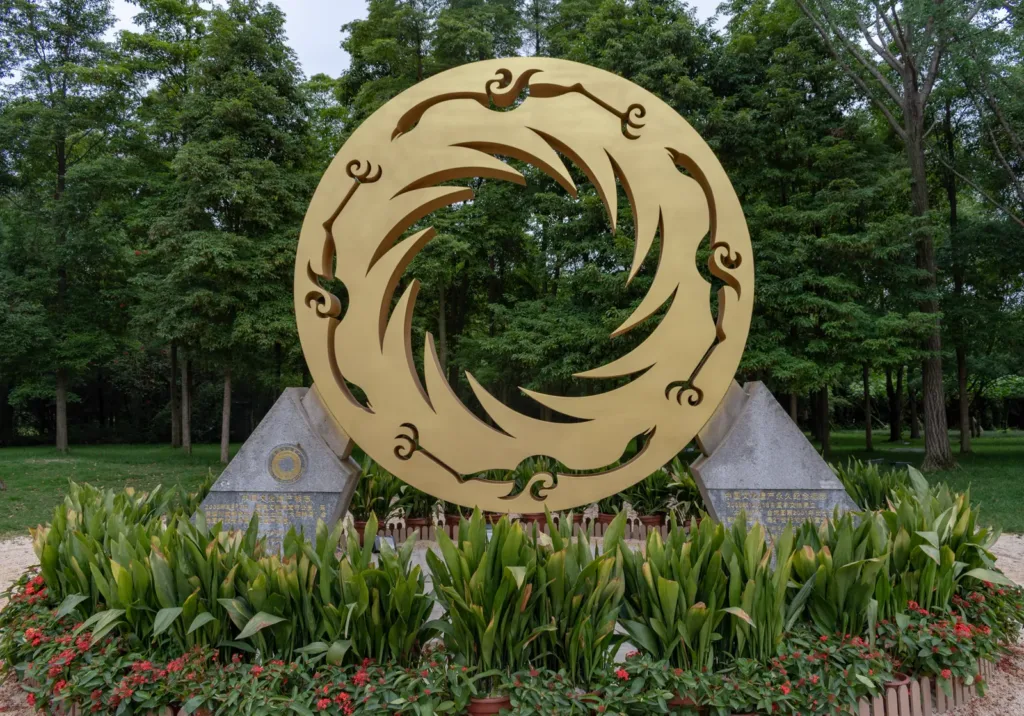 Outdoor monument of the Sun-and-Immortal-Birds cultural-heritage emblem in the museum grounds, photographed in 2018; it is not the excavated gold ornament. Photo: Xiquinho Silva · CC BY 2.0
Jinsha Site Museum金沙遗址
Jinsha Site Museum preserves and interprets a major ancient Shu archaeological site in Chengdu’s Qingyang District. The whole museum is temporarily closed for a comprehensive upgrade from 5 December 2025 through 30 April 2027; check the museum’s official notice before planning a later visit.
Read the place guide →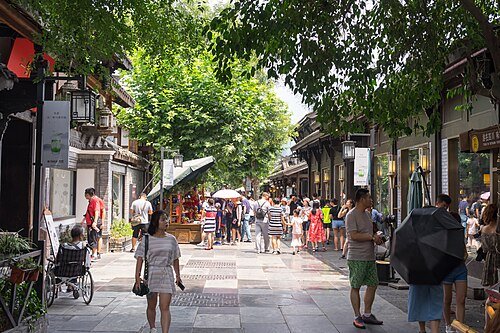 Kuanzhai Alley · 宽窄巷子
Kuanzhai Alleys宽窄巷子
Walk the three parallel lanes of Kuanzhai Alleys in Qingyang District to compare courtyard-house fronts, traces of the historic Shaocheng quarter, and a lively modern mix of tea rooms, food and shops. Metro Line 4’s Kuanzhai Alleys station is the most direct approach; admission to the public lanes is listed as free, while businesses set their own charges.
Read the place guide →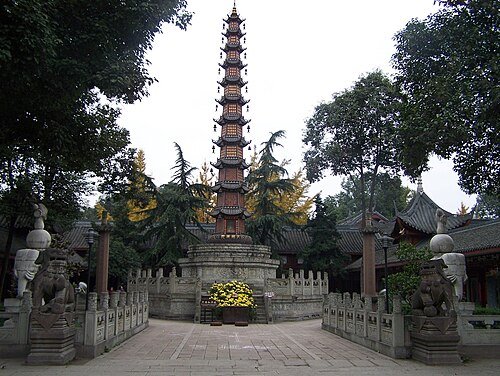 Wenshu Yuan Monastery · 文殊院
Wenshu Monastery文殊院
A working Buddhist monastery in central Chengdu, Wenshu Monastery is worth visiting for its ordered sequence of historic halls, garden setting, Buddhist art and a quieter pause amid the surrounding city. Entry is described by the monastery as free year-round; check with the temple before travelling for current hours or any temporary access restrictions.
Read the place guide →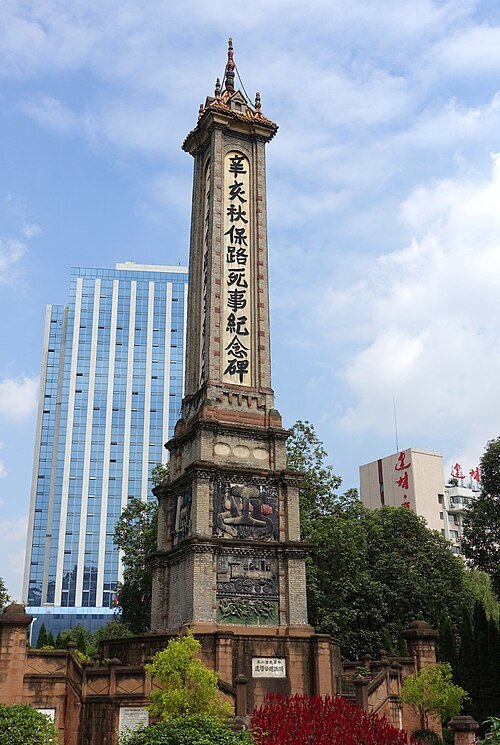 Railway Protection Movement Martyrs Monument in Chengdu People's Park.
People's Park (Chengdu)成都人民公园
A historic civic park in central Chengdu where a protected Railway Protection Movement memorial, the open-air Heming Teahouse and everyday public life share one green space. Visit for the garden and history, or sit for tea; the matchmaking area is a real social setting, not a scheduled show.
Read the place guide →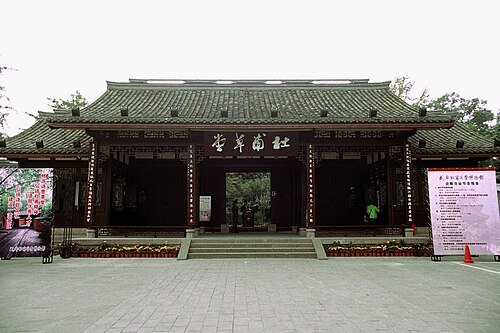 Du Fu Cottage · 杜甫草堂
Du Fu Thatched Cottage杜甫草堂
A leafy memorial museum in Qingyang where Chengdu’s most influential poet is remembered through a reconstructed thatched cottage, historic shrine halls, a red-walled path and a large garden. The site connects literary history with a calm walk through the Huanhua area.
Read the place guide →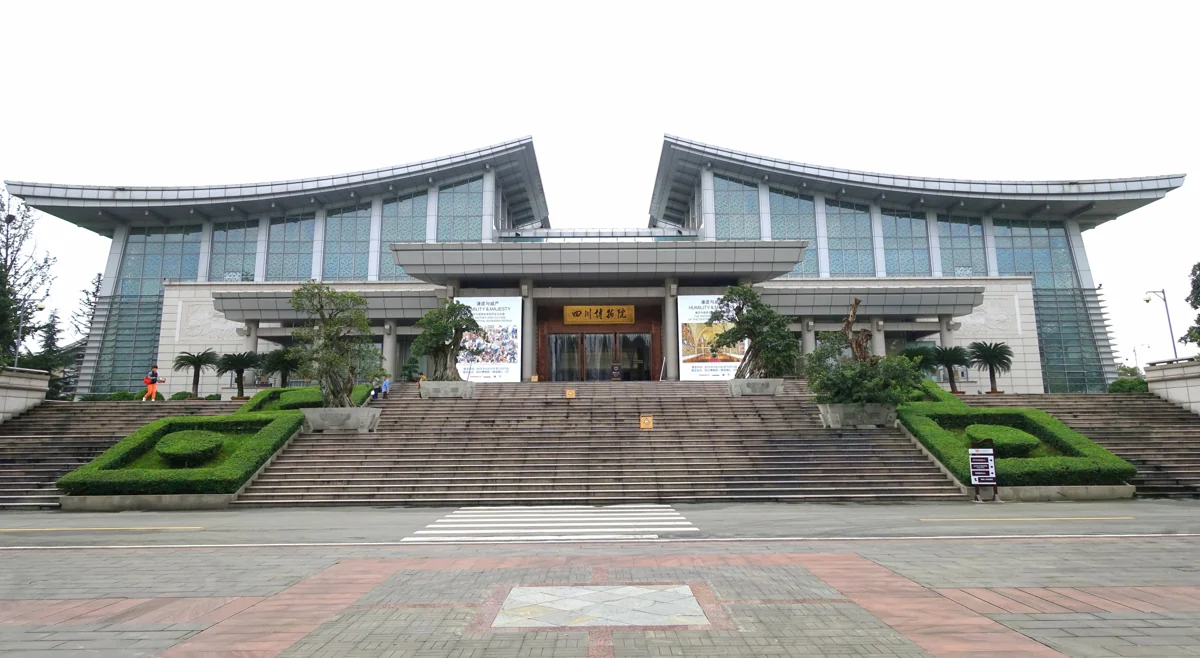 Sichuan Museum in Chengdu. Photograph by Daderot, 2015.
Sichuan Museum四川博物院
A three-floor introduction to Sichuan’s past, from ancient Shu bronzes and Han-period tomb art to Buddhist sculpture, regional cultures and Zhang Daqian’s paintings. The museum stands beside Du Fu Thatched Cottage in Qingyang District.
Read the place guide →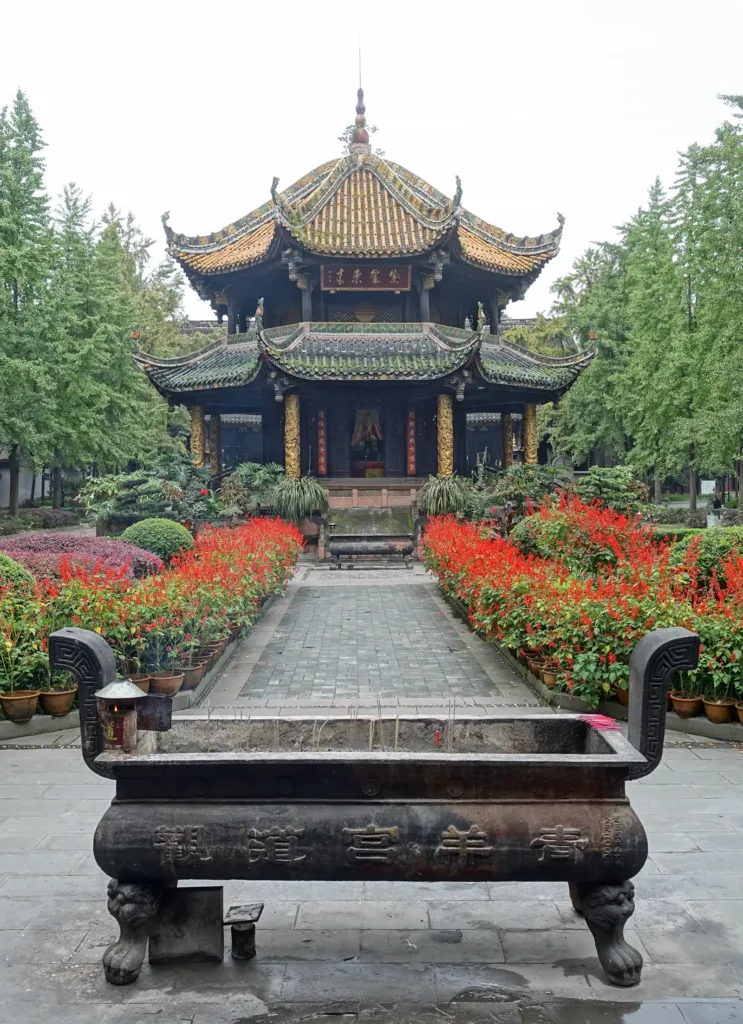 Eight Trigram Pavilion at Qingyang Palace, Chengdu. Photo: Daderot · CC0 1.0
Qingyang Palace青羊宫
Qingyang Palace is a Taoist temple in central Chengdu, best explored as a sequence of halls and courtyards. Look for the paired bronze rams, the two-storey Eight Trigram Pavilion, and the layered roofs and carved details of its Qing-era buildings. Visit respectfully as a religious site.
Read the place guide →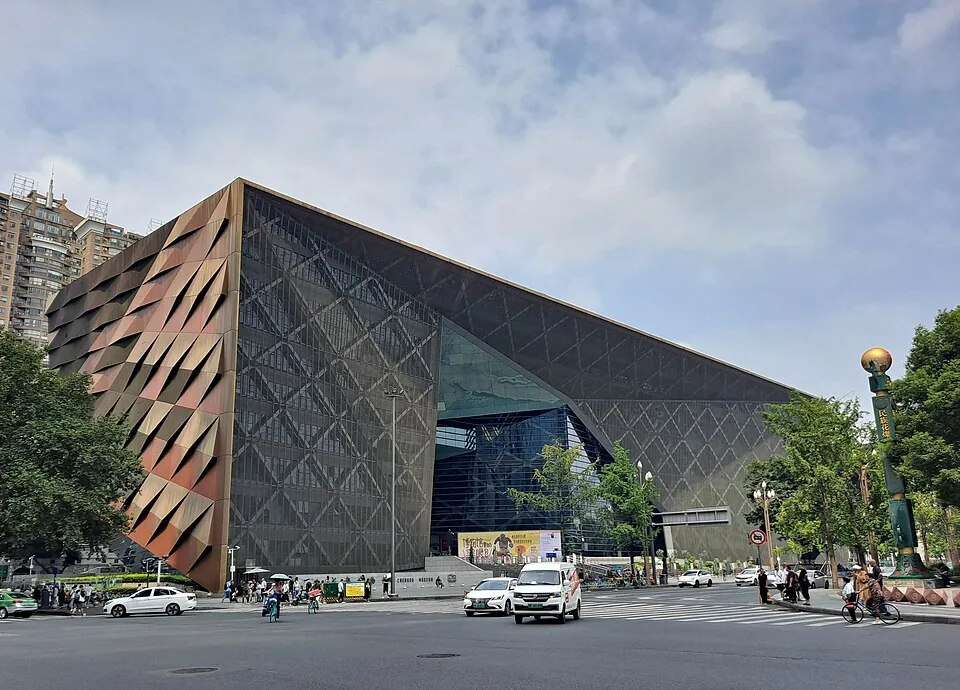 Chengdu Museum · 成都博物馆. Photo: 2023-09-15.
Chengdu Museum成都博物馆
On Tianfu Square’s west side, Chengdu Museum follows the city’s history through archaeological and historical galleries, with distinctive Chinese shadow-puppet and puppetry displays. Admission is free but requires advance booking; current opening hours and a temporary escalator replacement affect how to plan a visit.
Read the place guide →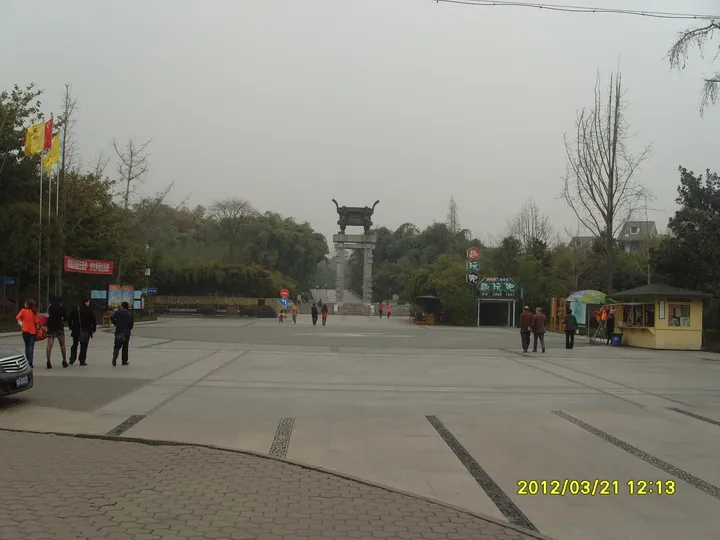 The south gate approach to Huanhuaxi Park in Qingyang District, Chengdu · 浣花溪公园南大门,成都市青羊区 Source-recorded photograph date: Taken on 21 March 2012.
Huanhuaxi Park浣花溪公园
A free-entry urban park in Qingyang District where streamside paths, Canglang Lake, wetland edges and a long poetry avenue bring Chengdu’s literary landscape into an everyday green space beside Du Fu Thatched Cottage.
Read the place guide → AI illustration · AI 示意图(仅供参考,非该地点实拍)
Sichuan Art Museum四川美术馆
A free-entry provincial art museum on the northwest side of Tianfu Square, with changing exhibitions and a print collection that includes the Shenzhou Prints Museum. Check the museum’s official reservation and exhibition notices before visiting.
Read the place guide →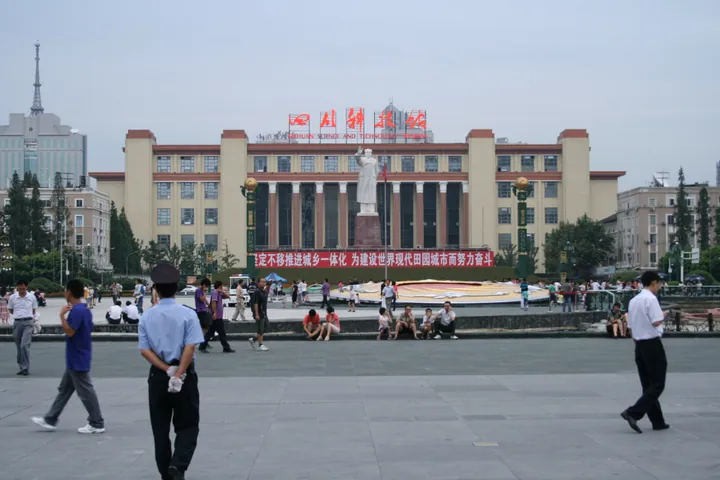 The Sichuan Science and Technology Museum building on Tianfu Square, Chengdu, with the Mao Zedong statue in front · 成都天府广场四川科技馆及毛泽东雕像 Source-recorded photograph date: 2010-08-14.
Sichuan Science and Technology Museum四川科技馆
A hands-on science museum on the north side of Tianfu Square, with galleries spanning aerospace, natural phenomena, human perception and Sichuan water engineering. Reserve through the museum’s official account, then use the Line 1 or 2 interchange at Tianfu Square.
Read the place guide →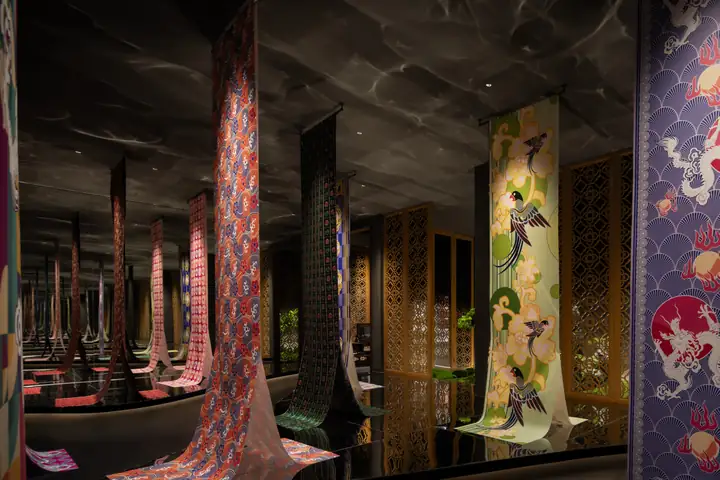 Shu Brocade and Embroidery Museum · 成都蜀锦织绣博物馆
Shu Brocade and Embroidery Museum成都蜀锦织绣博物馆
A specialist museum in Qingyang District traces Sichuan’s brocade and embroidery through historic textiles, clothing and looms, with a striking two-level loom atrium and displays that bring traditional patterns into contemporary gallery spaces.
Read the place guide → AI illustration · AI 示意图(仅供参考,非该地点实拍)
Intangible Cultural Heritage Park成都国际非物质文化遗产博览园
A large cultural campus in western Chengdu that combines the Sichuan Intangible Cultural Heritage Museum with changing exhibitions, events and other visitor facilities. Check what is open before travelling; the park is not a single continuously operating exhibition.
Read the place guide →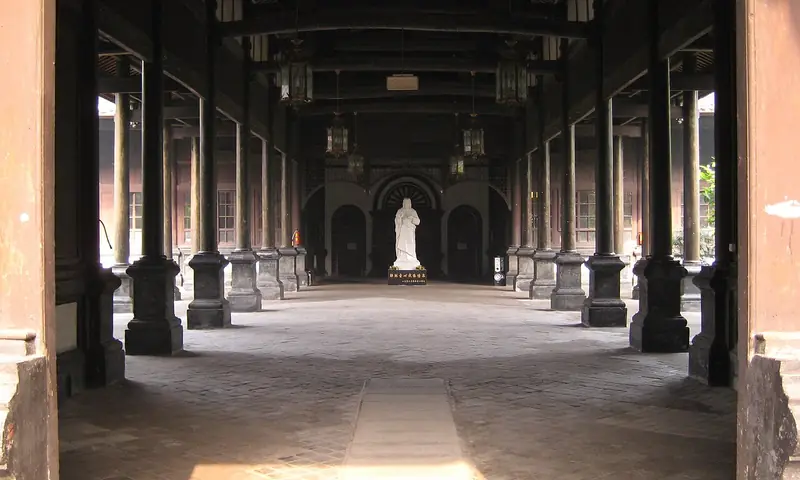 Pinganqiao Cathedral · 平安桥天主堂
Pinganqiao Cathedral平安桥天主堂
A working Catholic cathedral and protected historic complex in central Qingyang, where a church courtyard and Western ecclesiastical forms sit beside a traditional Chinese courtyard compound.
Read the place guide →Liyuan Guild Hall Sichuan Opera梨园会馆-非遗川剧变脸演出
A ticketed performance venue in Wenshu Fang where visitors can see excerpts of Sichuan opera, including face-changing, alongside other traditional stage skills. Book the Wenshuyuan branch and check the selected date’s program and ticket inclusions before travelling.
Read the place guide →Wenshufang文殊坊
A walkable cultural-commercial precinct around Wenshu Monastery, where Sichuan courtyard-style lanes, temple landmarks and contemporary food and cultural businesses meet. Explore its lanes and courtyards on foot; the precinct is broader than the monastery itself.
Read the place guide →Plan your visit
Getting there
Qingyang District is about 7 km (straight-line distance) from central Chengdu. Search for 青羊区 in a map app to find stations and your accommodation.
Where to stay →Build your route
Jinsha Site Museum and Kuanzhai Alleys are about 4 km apart (straight-line distance). The linked place guides have entrance and visit details.
Continue with Chengdu →More in Chengdu
Sources & geographic information
Administrative names and parent areas: Official geographic directory (dmfw.mca.gov.cn) · Reference date 2026-09-06.
Background text adapted from Qingyang, Chengdu — Wikipedia contributors, under CC BY-SA 4.0. Text has been shortened and reorganized; source revision 1301055954.
Photo: Kuanzhai Alleys · JianEn Yu · CC BY 2.0. Wikimedia Commons image, fitted to the card frame.

Photo: Wenshu Monastery · Jason Zou · Public domain. Wikimedia Commons image, fitted to the card frame.

Photo: People's Park (Chengdu) · Daderot · CC0. Wikimedia Commons image, fitted to the card frame.

Photo: Du Fu Thatched Cottage · User:唐戈 · CC BY-SA 3.0. Wikimedia Commons image, fitted to the card frame.

Photo: Sichuan Museum · Daderot · CC0 1.0 Universal. Resized and encoded as WebP; photograph dates from 2015.

Photo: Chengdu Museum · EditQ · CC0. Resized for the web; the photo itself has not been edited.

Photo: Huanhuaxi Park · wuzhongj · CC BY 3.0. Resized for the web; the photo itself has not been edited. Thumbnails may show a cropped view.

Photo: Sichuan Science and Technology Museum · AlexHe34 · CC BY-SA 3.0. Resized for the web; the photo itself has not been edited. Thumbnails may show a cropped view.

Photo: Shu Brocade and Embroidery Museum · gs.ctrip.com. Resized for the web; the photo itself has not been edited.
Photo: Pinganqiao Cathedral · Hallelujahgod · CC BY 3.0. Resized for the web; the photo itself has not been edited.

Map data © OpenStreetMap contributors. Pins mark approximate centres, not entrances or boundaries.
Image credits & notes (2)
- The entrance to Qingyang Palace in Qingyang District, Chengdu. Photograph date recorded by the source: 21 June 2006 (according to Exif data).Photo: No machine-readable author provided. Dice~commonswiki assumed (based on copyright claims). · CC BY-SA 3.0Resized for the web; the photo itself has not been edited. Thumbnails may show a cropped view.
- Garden entrance at Du Fu Thatched Cottage Museum. Photo: Tyg728Photo: CC BY-SA 4.0
