

Explore the region
A river crossing and a market-town plan
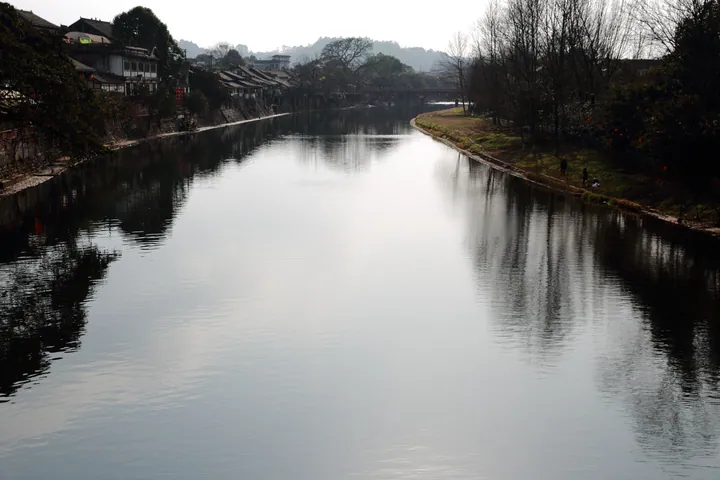
Pingle lies in Qionglai, within Chengdu municipality. The local government describes it as a historic settlement shaped by the river and by its former role as a western Sichuan goods-distribution centre and water wharf. Leshan Bridge crosses the Baimo River at the historic core. The old streets follow the river, with a branching, fishbone-like layout; the government account counts 33 old lanes and 22 streets retaining a Ming–Qing-era streetscape. These are useful clues for reading the place as a working market town rather than a single monumental complex.
Begin around the Leshan Bridge (乐善桥), the old crossing over the Baimo River, then walk the riverfront and turn into the lanes on either side. The seven-arch stone bridge is a Qing-dynasty structure; a 2025 report describes its distinctive peach-shaped arch openings. Look across the water for the close-set riverside houses and shopfronts, then follow the narrow lanes inland to see how the older street grid connects back to the waterfront. There is no need to force a fixed circuit: choose a crossing that is open on the day, and return along a different lane where access permits.
The town’s long-distance-trade history is associated with the Southern Silk Road and the Tea–Horse Road. The government account places Pingle among the region’s historic water and land trading routes, but the surviving visitor experience is best understood through the river, crossing, lanes and traditional building pattern rather than as a reconstructed ancient caravan route.
Entry and time
A current Trip.com attraction listing identifies the town as free to enter and gives the address as 四川省成都市邛崃市兴新街139号. This is a secondary listing, not a current official operating notice. No current official source retrieved for this guide confirms fixed opening hours, a general reservation requirement, or the status of every individual building and riverside business. Check on arrival for temporary closures or separately ticketed attractions; the free-entry listing for the town does not establish that every nearby attraction or activity is free.
Allow a few unhurried hours to walk the bridge, riverfront and lanes; this is an editorial suggestion, not an official duration. The Western Sichuan Bamboo Sea (川西竹海) is a separate nearby attraction, not part of the ancient-town streets. Plan its admission and return transport separately rather than assuming that a town visit includes it.
Getting there
By rail and local bus: Take the Chengdu–Ya’an railway to Qionglai Station (邛崃站), then look for local bus route 11 serving Pingle Ancient Town. A 2024 report quoting the Qionglai transport authority says the station’s bus connections included a route serving Pingle and Tiantai Mountain. That report does not give a verified stop name, current timetable or present-day service notice. At the station, confirm that route 11 is operating toward Pingle and ask the driver which stop serves 平乐古镇; confirm a return connection before setting out. No Chengdu Metro line reaches Pingle, and no reliable metro exit or last-mile walking route applies at the town.
By taxi or ride-hail: Use 平乐古镇, 四川省成都市邛崃市兴新街139号 as the Chinese navigation destination. The old-town lanes are not a guaranteed vehicle drop-off point. Ask to be let out only at a legal public curb or signed visitor access point, then continue on foot; follow local traffic controls and do not ask the driver to enter pedestrian-only lanes. The precise designated visitor drop-off point was not confirmed in the sources available for this guide.
By bus from Chengdu: A rail-first connection via Qionglai is the best-supported public-transport option in the sources checked. The exact current coach departure point, timetable and direct service from Chengdu were not confirmed, so do not rely on older online schedules without checking with the operator.
Combine your visit
Choose from these complementary stops when planning your visit.
-
Leshan Bridge乐善桥
Begin with the bridge and river crossing.
-
Riverside lanes白沫江河岸老街
Explore the old buildings and waterfront.
-
Riverside tea stop临江茶馆
Allow time to enjoy the town between walks.
This is a suggested combination, not a timed route; confirm the opening and transport arrangements for your date.
Find Pingle Ancient Town
平乐古镇 · 邛崃市
The pin marks the area, not the entrance.
More places nearby
Approximate straight-line distances between map pins, not travel distances.
Western Sichuan Bamboo Sea 川西竹海
3 km awayWestern Sichuan Bamboo Sea combines a bamboo-covered valley near Pingle with modern elevated walking facilities. The lower stream setting and Jinji bridge provide a quieter landscape, while high bridges and glass sections create…
View guide →Qiong Kiln Site 邛窑遗址
12 km awayQiong Kiln Archaeological Park explains the ceramic industry that flourished around Qionglai. The Shifangtang site forms the visitor core, with protected kiln remains and exhibitions showing how local pottery was made and…
View guide →Shixiang Lake 石象湖
19 km awayShixiang Lake combines wooded water inlets with landscaped flower gardens in Pujiang. The lake’s narrow bays create a more enclosed setting than Chengdu’s broad urban lakes, while the planted lawns and flower areas offer a…
View guide →Sources & visit information
Sources checked on 21 October 2026. Hours, tickets, reservations and transport can change; confirm with the operator before you go.
- Pingle Ancient Town, Qionglai Municipal People's Government ↗
- Pingle Ancient Town, Leshan Bridge and the Baimo River, Beijing Daily ↗
- Sichuan's high-speed rail stations add bus-style connections, People's Daily Online Sichuan ↗
- Pingle Ancient Town visitor listing, Trip.com ↗
- Qionglai Culture, Radio, Television, Sports and Tourism Bureau — 2025 proposal response ↗
Image credits & notes (1)
- The canal running through Pingle Ancient Town, Qionglai, lined with traditional buildings · 邛崃平乐古镇沿河老街 Source-recorded photograph date: Taken on 19 January 2014.Photo: landagent · CC BY-SA 3.0Resized for the web; the photo itself has not been edited. Thumbnails may show a cropped view.
