


Photo adjustments
Wikimedia thumbnail; fitted to the ranking-card frame.
Explore the region
About Jinli Street
Qing-style shopfronts frame a pedestrian route filled with Sichuan snacks, craft shops and souvenir stalls. The Three Kingdoms theme connects the street with the neighbouring memorial complex, but the two provide different experiences: one is a busy leisure district, the other a historical site with separate admission. Look at the building details before choosing a food stop and continuing to the shrine if planned.
Jinli's name derives from Jinguan Cheng (锦官城, ‘brocade officials' city’): the fourth-century Chronicles of Huayang (华阳国志) records that brocade woven locally came out especially bright when washed in this stretch of the river, giving rise to the name, which later became a byname for Chengdu itself. Local tradition holds that a commercial street existed here as early as the Qin and Han dynasties and through the Three Kingdoms period.
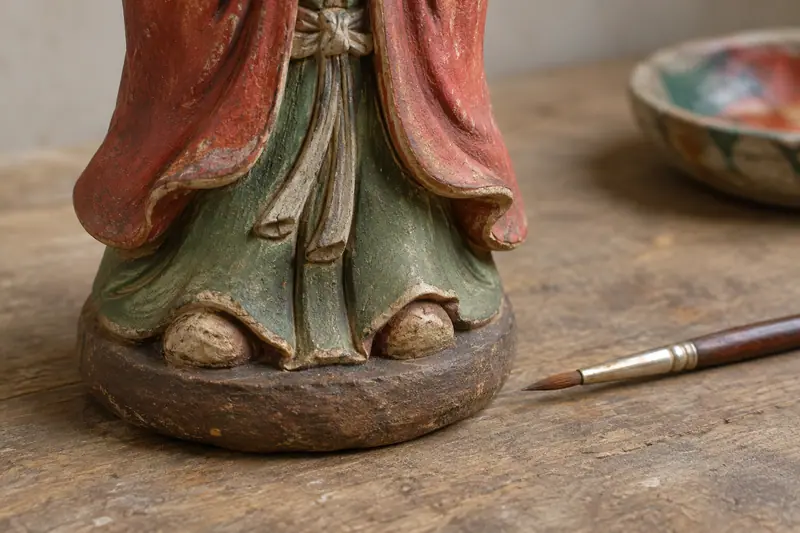
The present street was rebuilt by the Chengdu Wuhou Shrine Museum as part of the Wuhou Shrine complex and runs 550 metres in imitation Qing and early-Republic architectural style. It opened in October 2004, and an extension known as Jinli Phase Two (水岸锦里) began operating in January 2009. Shops sell items such as chopsticks, tea, lanterns and silk-filled quilts, and foods including Zhang Fei beef, sanda pao (三大炮) and feichang fen (肥肠粉), alongside crafts such as clay figures and sugar painting.
In 2005 Jinli was named one of the National Top Ten City Commercial Pedestrian Streets, alongside Beijing's Wangfujing and Chongqing's Jiefangbei, and in 2006 the Ministry of Culture designated it a National Cultural Industry Demonstration Base, recognitions that followed its 2004 reopening as a themed commercial street.
What to look for
- Traditional-style shopfronts and rooflines frame the pedestrian street.
- Snack and craft stalls show the street’s role as a modern Sichuan leisure district.
Location & getting there
Getting to Jinli Street
Approach from Gaoshengqiao station on Metro Line 3 and continue towards Jinli beside Wuhou Shrine. Confirm whether your plan includes separate entry to the shrine.
Combine your visit
Suggested order for the visit:
-
Street entrance
Observe the traditional-style frontage.
-
Snack and craft lane
Choose a food or craft stop.
-
Wuhou Shrine, if booked
Add the neighbouring memorial as a separate visit.
This is an editorial sequence of named spaces or places. It does not imply a verified walking connection or promise opening, ticket availability or a journey time.
Find Jinli Street
锦里 · 武侯区
The pin marks the area, not the entrance.
More places nearby
Approximate straight-line distances between map pins, not travel distances.
Wuhou Shrine 武侯祠
Less than 1 km awayWuhou Shrine commemorates Zhuge Liang and the Shu figures associated with the Three Kingdoms period. Statues in the temple halls turn those historical and literary names into a sequence of people, while gardens provide a quieter…
View guide →People's Park (Chengdu) 成都人民公园
1 km awayPeople’s Park brings together Chengdu’s tea culture, planted gardens and a monument to the Railway Protection Movement. Heming Teahouse is a principal gathering place, with tables offering a close view of everyday social life…
View guide →Shu Brocade and Embroidery Museum 成都蜀锦织绣博物馆
2 km awayChengdu Shu Brocade and Embroidery Museum introduces two related but different textile traditions. Brocade patterns are created through weaving, while embroidery adds stitched decoration to cloth. The museum’s displays and…
View guide →Sources & visit information
The sources below support the place-specific description and arrival information. Suggested combinations are editorial planning ideas; confirm current opening, entry arrangements and transport services for your date.
Visitor information adapted and edited from Wikipedia contributors, “Jinli” · CC BY-SA 4.0. Source revision 1366512362.
Visitor information adapted and edited from Wikivoyage contributors, Chengdu · CC BY-SA 4.0. Source revision 5341133.
Background paragraphs translated and condensed from Wikipedia contributors, "锦里", Chinese Wikipedia · CC BY-SA 4.0. Source revision 85369555.