

Explore the region
What to see and how to explore
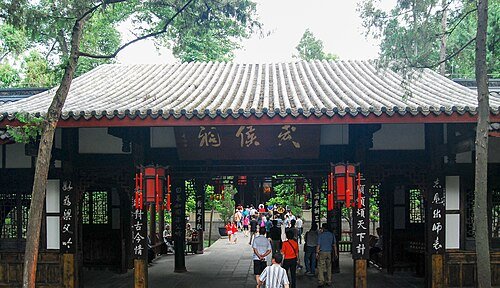
The name “Wuhou Shrine” now refers to a larger ensemble, not only to a shrine for Zhuge Liang. Its Three Kingdoms historic area brings together Huiling, the Han Zhaolie Temple, the Wuhou Shrine and Sanyi Temple. The arrangement reflects a change in worship: in 1391 the Shu prince combined Liu Bei’s temple and Zhuge Liang’s shrine into a shared memorial, and the present paired-hall arrangement continues that emphasis on ruler and minister.
Enter through the south/main gate and follow the central sequence at an unhurried pace. The approach leads into the Han Zhaolie Temple precinct and past the stele pavilions; look for the Tang-dynasty inscription known as the “Three Perfections” stele, praised for its text, calligraphy and carving. Continue to Liu Bei Hall, with the civil-official and military-official galleries along its sides. Their Qing-period painted figures and accompanying biographies make the galleries a useful way to distinguish the court’s supporting cast from the better-known rulers.
Beyond the crossing hall, Zhuge Liang Hall forms the next focal point. Pause at the hall and its celebrated “攻心联” couplet, which reflects on statecraft as well as military skill. Then take the red-wall passage toward Huiling, Liu Bei’s tomb precinct, and visit Sanyi Temple, whose present building was relocated here from another part of Chengdu. The buildings are not a Three Kingdoms-period stage set: their present form records later rebuilding, ritual choices and conservation. The museum’s official heritage database describes the principal structures, galleries, tomb route and the passage joining Huiling with the shrine.
Allow time to notice the spatial contrast: the formal axial courtyards and halls organize the shared memorial, while the shaded tomb path and gardens slow the transition between them. The western area and the Jinli folk-culture street are also part of the broader museum complex, but Jinli is an adjacent visitor street rather than an additional Three Kingdoms-era temple; do not assume the historic-area ticket includes every separately managed attraction or activity.
Tickets and opening
The museum’s Chinese homepage and a current Chengdu government visitor listing give the standard ticket as CNY 50, concession ticket CNY 25, opening at 09:00, closing at 18:00, with ticket sales stopping at 17:00. Seasonal extended hours and special public programs can change the schedule, so check the museum’s live official notice for the visit date. Its English ticket page currently lists a different closing time (19:00, last admission 18:00); where the pages conflict, rely on the current Chinese official notice or confirm directly before setting out.
The English ticket rules say tickets are sold by real-name online booking up to 14 days ahead; passports can be used, and online payment is limited to WeChat Pay or Alipay. Visitors unable to use those payment methods may ask at the on-site service window about cash purchase. Book through the museum’s own website or official WeChat account, not an unverified reseller. Admission is through the south/main gate. Security screening applies; the museum prohibits smoking and touching or climbing on historic fabric.
Getting there
Metro: The museum’s own traffic guide recommends Chengdu Metro Line 10 to Wuhouci (Jinli) Station (武侯祠(锦里)站), Exit A2, then about a three-minute walk to the museum. It also lists Lines 3 or 5 to Gaoshengqiao Station (高升桥站), Exit A, followed by about a ten-minute walk. Follow the museum and south-gate signs on the final approach; these are the museum’s published station and exit directions.
Bus: The museum lists routes 1, 57, 82, 334 and 335 as serving the museum. Its official page does not identify a separate route-specific stop name, so check the destination display and stop announcements rather than assuming an unverified stop label.
Taxi or ride-hail: Set the destination as 成都武侯祠博物馆南门,成都市武侯区武侯祠大街231号 (Chengdu Wuhou Shrine Museum South Gate, No. 231 Wuhouci Street, Wuhou District). The ticket instructions identify the south gate as the entry gate, and the museum gives this street address for its parking facility. Ask the driver to use a lawful curbside or marked passenger drop-off point; do not request stopping in a restricted lane or assume a car can enter the pedestrian forecourt.
Combine your visit
Suggested order for the visit:
-
Memorial halls
Follow the named figures and their relationships.
-
Temple gardens
Pause between the hall visits.
-
Jinli
Add the adjacent street as a separate food and shopping stop.
This is an editorial sequence of named spaces or places. It does not imply a verified walking connection or promise opening, ticket availability or a journey time.
Find Wuhou Shrine
武侯祠 · 武侯区
The pin marks the area, not the entrance.
More places nearby
Approximate straight-line distances between map pins, not travel distances.
Jinli Street 锦里
Less than 1 km awayJinli is a rebuilt traditional-style commercial street beside Wuhou Shrine. Qing-style shopfronts frame a pedestrian route filled with Sichuan snacks, craft shops and souvenir stalls. The Three Kingdoms theme connects the street…
View guide →People's Park (Chengdu) 成都人民公园
1 km awayPeople’s Park brings together Chengdu’s tea culture, planted gardens and a monument to the Railway Protection Movement. Heming Teahouse is a principal gathering place, with tables offering a close view of everyday social life…
View guide →Shu Brocade and Embroidery Museum 成都蜀锦织绣博物馆
2 km awayChengdu Shu Brocade and Embroidery Museum introduces two related but different textile traditions. Brocade patterns are created through weaving, while embroidery adds stitched decoration to cloth. The museum’s displays and…
View guide →Sources & visit information
Sources checked on 21 October 2026. Hours, tickets, reservations and transport can change; confirm with the operator before you go.
Image credits & notes (1)
- Wuhou Memorial Temple · 武侯祠Photo: Shizhao · CC BY-SA 3.0Wikimedia Commons image, fitted to the card frame.
