

Explore the region
What to see
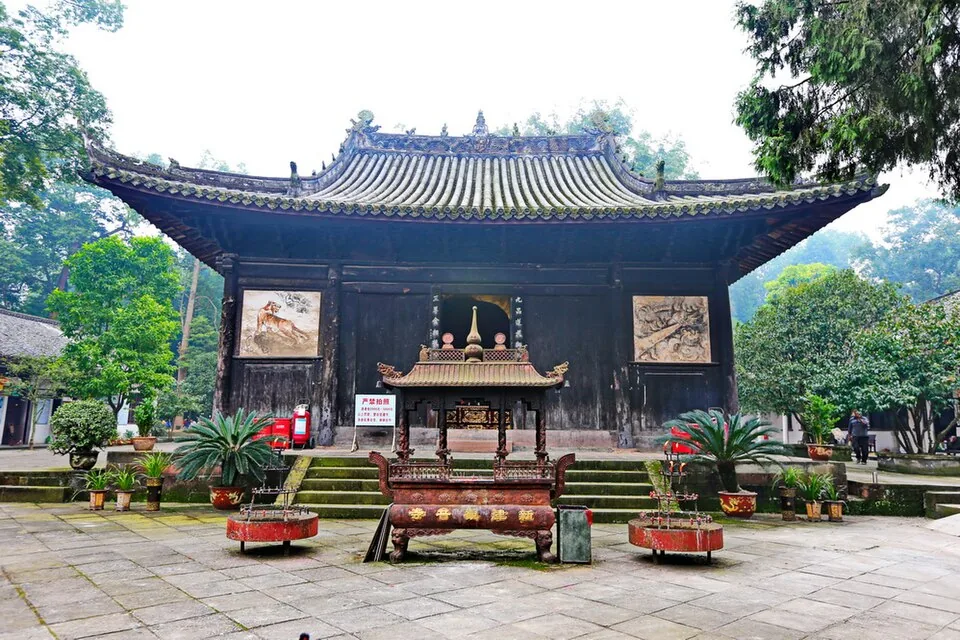
Guanyin Temple stands at the foot of Jiulian Mountain in Jiulian Village, Yongshang Town, Xinjin District. The district’s 2026 cultural-relic directory lists this as its current locality; older records use a different village name, so use the current official listing when arranging a ride. The temple was founded in 1181, and the State Council listed it as a Major Historical and Cultural Site Protected at the National Level in 2001. Its surviving complex brings together Qing-dynasty entrance and subsidiary halls with the Ming-dynasty Pilu Hall (毗卢殿) and Guanyin Hall (观音殿).
Begin with Pilu Hall if it is open. Its seven mural panels, painted in 1468, are arranged in bands: celestial attendants and canopies above, the Twelve Enlightened Ones and twenty-four deities in the middle, and altar furnishings, guardian figures and donors below. Rather than one enormous scripture tableau, the linked scenes place devotional figures within a shared architectural world. Look for the fine linear drawing, saturated mineral colours and delicate treatment of garments; the district account notes the use of mineral pigments, gold and pearl powder. Take time to compare the repeated figures and details across the panels instead of trying to take in the whole wall at once.
Guanyin Hall offers a different kind of encounter: a sculptural ensemble centred on Guanyin with Manjushri and Samantabhadra, surrounded by arhat figures and relief work. The district account dates the hall to 1469 and describes the central images and the carved mountain-scene backdrop. Its interiors have been subject to conservation work at different times, so these works are a historical guide to what the hall contains, not a promise that every image is currently visible.
A gentle route is to pause at the entrance and surviving halls, then spend the longest viewing time in whichever historic interior staff have opened. Do not enter closed or cordoned areas. This is a protected religious site as well as a heritage destination: keep voices low, do not touch painted or sculpted surfaces, and follow current signs and staff instructions. Ask before taking photographs; do not assume photography is allowed inside protected halls.
Opening, tickets and access
As checked on 21 October 2026, the official sources reviewed do not publish a current visitor timetable, admission price, reservation procedure or a guarantee that the historic interiors are open. Confirm these details with the temple or Xinjin cultural-heritage authorities before making a special journey. The National Cultural Heritage Administration reported survey and documentation work at the temple in 2025; that report documents conservation activity, not a visitor schedule.
By metro and road transfer: Take Chengdu Metro Line 10 to Xinping (新平站), the line’s Xinjin terminal, then continue by taxi or a pre-arranged road ride to the temple. The metro extension to Xinping is documented in the current line-operation report. No reliable station-exit number or direct bus service to the temple was verified, so do not plan on an unconfirmed last-mile walk or bus. Arrange a return ride as well; no dependable return timetable was established in this check.
For a taxi or ride-hail request, use 新津观音寺(成都市新津区永商镇九莲村九莲山麓). The current district listing gives the locality but not a confirmed vehicle drop-off bay or numbered tourist gate. Ask the driver to use the signed public approach and stop only at a lawful stopping place; follow on-site signs or staff for the visitor entrance. Do not ask for an unverified gate-side drop-off.
Combine your visit
Choose from these complementary stops when planning your visit.
-
Temple approach观音寺入寺院落
Check which historic halls are open.
-
Pilu Hall毗卢殿
Spend time with the permitted mural views.
-
Open temple courtyards开放寺院庭院
Continue only through areas released for visitors.
This is a suggested combination, not a timed route; confirm the opening and transport arrangements for your date.
Find Guanyin Temple, Xinjin
新津观音寺 · 新津区
The pin marks the area, not the entrance.
More places nearby
Approximate straight-line distances between map pins, not travel distances.
Laojun Mountain, Xinjin 新津老君山
5 km awayXinjin’s Laojun Mountain is a wooded Taoist temple hill, with steep stairways linking a series of halls. Hunyuan Hall is devoted to Laozi, while the higher Sanqing Hall introduces the Three Pure Ones. The sequence of buildings…
View guide →Baodun Archaeological Site 宝墩遗址
10 km awayBaodun introduces the prehistoric settlement history of the Chengdu Plain. Its exhibition explains the ancient walled town, rice agriculture and the roots of Shu culture through archaeological finds and interpretation. The…
View guide →Tianfu Agricultural Expo Park 中国天府农业博览园
16 km awayTianfu Agricultural Expo Park places large exhibition structures within the farming landscape of Xinjin. The main halls use sweeping timber-and-steel roof forms with a lightweight membrane enclosure, making the architecture a…
View guide →Sources & visit information
Sources checked on 21 October 2026. Hours, tickets, reservations and transport can change; confirm with the operator before you go.
- Xinjin District Government: Guanyin Temple ↗
- National Cultural Heritage Administration: Sichuan's Fourth National Cultural Heritage Survey ↗
- China News Service: Restoration of the Ming Murals at Xinjin Guanyin Temple ↗
- Sichuan Online: Chengdu Metro Line 10 Extension Opens ↗
- Xinjin District Government: Cultural Relics Protection Units Directory ↗
Image credits & notes (1)
- Guanyin Temple in Xinjin, Chengdu. Photo: 2015-10-16 10:38:16.Photo: Nekitarc · CC BY-SA 4.0Resized for the web; the photo itself has not been edited.
