

Explore the region
Tap any red Chinese text to hear it in Mandarin.
Why go
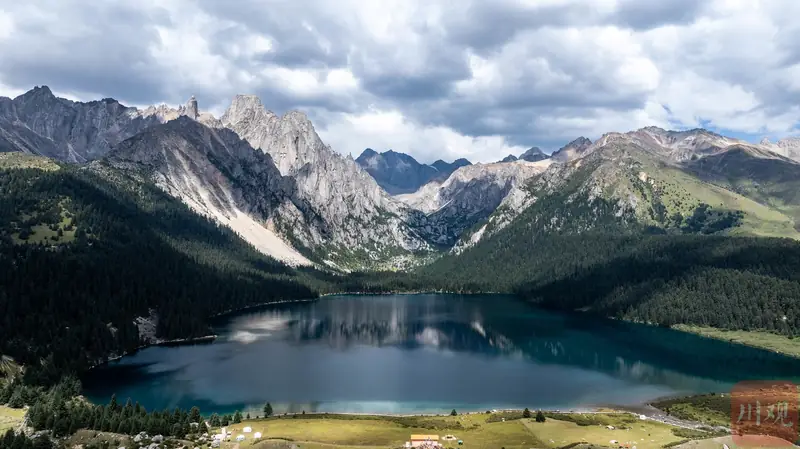
Cuopu Valley is best understood as a connected landscape, not a single lake stop. Cuopu Lake sits among forest and unusual bare-rock peaks; across the water, Zhajinjiabo Sacred Mountain and Nitegangri Peak give the lake its distinctive frame. The valley also brings together grassland, streams, waterfalls, wildlife habitat and a Tibetan Buddhist monastery.
The Chaluo geothermal field is the other reason to come. Springs appear on hillsides, in woodland and fields, beside the road and near the river. China National Geography describes the Zhangde grassland springs as commonly above 80°C, while the county account records intermittent vents whose jets can exceed 100°C. Look for steam, mineral deposits and changes in the ground rather than trying to touch the water; hot vents are a real burn hazard.
Near the lake, Cuopu Monastery is a Nyingma Tibetan Buddhist monastery in a forest setting. It is a place to slow down and observe the relationship between religious space and the surrounding landscape, not a staged wildlife encounter. Keep voices low, ask before photographing people or ritual activity, and do not feed or approach animals even when birds or other wildlife appear close to visitors.
Zhangde grassland opens the view beyond the forest, with snow mountains and wetland-like pools around the hot-spring country. Treat pasture and village life as lived spaces: remain on the route open to visitors, do not enter tents or private land, and ask before photographing residents or livestock.
Planning the visit
The Sichuan tourism authority’s published list names Cuopu Valley Scenic Area as a 4A attraction in Batang County; that list is dated 11 April 2022 and should not be read as a current operating notice. A current Trip.com listing displays opening hours of 08:30–15:30, with tickets available until 15:30, and shows admission packages that may include a round-trip sightseeing bus or a self-driving option. Prices, inclusions and availability can change by date, so confirm the live listing or the operator before setting out. The sources reviewed here do not establish whether a foreign passport can be used for every booking or check-in step.
A 2020 government-site report described a seasonal reopening and a 1,000-person daily holiday cap. That is historical context, not a quota for your visit; do not carry its date, cap or promotional fares forward to a later season.
Getting there and moving around
The documented approach is by road from National Highway 318 at the mouth of the valley in Chaluo Township, north of Batang and on the corridor between Batang and Litang. The practical final leg is a private car or a chartered vehicle from the G318 corridor; the sources do not establish a named public-bus stop or a railway connection at the scenic area.
Search or show the Chinese name 措普沟景区,巴塘县茶洛乡 Cuòpǔ Gōu Jǐngqū, Bātáng Xiàn Cháluò Xiāng in Amap or another mainland map. The exact staffed entrance, parking arrangement and point where any internal sightseeing bus departs are not consistently stated in the sources, so confirm those three details before leaving Batang or Litang. Keep enough daylight for the return road, and check weather and road conditions: rain, snow, water levels and seasonal operations can change what is open inside the valley.
Safety and etiquette
Do not enter a geothermal vent, stream outlet or fenced-off water area. A spring that looks calm can be scalding. High elevation, strong sun, cold wind and sudden weather changes are also part of the setting; plan conservatively, carry water and sun protection, and stop or descend if you feel unwell. Do not plan an un-managed trail to a lake, spring or peak simply because it appears on a photograph.
Find Cuopu Valley
措普沟 · 巴塘县
The pin marks the area, not the entrance.
Sources & visit information
Sources checked on 1 November 2026. Hours, tickets, reservations and transport can change; confirm with the operator before you go.
Image credits & notes (1)
- Cuopu Valley · 措普沟Photo: sichuan.scol.com.cnResized for the web; the photo itself has not been edited.