

Explore the region
Tap any red Chinese text to hear it in Mandarin.
Why Yading is different
Yading is a protected mountain landscape in Daocheng County at the southern edge of Garzê. UNESCO describes the reserve as part of the eastern Tibetan Plateau, with three sacred mountains inside it and a local tradition of revering nature. The setting is not just a line of snow peaks: glaciers, forests, high meadows and blue lakes make the valley feel layered as you move upward.
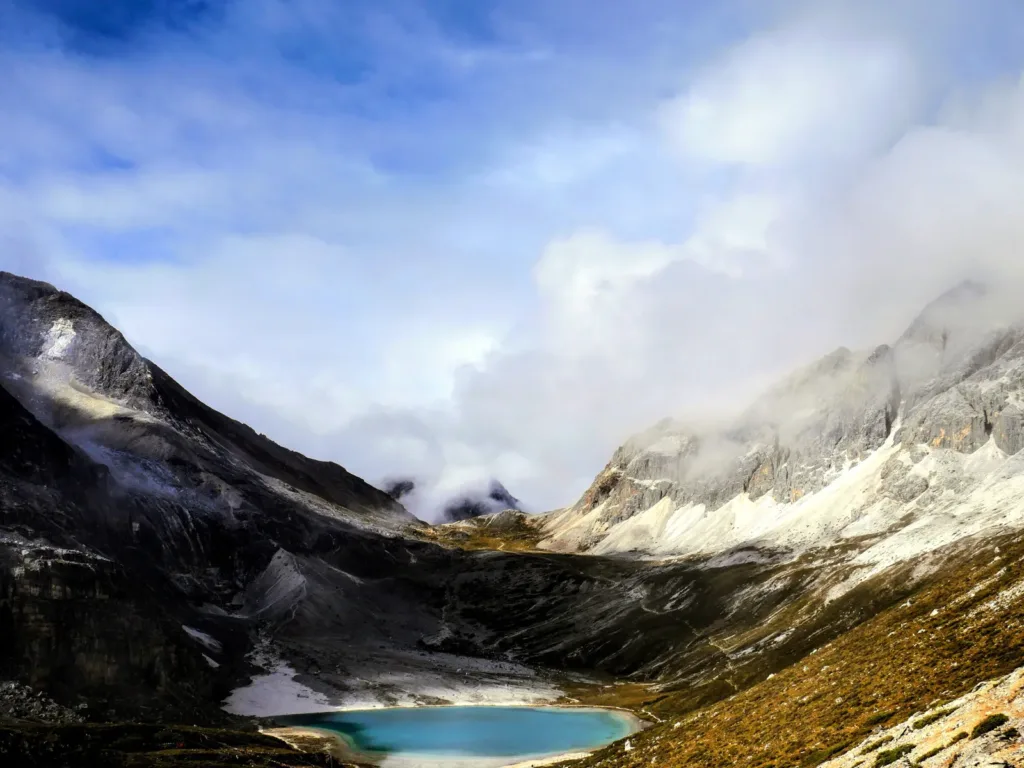
The three peaks—Xiannairi, Yangmaiyong and Xianuoduoji—are the visual anchors. Around them, the visitor area brings together Chonggu Temple, Chonggu Meadow, Luorong Pasture, Zhuoma La Lake (Pearl Lake), Gongga Tso, Milk Lake and Five-Colour Lake. A good visit alternates between looking outward at the mountains and looking closely at water, boardwalks, pasture and the traces of religious life.
Yading is not one compact viewpoint and it is not one compulsory loop. The local visitor-service account distinguishes short, middle and long lines. Choose the part that fits your body and the day’s opening notice, rather than treating the highest lake as a test that every visitor has to complete.
What to see
Short line: Chonggu Temple, Xinbaohu and Zhuoma La Lake. This is the gentler way to understand the valley’s lower visitor area. Look for the relationship between the temple, meadow and Xiannairi rather than rushing straight to a photo stop. At Zhuoma La Lake, reflections and changing light are more rewarding when you pause at the marked viewing areas. The government visitor information describes this line as the relaxed option, but its individual stops can still be affected by weather and management.
Middle line: the mountain outlook. The middle line is described as covering views toward Xianuoduoji and Yangmaiyong. It suits visitors who want more open mountain scenery without automatically committing to the upper lakes. Keep the line and the return connection separate in your plan: a scenic route is not proof that every shuttle or trail segment is running that day.
Long line: Luorong Pasture to the upper lakes. The Jin’gang challenge line continues toward Gongga Tso, Milk Lake and Five-Colour Lake. The local government describes it as about 10 km return from Luorong Pasture, with roughly 500–550 m of net ascent, a 6–8 hour outing and a highest point around 4,700 m. This is a serious high-altitude hike, not a short walk after a bus ride.
The operator’s 2026 notice says the Jin’gang line from Gongga Tso to the Milk Lake and Five-Colour Lake area is scheduled to operate from 15 April to 25 November 2026. A date on a calendar does not override a same-day closure, weather warning or cut-off. If the upper line is closed, enjoy the lower valley rather than entering an unmanaged route or trying to bypass a barrier.
Entrance, tickets and transport
Use the Yading Scenic Area Visitor Centre, Shangri-La Town, Daocheng County—稻城亚丁景区游客中心,四川省甘孜藏族自治州稻城县香格里拉镇—as the practical entrance and transfer point. The airport and Daocheng town are arrival points for the wider county, not substitutes for the scenic-area visitor centre. From the visitor-centre area, the road to the core area at Zhaguanbeng and Yading Village is a steep, winding mountain road of about 38 km and is the only external road into the core area. Current reporting says the area is not suitable for visitors to drive their own cars into the core; plan around the scenic shuttle instead.
For the 2026 peak-season window, the operator bulletin lists admission at CNY 146 per person from 16 April through 25 November 2026. It lists the admission ticket separately from the shuttle and sightseeing-vehicle operating schedules; do not assume that a ticket includes every internal ride. A county-government article published in August publicised a limited free-entry campaign that included buses, but it was a time-bound promotion rather than a standing fare. Check the current official checkout before paying.
The same bulletin gives these peak-season operating times: visitor-centre ticket sales 07:00–16:40; scenic shuttle from the visitor centre to Zhaguanbeng 07:10–17:00, with return services 08:30–19:00; Yading Village to Zhaguanbeng 07:30–16:30; sightseeing vehicles from Chonggu Temple to Luorong Pasture 08:00–16:30, with return services 08:30–18:00. A horse service from Luorong Pasture to Gongga Tso is listed as 08:00–14:00 until that day’s service ends. These are the bulletin’s 15 April–25 November times, not a promise for the low season, when the same notice gives a different timetable and says the horse service is suspended.
The government service report says the scenic area uses online real-name reservation, a daily maximum capacity of 15,000 visitors and a reservation channel that closes when full. The sources read for this article do not establish whether a foreign passport can complete the same reservation and ticketing process as a Chinese identity card. International visitors should ask the operator about passport entry before relying on a domestic-ID workflow.
For a road transfer, give a driver the Chinese destination 稻城亚丁景区游客中心 Dàochéng Yàdīng Jǐngqū Yóukè Zhōngxīn and confirm that you are going to the visitor centre in Shangri-La Town, not Daocheng Yading Airport or Daocheng town. After entering, note the last return shuttle for your segment before walking. The local shuttle is the return connection; do not assume that a late taxi can collect you inside the protected core.
Altitude and respectful travel
The core visitor area sits roughly between 3,700 and 4,700 m. The upper line’s length, ascent and thin air can turn a photo plan into an endurance day. Build in time to slow down, drink water, turn back early and return before the transport cut-off. Do not continue upward through a closure, leave the marked trail for a shortcut, or treat a medical problem as something to solve with determination alone.
The three mountains have cultural importance as well as visual power. Keep to marked paths around lakes and meadows, do not disturb wildlife or local religious places, and ask before photographing people. The reserve’s appeal depends on the fact that the landscape is protected and lived in, not staged for visitors.
Combine your visit
Suggested order for a focused visit to this part of Sichuan.
-
Chonggu Temple and meadow冲古寺与冲古草甸
Begin with the religious and valley setting.
-
Zhuoma La Lake, Pearl Lake卓玛拉措(珍珠海)
Choose the shorter open route rather than assuming the upper lakes are necessary.
Confirm the opening of individual stops and the return connection. This is an editorial sequence, not a combined ticket.
Find Yading
稻城亚丁 · 稻城县
The pin marks the area, not the entrance.
Sources & visit information
Sources checked on 1 November 2026. Hours, tickets, reservations and transport can change; confirm with the operator before you go.
Image credits & notes (1)
- Milk Lake in Yading National Nature Reserve, Daocheng County, Sichuan; photographed on 18 September 2025. Photo: Izeberg007Photo: CC0 1.0