

Explore the region
Why this place is different
Mugecuo is both a lake and the anchor of the larger Kangding Love Song Scenic Area. Kangding’s tourism plan treats it as a core scenic attraction within the city’s G318 “love-song” cultural landscape belt, while the visitor area combines a high lake, forested slopes, grassland and hot-spring features rather than presenting one viewpoint in isolation.
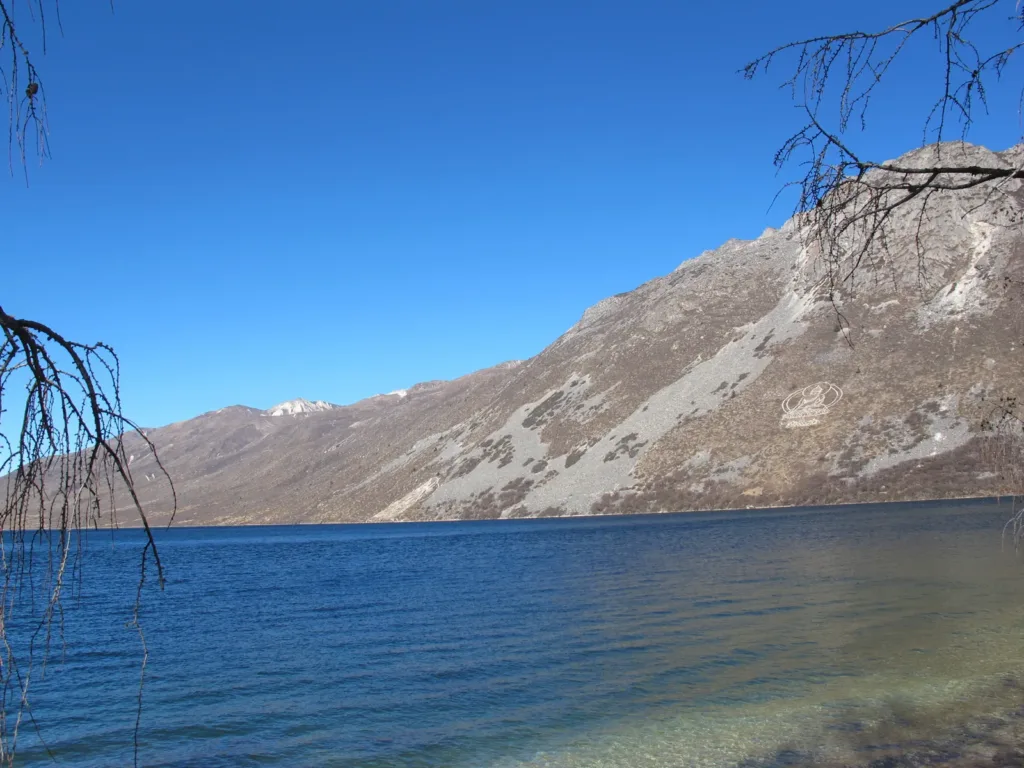
The lake, also called Yeren Hai (“Wild Man Lake”), sits at roughly 3,700 metres. Pines, firs and rhododendrons frame the water, with snow peaks visible around the upper part of the route. The point of the visit is to notice how the landscape changes as you move downhill: open water and mountain weather at the top, woodland and seasonal flowers in the middle, then steaming mineral springs and warmer-looking lakes below.
What to look for
Mugecuo Lake and the upper route
Start with the lake itself rather than rushing straight to photographs. Look across the water for the relationship between the shoreline forest, high ridges and changing cloud; at this elevation, light and weather can alter the view within minutes. The established route is designed around a scenic bus to the lake, followed by stops at the major attractions on the way down. A current international booking page lists a separate sightseeing-car product, while the published guide describes the bus as the normal way to connect the main stops. Confirm the exact ticket combination at the time of booking.
Rhododendron Valley and Fragrant Grassland
Rhododendron Valley is the wooded transition between the lake and the lower features. The usual flowering period is late April to July, but the timing shifts with snow and temperature, so treat those months as a guide rather than a guarantee. Fragrant Grassland is described as the lower end of the scenic route, where open meadow replaces the enclosed woodland.
Medicine Pool Boiling Springs
At Medicine Pool Boiling Springs (药池沸泉), the interest is geological as much as culinary: hot water rises from the rock, and one spring is reported to reach about 90°C. Eggs cooked in the hot spring are sold locally as “beancurd-jelly eggs” (豆花鸡蛋); the partly set white and firmer yolk are the texture visitors are meant to notice. This is a hot spring feature, not a bathing pool: stay on the marked path, do not touch the water or approach a vent, and do not treat the egg as a guarantee of any dietary or allergy status.
Seven-Colour Lake
Seven-Colour Lake is a crescent-shaped plateau lake of about 20 hectares. Its colour changes with weather and reflected light, while the guide reports water temperatures of up to about 67°C. Read it as a highland lake with hot-spring features, not as an invitation to enter the water.
Peak-season cultural performances have also been reported in the scenic area, including Kangding folk songs, Batang xianzi and guozhuang. These programmes are seasonal and operational rather than a daily feature of the landscape, so do not plan a visit around a performance without checking the current schedule.
Planning the visit
The scenic area is in Yala Township, Kangding City. The accessible booking listing gives the destination as Mugecuo, Yala Township, Kangding City, Garze Tibetan Autonomous Prefecture, Sichuan 626000, and lists dated admission, sightseeing-car and cruise products. The same page does not publish a complete current timetable or a complete foreign-passport entry procedure. Check the current ticket terms and ask specifically about passport exchange, reservation and inspection before travelling; a domestic-ID process should not be assumed to work for a foreign passport.
A January 2025 report describes a visitor centre, parking, toilets, rest areas and upgraded safety and information facilities. Use the scenic-area visitor centre as the practical arrival point and keep the Chinese name 康定情歌(木格措)景区 available for a driver. The exact gate or drop-off label is not separately published in the sources used here, so confirm the final drop-off point before leaving Kangding.
There is no verified regular city bus from Kangding downtown to the scenic area in the available transport guide. Arrange a round-trip taxi or hired car rather than assuming that a return vehicle will be waiting at the exit. Long-distance coaches to Kangding are described from Chengdu, but the current arrival-station name and departure timetable need checking in a live ticketing system; from Kangding, the last leg remains a separate road transfer.
The scenic area covers a high-altitude route rather than a compact lakeside park. Allow several hours for the bus-and-stop sequence, carry warm and rainproof layers, and slow down if you feel unwell. Avoid leaving the managed paths for unmarked mountain routes. Current ticket prices, opening hours, lake cruises, winter access and any weather-related closures should be confirmed shortly before departure; an older guide’s seasonal prices and 08:00–17:00 hours are not used here as current figures.
Find Mugecuo Lake
木格措 · 康定市
The pin marks the area, not the entrance.
Sources & visit information
Sources checked on 1 November 2026. Hours, tickets, reservations and transport can change; confirm with the operator before you go.
Image credits & notes (1)
- Mugecuo Lake, Kangding, photographed on 24 November 2012. Photo: Nyx NingPhoto: CC BY-SA 3.0