

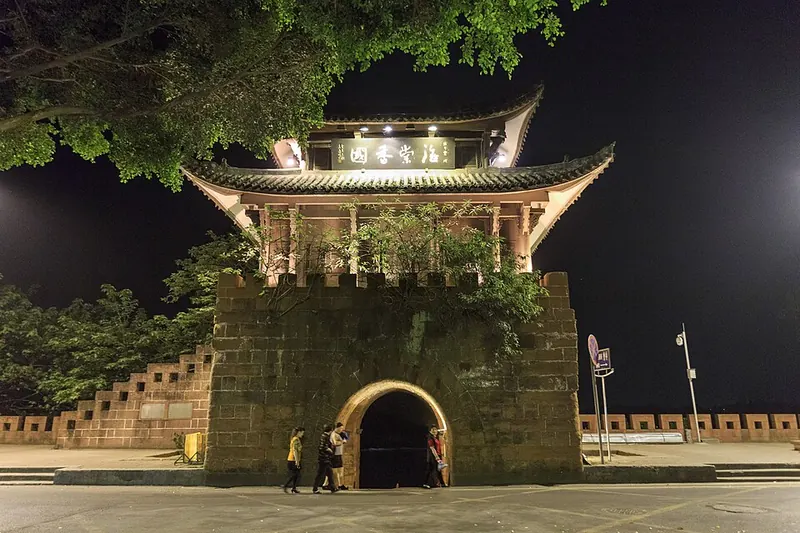
Photo adjustments
Full frame retained; proportionally resized and converted to WebP. No retouching or changes to the photographed subject. Card displays may crop the view.
Explore the region
About Leshan
Its older name, Jiazhou, survives in the streets and local food culture of the urban centre. A visit works best as more than a hurried photograph of the statue: give the cliff-side monument its own session, then cross back for riverside walking and Leshan snacks. Mount Emei is a separate mountain excursion requiring another transfer and a realistic allowance for ascent.
Leshan's urban center was already the seat of Kaiming, King of Shu, more than 2,000 years ago. The Han dynasty established Nan'an County there, and the Northern Zhou dynasty later created Emei County and Pingqiang County. Under the Sui dynasty, Emei County was renamed Qingyi County in 589 and then Longyou County in 590, before a separate Emei County was set up again in 593. Longyou County was the seat of Jiazhou (嘉州) in the Tang dynasty, was reorganized as Jiading Prefecture (嘉定府) in the Song dynasty, and became Jiading Direct-administered Prefecture in the Ming dynasty. Jiading Prefecture was restored in 1734, when Leshan County (乐山县) was also established.
Leshan sits in central Sichuan province in the hilly southwest of the Sichuan Basin. The city's north lies within the Chengdu Plain, its east is hill country, and its southwest is mountainous, with alluvial flatland along the riverbanks. Leshan borders Meishan to the north, Zigong and Yibin to the east, the Liangshan area to the south, and Ya'an to the west. It is designated a National Historic and Cultural City (国家历史文化名城) and a China Outstanding Tourism City (中国优秀旅游城市).
What to look for
- The Giant Buddha and Lingyun hillside give the river junction its defining landmark.
- The old urban centre offers a contrasting evening of riverside streets and local snacks.
Location & getting there
Getting to Leshan
Arrive at Leshan railway station, then take local transport to the city centre or the separately signed Giant Buddha visitor area. Emeishan station serves the mountain side of a combined trip; the two stations are not interchangeable.
Combine your visit
Suggested order for a focused visit to this part of Leshan.
-
Leshan Giant Buddha乐山大佛
Make the carved monument the main visit.
-
Old Jiazhou riverside嘉州老城江岸
Return across the river for the urban waterfront.
-
Suji苏稽
Use a separate local transfer for its beef-soup and rice-candy food traditions.
Confirm the opening of individual stops and the return connection. This is an editorial sequence, not a combined ticket.
Find Leshan overview
乐山 · 市中区
The pin marks the area, not the entrance.
More places nearby
Approximate straight-line distances between map pins, not travel distances.
Tieniu Gate 铁牛门
Less than 1 km awayTieniu Gate, also known as Lizheng Gate, is one of the surviving entrances associated with Leshan’s old city. Its riverside position makes it a useful place to understand how the town met the waterfront. The present monument…
View guide →Lingyun Temple 凌云寺
Less than 1 km awayLingyun Temple stands on Lingyun Mountain beside the Leshan Giant Buddha and is also known as the Great Buddha Temple. Its named spaces include the Heavenly Kings Hall, Mahavira Hall and Sutra Library. The temple adds an active…
View guide →Haitang Park 海棠公园
Less than 1 km awayHaitang Park is a small everyday green space in Leshan’s old urban area, useful for a pause between food streets and riverfront sightseeing. Its attraction is local rhythm: people taking exercise, sitting in the shade and…
View guide →Sources & visit information
The sources below support the place-specific description and arrival information. Suggested combinations are editorial planning ideas; confirm current opening, entry arrangements and transport services for your date.
Visitor information adapted and edited from Wikivoyage contributors: Leshan visitor orientation · CC BY-SA 4.0.
Visitor information adapted and edited from Wikipedia contributors, “Leshan” · CC BY-SA 4.0. Source revision 1366159581.
Background paragraphs translated and condensed from Wikipedia contributors, "乐山市", Chinese Wikipedia · CC BY-SA 4.0. Source revision 94240840.