

Explore the region
About Drum Tower of Tianjin
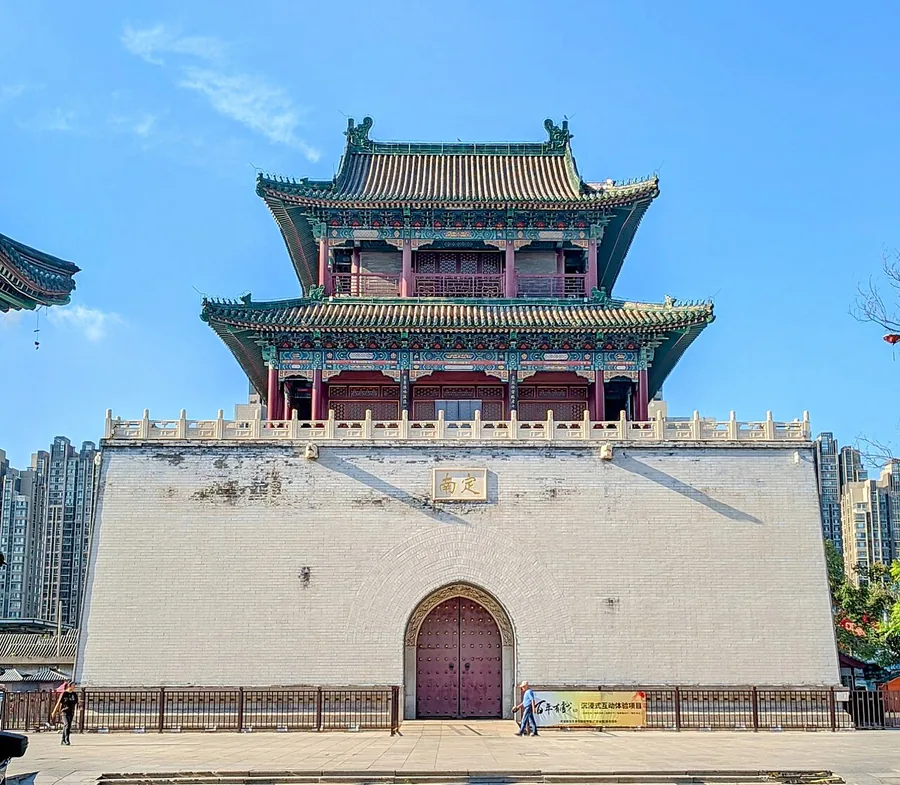
The visible tower is a reconstruction completed in 2001, and it houses a bell despite its name. Changing exhibitions can add an indoor stop, but the tower's main value is as a point from which to understand the old street pattern. Nearby guild halls and courtyard museums provide more detailed encounters with the merchant city than the reconstructed tower alone.
In the second year of the Yongle era (1404) Tianjin was established as a military garrison, and during the Hongzhi era (1493) the Shandong military official Liu Fu (刘福) built a drum tower at the center of the old walled city. The original structure was a three-story brick-and-timber tower on a square brick platform, with arched gateways aligned with the old city's four gates; it held a large iron bell cast in the Tang-Song style, rung 108 times each morning and evening, and was counted among the 'Three Treasures of Tianjin' (天津三宝). The Republican government rebuilt it in 1921, and it was demolished on 7 November 1952.
Following renovation of the old town beginning in 1994, reconstruction started on 25 November 2000 and was completed on 28 September 2001. The new tower stands 27 meters high on a Mount Sumeru-style pedestal (须弥基座), combining a reinforced-concrete brick base with a timber upper structure in Ming-Qing joinery style. Its four arched gateways carry restored marble inscriptions reading 'Zhendong, Anxi, Dingnan, Gongbei' (镇东、安西、定南、拱北). The reconstruction is designated a national 2A tourist attraction (国家2A级景区), and its surroundings now form a commercial district called Drum Tower Commercial Street (鼓楼商业街).
What to look for
- The reconstructed tower and the bell associated with its present interior.
- The east–west Gulou street alignment around the former city center.
- The neighboring Guangdong Guild Hall, home of the Opera Museum.
Location & getting there
Getting to Drum Tower of Tianjin
Approach on Gulou East Street in Nankai, north of Gulou Metro station on Line 2.
- Use the tower as the meeting point, then choose the east or west street for the rest of the visit.
Combine your visit
Suggested order within this visit:
-
Drum Tower
Start with the old city's central orientation point.
-
Guangdong Guild Hall广东会馆
Add surviving merchant architecture and the historic theater.
-
Gulou Street
Continue through the surrounding commercial street.
This sequence is an editorial suggestion based on the features described in the sources. Access to individual buildings or areas should be checked locally; no travel time or shared admission is implied.
Find Drum Tower of Tianjin
天津鼓楼 · 南开区
The pin marks the area, not the entrance.
More places nearby
Approximate straight-line distances between map pins, not travel distances.
Guangdong Guild Hall (Tianjin) 广东会馆
Less than 1 km awayThe Guangdong Guild Hall began as a meeting place for merchants from Guangdong and now houses Tianjin's Opera Museum. The late-Qing building links trade, regional identity and performance through its historic theater. It also…
View guide →Tianjin Confucian Temple 天津文庙
Less than 1 km awayTianjin Confucian Temple preserves the unusual arrangement of prefectural and county Confucian temples standing side by side. The complex belonged to the city's system of official education and ritual, rather than functioning as…
View guide →Joy City Shopping Mall (South Gate Street) 南开大悦城
Less than 1 km awayNankai Joy City is the South Gate Street shopping complex, distinct from Tianjin's other malls using the Joy City name. Its best-known feature is a themed indoor shopping street: the former Qi'e Commune was relaunched as Qi'e…
View guide →Sources & visit information
The sources below support the place-specific description and arrival information. Suggested combinations are editorial planning ideas; confirm current opening, entry arrangements and transport services for your date.
Visitor information adapted and edited from Wikivoyage contributors · CC BY-SA 4.0. Source revision 5266584.
Background paragraphs translated and condensed from Wikipedia contributors, "天津鼓楼", Chinese Wikipedia · CC BY-SA 4.0. Source revision 85071478.
Image credits & notes (1)
- The south-facing side of Tianjin Drum Tower.Photo: KangTyngrwey · CC BY 4.0Resized for the web; the photo itself has not been edited.
