

Photo adjustments
Resized and WebP compressed; subject not altered.
Explore the region
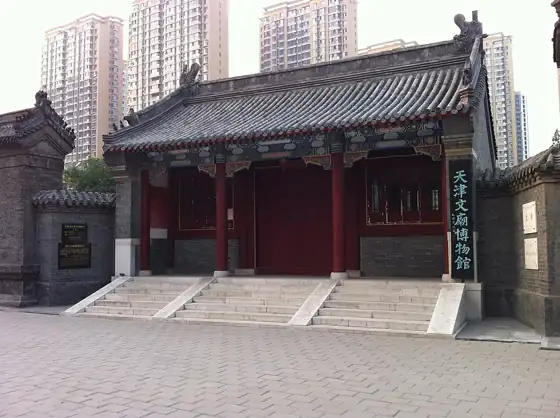
About Tianjin Confucian Temple
The complex belonged to the city's system of official education and ritual, rather than functioning as a Buddhist monastery. Its pools, ceremonial gateways and main halls form a sequence of increasingly formal spaces. Follow that progression on foot, paying attention to how parallel compounds express different levels of local government. The museum interpretation adds the life of Confucius and the role of learning to the surviving architectural setting.
The temple was first built in 1436, when Zhu Sheng (朱胜), commander of the Tianjin garrison, donated his residence to serve as a school with accompanying halls and offices. Its Hall of Great Achievement (大成殿) was completed in 1447, when the school was known as the Garrison School (卫学). After Tianjin's status changed from a garrison to a department in 1725 and to a prefecture in 1731, the school became the Prefectural School (府学), and in 1734 a County School (县学) was added beside it. The temple was listed as a municipal cultural relic protection unit in 1954.
The temple's buildings are arranged along a south-to-north axis of increasingly formal spaces, from an outer spirit wall and a ceremonial pool through a series of gates to the Hall of Great Achievement (大成殿), the temple's principal hall, with the Chongsheng Shrine (崇圣祠) and flanking side halls behind it.
The temple is designated a special-protection-level historic building (特殊保护等级历史风貌建筑). The site now houses the Tianjin Confucian Temple Museum, which includes a restored display of the Hall of Great Achievement's interior and occasionally presents ceremonial music performances for sacrifices to Confucius (祭孔古乐).
What to look for
- The parallel prefectural and county temple compounds.
- The Pan pools and ceremonial archways on the approach.
- The main Confucian halls and their ordered courtyards.
Location & getting there
Getting to Tianjin Confucian Temple
Use 2 Dongmennei Street in Nankai for Tianjin Confucian Temple Museum.
- Dongnanjiao station on Metro Line 2 is south of the temple; Ancient Culture Street lies to the east.
Combine your visit
Suggested order within this visit:
-
Pools and ceremonial gateways
Begin with the approach associated with learning and ritual.
-
Main temple halls
See the formal core of the Confucian complex.
-
Parallel courtyard compound
Compare the side-by-side prefectural and county layout.
This sequence is an editorial suggestion based on the features described in the sources. Access to individual buildings or areas should be checked locally; no travel time or shared admission is implied.
Find Tianjin Confucian Temple
天津文庙 · 南开区
The pin marks the area, not the entrance.
More places nearby
Approximate straight-line distances between map pins, not travel distances.
Tianhou Temple (Tianjin) 天津天后宫
Less than 1 km awayTianhou Temple is the Mazu shrine at the heart of Ancient Culture Street. Its origins in the Yuan period reflect Tianjin's long relationship with sailors, navigation and river trade. Unlike the surrounding modern shopping…
View guide →Joy City Shopping Mall (South Gate Street) 南开大悦城
Less than 1 km awayNankai Joy City is the South Gate Street shopping complex, distinct from Tianjin's other malls using the Joy City name. Its best-known feature is a themed indoor shopping street: the former Qi'e Commune was relaunched as Qi'e…
View guide →Guangdong Guild Hall (Tianjin) 广东会馆
Less than 1 km awayThe Guangdong Guild Hall began as a meeting place for merchants from Guangdong and now houses Tianjin's Opera Museum. The late-Qing building links trade, regional identity and performance through its historic theater. It also…
View guide →Sources & visit information
The sources below support the place-specific description and arrival information. Suggested combinations are editorial planning ideas; confirm current opening, entry arrangements and transport services for your date.
- Wikivoyage: Tianjin/Central Districts ↗
- Tianjin Culture and Tourism Bureau: Confucian Temple architecture ↗
- Chinese Wikipedia: 天津文庙 (revision 93132738, 2026-06-19) ↗
Visitor information adapted and edited from Wikivoyage contributors · CC BY-SA 4.0. Source revision 5266584.
Background paragraphs translated and condensed from Wikipedia contributors, "天津文庙", Chinese Wikipedia · CC BY-SA 4.0. Source revision 93132738.