

Entry & permits for Tibet (Xizang)
Foreign tourists need Tibet entry approval, commonly called a Tibet Travel Permit, and an organised visit arranged through a specialist travel agency in China. Confirm your approved route before booking transport. Requirements differ for Taiwan residents and for travellers using mainland or Hong Kong/Macao Chinese resident documents; check the document guide before you book.
Check the travel-document requirements →Policy scope verified: 2026-09-06. UK FCDO: China regional travel advice ↗ State Council Taiwan Affairs Office: Tibet entry approval ↗ Xizang Department of Culture and Tourism: Medog border permit notice ↗
Explore the region
Tap any red Chinese text to hear it in Mandarin.
What Barkhor is
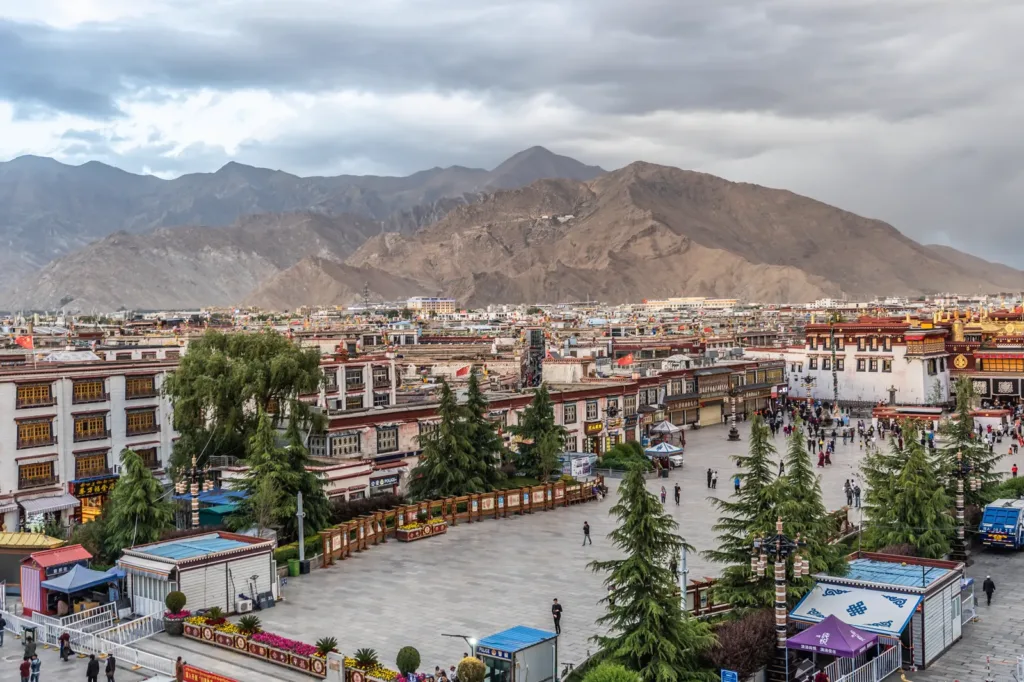
“Barkhor” means the middle circuit in Tibetan. The route formed around the Jokhang as worshippers walked clockwise around the temple, and the surrounding area developed into a mixed cultural, commercial and residential quarter. Today, follow the temple-facing streets and look beyond the shop fronts for old façades, courtyard entrances and the steady movement of people making the circuit.
At the circuit’s entrance, the Tang–Tubo Alliance Stele records the 821 agreement between Tang and Tubo and stands as a visible historical marker beside the old town. A short walk farther brings you to the former Qing Resident Commissioners’ Office exhibition site. The wider Barkhor old city also retains historic courtyard compounds and remains a lived neighborhood, so residents’ routines are part of what you are observing.
How to walk respectfully
Start at Barkhor Square on the Jokhang-facing side and follow the pilgrimage flow clockwise. Keep clear of people making prostrations and do not block the route for photographs. Ask before taking close-up pictures of worshippers; religious buildings and devotional activity are not staged performances.
Treat the street walk and a visit inside the Jokhang as two different activities. Barkhor is the historic street circuit; Jokhang interior access has its own current reservation and ticket arrangements. A September 2026 notice from Lhasa’s tourism authority advised visitors to search for the Jokhang reservation mini-program in advance. That advice does not replace Tibet entry approval, and a Jokhang ticket does not legalise entry into Tibet.
Entry requirements and practical access
For foreign tourists, entry to Tibet must be arranged through a specialist travel agent in China with the required Tibet permit, and travel must be on an organised tour. Confirm that Barkhor and any Jokhang visit are on the approved itinerary before booking or boarding transport. Do not assume that an urban public street can be visited independently outside those requirements.
Barkhor is in Lhasa’s old Chengguan district and is best completed on foot once you reach a lawful drop-off point. There is no metro access to this old-town loop. Give a taxi or ride-hailing driver the Chinese destination 八廓街 Bākuò Jiē or 大昭寺广场 Dàzhāo Sì Guǎngchǎng; traffic controls and security arrangements can change where vehicles may stop. From Lhasa Railway Station or Liuwu Coach Station, continue by taxi or ride-hail rather than treating either transport hub as a walkable entrance. Current bus numbers and exact fares are not stated here because they require a date-specific check.
The city’s air gateway is Lhasa Gonggar International Airport, which is outside Lhasa in Gonggar County, Shannan. The latest official airport guide read for this entry lists the airport bus from Terminal 3 Gate 5 to Lhasa’s 民航售票厅, about 70 minutes and RMB 30; from the city endpoint, continue by taxi or ride-hail to Barkhor. Airport-bus timings and stops can change, so confirm the same day.
Lhasa is about 3,650 metres above sea level. The city tourism authority recommends taking the first day slowly; its own example for the first 24 hours is resting with sweet tea in Barkhor rather than rushing into strenuous activity. Seek medical help if symptoms are severe.
Combine your visit
Suggested order for this visit:
-
Barkhor Square and western temple frontage
Orient the walk around the Jokhang's position.
-
Northern and eastern Barkhor streets
Follow the clockwise circuit through its old-town trading sections.
-
Southern and western return
Complete the temple circuit without cutting against the pilgrimage flow.
This is an editorial sequence based on the features described in the sources. Confirm access locally; no walking time, shared admission or guaranteed interior access is implied.
Find Barkhor
八廓街 · 拉萨
The pin marks the area, not the entrance.
More places nearby
Approximate straight-line distances between map pins, not travel distances.
Jokhang Temple 大昭寺
Less than 1 km awayJokhang Temple faces west onto Barkhor Square in Lhasa’s old town. Founded in the seventh century and enlarged over many generations, the temple is especially associated with the Jowo Shakyamuni image, traditionally linked with…
View guide →Former Qing Resident Commissioners’ Office 清政府驻藏大臣衙门旧址
Less than 1 km awayThis restored three-storey Tibetan courtyard northeast of the Jokhang housed an early Qing resident commissioner's office. Its local name, Chongsai Kang, refers to seeing the market: the south-facing windows overlook the Barkhor…
View guide →Ramoche Temple 小昭寺
Less than 1 km awayRamoche stands north of the Barkhor and is traditionally paired with the Jokhang as one of Lhasa's two great early temples. Its central object of devotion is a gilded image representing Shakyamuni at eight years old, giving this…
View guide →Sources & visit information
Sources checked on 23 October 2026. Hours, tickets, reservations and transport can change; confirm with the operator before you go.
Image credits & notes (1)
- A broad view over Barkhor Square and the old-town streets around the Jokhang in Lhasa, with the mountains behind. Photo: Stan AdamPhoto: Public domain