

Entry & permits for Tibet (Xizang)
Foreign tourists need Tibet entry approval, commonly called a Tibet Travel Permit, and an organised visit arranged through a specialist travel agency in China. Confirm your approved route before booking transport. Requirements differ for Taiwan residents and for travellers using mainland or Hong Kong/Macao Chinese resident documents; check the document guide before you book.
Check the travel-document requirements →Policy scope verified: 2026-09-06. UK FCDO: China regional travel advice ↗ State Council Taiwan Affairs Office: Tibet entry approval ↗ Xizang Department of Culture and Tourism: Medog border permit notice ↗
Explore the region
Tap any red Chinese text to hear it in Mandarin.
Why visit
The museum’s permanent exhibition, Song of the Snowlands — Tibet History and Culture Exhibition (雪域长歌—西藏历史与文化展), occupies the second floor. The museum lists five sections, from prehistory through the Tang–Song, Yuan–Ming and Qing–Republican periods, followed by a modern section. It lists more than 2,000 objects and gives the exhibition run as 8 July 2022 to 8 July 2032; check the museum’s notice board for any gallery changes on the day.
Start with the Karuo dwelling reconstruction and the double-bodied pottery vessel. The exhibition’s object list also includes stone tools, material from the Qugong site, black pottery, textiles, official seals and patents, Buddhist images, thangka, Tibetan books, and traditional Tibetan opera instruments and masks. These are more useful anchors than trying to absorb every label: notice how domestic life, trade, government records, religion and performance are represented through things that can be examined at close range.
The museum’s official overview also identifies a permanent folk-culture exhibition, People Closest to the Sun (离太阳最近的人), alongside the history-and-culture exhibition. It describes holdings that include prehistoric remains, Buddhist images, government seals and edicts, gold- and silver-written Tibetan books, thangka, and craft, clothing and household objects. Treat religious art as cultural heritage rather than a photo prop, and follow each gallery’s photography and no-touch signs.
Practical visit
The museum’s current official service page gives this seasonal schedule: 1 May–31 October, 09:30–18:30, with last entry at 17:30; 1 November–30 April, 10:00–17:30, with last entry at 16:30. It is normally closed on Mondays, with special notices taking priority. Lhasa’s government visitor guide confirms that admission is free and says visitors can reserve through the official Tibet Museum WeChat account or register on site with an identity document. The online reservation page is the right place to check a date-specific arrangement; the public pages I could read do not clearly state how a foreign passport is handled, so confirm this with the museum or your Tibet travel organiser rather than assuming a mainland-ID instruction applies to every visitor.
The address needs a final check before departure. The museum’s public-service page currently lists 西藏自治区拉萨市城关区罗布林卡路34号; the same official site footer lists 民族南路2号, while a September 2026 Lhasa government cultural-tourism guide lists 罗布林卡路19号. The museum is by Norbulingka, but these address lines are not interchangeable for a taxi or map pin. Use the Chinese name 西藏博物馆 Xīzàng Bówùguǎn, check the official booking page, and call 0891-6835244 / 0891-6812210 if the booking confirmation does not settle the entrance address.
For buses, the museum’s own route page lists 西藏博物馆站 Xīzàng Bówùguǎn Zhàn on routes 2, 8, 13 and 24; 罗布林卡南站 Luóbùlínkǎ Nán Zhàn on routes 2, 14 and K02; and 纪念碑站 Jìniànbēi Zhàn on routes 1, 9, 10, 15, 18, 19 and 38. It gives no metro connection, timetable or fare, so do not infer a precise transfer or journey time from this list. A taxi or ride-hailing car using the Chinese destination is the simplest last-mile option; keep the confirmed Chinese address for the return trip.
Tibet entry permission is separate
A free museum ticket or reservation is not permission to enter the Tibet Autonomous Region. The UK Foreign, Commonwealth & Development Office currently states that foreign tourists must obtain a permit through a specialist travel agent in China and travel on an organised tour. Do not assume that a museum booking makes independent travel legal, and do not attempt to bypass checks. Arrange the approved Tibet itinerary and entry documents first, then confirm that the museum visit fits the route and the current booking rules.
Combine your visit
Suggested order for this visit:
-
Prehistoric archaeology section
Begin with the Karuo material and reconstructed domestic setting.
-
Historical galleries
Continue through the object-based chronology on the second floor.
-
Folk-culture displays
Finish with food, clothing and storytelling traditions.
This is an editorial sequence based on the features described in the sources. Confirm access locally; no walking time, shared admission or guaranteed interior access is implied.
Find Tibet Museum
西藏博物馆 · 拉萨
The pin marks the area, not the entrance.
More places nearby
Approximate straight-line distances between map pins, not travel distances.
Norbulingka 罗布林卡
Less than 1 km awayNorbulingka combines summer palaces with gardens on Lhasa’s western side. The Kelsang Palace began the complex in the eighteenth century, while later Dalai Lamas added residences and pavilions. The Lake Palace introduces a…
View guide →Potala Palace 布达拉宫
2 km awayThe Potala rises from Marpo Ri, Lhasa’s Red Hill, as a stepped mass of white walls surrounding the crimson Red Palace. Its former residential and ceremonial spaces trace the history of the Dalai Lamas, while chapels and gilded…
View guide →Ramoche Temple 小昭寺
3 km awayRamoche stands north of the Barkhor and is traditionally paired with the Jokhang as one of Lhasa's two great early temples. Its central object of devotion is a gilded image representing Shakyamuni at eight years old, giving this…
View guide →Sources & visit information
Sources checked on 23 October 2026. Hours, tickets, reservations and transport can change; confirm with the operator before you go.
- Tibet Museum official website ↗
- Tibet Museum official public service: opening hours and routes ↗
- Tibet Museum: Song of the Snowlands permanent exhibition ↗
- Tibet Museum official overview and history ↗
- Lhasa Government: museum reservation guide ↗
- FCDO China travel advice: regional risks in Tibet and the TAR ↗
- 逛馆+手作!解锁拉萨小众文化玩法 ↗
Image credits & notes (1)
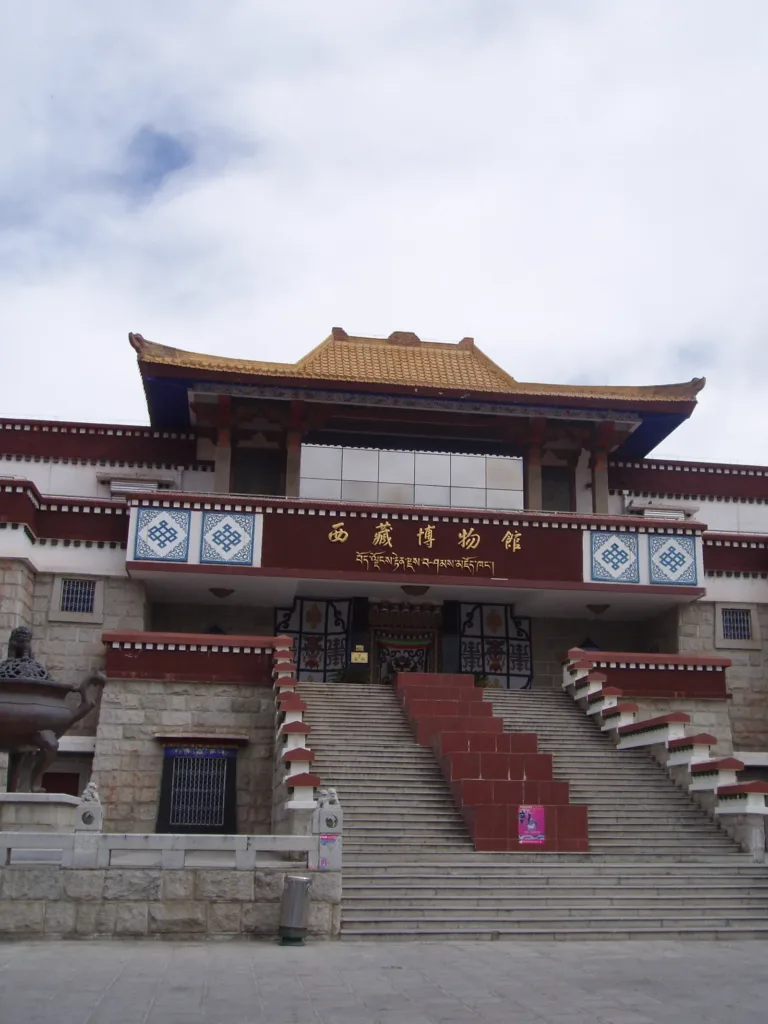
- Front entrance of Tibet Museum (西藏博物馆) in Lhasa, photographed in February 2007. Photo: Fanghong (Wikimedia Commons username: Fanghong)Photo: CC BY-SA 3.0