

Entry & permits for Tibet (Xizang)
Foreign tourists need Tibet entry approval, commonly called a Tibet Travel Permit, and an organised visit arranged through a specialist travel agency in China. Confirm your approved route before booking transport. Requirements differ for Taiwan residents and for travellers using mainland or Hong Kong/Macao Chinese resident documents; check the document guide before you book.
Check the travel-document requirements →Policy scope verified: 2026-09-06. UK FCDO: China regional travel advice ↗ State Council Taiwan Affairs Office: Tibet entry approval ↗ Xizang Department of Culture and Tourism: Medog border permit notice ↗
Explore the region
Tap any red Chinese text to hear it in Mandarin.
Why visit
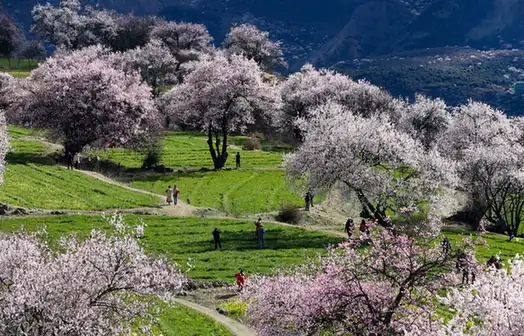
Suosong is a lived-in village in Pailong Town, Milin City, on the north bank of the Yarlung Tsangpo Grand Canyon. It is not a museum or a single monument: the experience is the relationship between the settlement, the river far below, the peach groves and fields, and the snow-covered Namcha Barwa massif beyond the gorge. The regional tourism authority identifies the village as a north-bank location, while Xinhua describes it as a mountainside settlement with peach groves and a view toward the peak.
The village viewpoint is the reason to stay rather than rush through. Look first at the full layers of the view: the river cutting through the canyon, the steep slopes, and Namcha Barwa when cloud allows. In spring, peach blossom, green barley fields and snow give the scene its most recognisable contrast. The Milin tourism office’s 2024 route guide labels April as the peach-blossom peak; an older municipal page describes the season as March, so flowering shifts with the year. Check the current bloom report before planning around one date.
Winter offers a different reading of the same landscape. The Tibet regional tourism department describes snow on the high peaks, forest through the middle slopes and a clearer, fast-moving river below. Autumn is better approached as a landscape-and-light visit than as a guaranteed event. Namcha Barwa is frequently cloud-covered, so allow time for changing weather rather than treating a clear summit as a promise.
Suosong is also a place to sleep in a working village. Official reporting describes a network of family guesthouses and homestays that grew as roads and a bridge made regular visitor access possible. Book a room whose Chinese address explicitly says 索松村 Suǒsōng Cūn, and confirm whether meals, heating and a view are included. A guesthouse courtyard, a family home, a field and a livestock area are not public exhibits: ask before entering or photographing people, homes or animals, and stay on the road or the host’s designated viewing area.
Village, scenic area and paid activities
Keep three things separate when planning: Suosong Village, the larger Yarlung Tsangpo Grand Canyon scenic area, and any separately sold activity such as a shuttle, cruise or accommodation package. Linzhi’s tourism guide places the managed scenic area in Pailong and describes entry through its visitor ticket hall and a shuttle circuit; it also gives different arrangements for guests staying at scenic-area hotels. Those terms and prices are time-sensitive. Confirm at the operator or with your host whether your plan is a village stay, a scenic-area visit, or both. A village walk does not by itself establish access to every managed viewpoint or paid activity.
For a respectful visit, spend time at the village-facing viewpoint, then walk only on roads and paths that hosts or local signs indicate. Do not descend toward the river, cross farm plots for a photograph, or follow an unmarked trail along the cliff. The point is to observe how the settlement sits in the canyon, not to turn residents’ homes into a stage.
Getting there
There is no applicable metro service, and the sources read for this entry do not establish a fixed public shuttle or a single standard visitor entrance inside Suosong. For the public-transport approach, a Linzhi tourism guide lists coaches from 林芝客运中心 (Linzhi Passenger Transport Center) to 派镇 (Pailong), the town serving the Grand Canyon, at about 81 km and roughly two hours; the page says vehicles depart when full. It listed RMB 62 when published in 2024, but that fare and the day’s departure practice should be confirmed before travel. From Pailong, arrange the final road leg with your accommodation or a licensed driver and confirm the return plan before leaving.
The same city tourism office describes the road from 米林机场 (Milin Airport) to the Grand Canyon area as about two hours. That is a scenic-area estimate, not a guaranteed door-to-door time for a particular homestay in Suosong. For a taxi or ride-hail, show the driver 米林市派镇索松村 Mǐlín Shì Pài Zhèn Suǒsōng Cūn together with your lodging’s full Chinese name and address; do not rely on “Grand Canyon” alone. The sources do not provide a reliable fixed fare, drop-off point or village-wide street address.
International visitors should settle the Tibet travel rules before booking this remote stay. The UK Foreign, Commonwealth & Development Office advises that travel to Tibet and the Tibet Autonomous Region requires a permit arranged through a specialist travel agent in China and an organised tour, and that authorities may stop issuing permits or restrict travel without notice. Ask the operator to confirm that the approved itinerary explicitly includes Linzhi/Milin and Suosong Village; a general China visa or a domestic resident document is not a substitute for that route approval.
Find Suosong Village
索松村 · 米林市
The pin marks the area, not the entrance.
Sources & visit information
Sources checked on 1 November 2026. Hours, tickets, reservations and transport can change; confirm with the operator before you go.
Image credits & notes (1)
- Suosong Village · 索松村Photo: pic.people.com.cnResized for the web; the photo itself has not been edited.