

Entry & permits for Tibet (Xizang)
Foreign tourists need Tibet entry approval, commonly called a Tibet Travel Permit, and an organised visit arranged through a specialist travel agency in China. Confirm your approved route before booking transport. Requirements differ for Taiwan residents and for travellers using mainland or Hong Kong/Macao Chinese resident documents; check the document guide before you book.
Check the travel-document requirements →Policy scope verified: 2026-09-06. UK FCDO: China regional travel advice ↗ State Council Taiwan Affairs Office: Tibet entry approval ↗ Xizang Department of Culture and Tourism: Medog border permit notice ↗
Explore the region
Tap any red Chinese text to hear it in Mandarin.
In brief
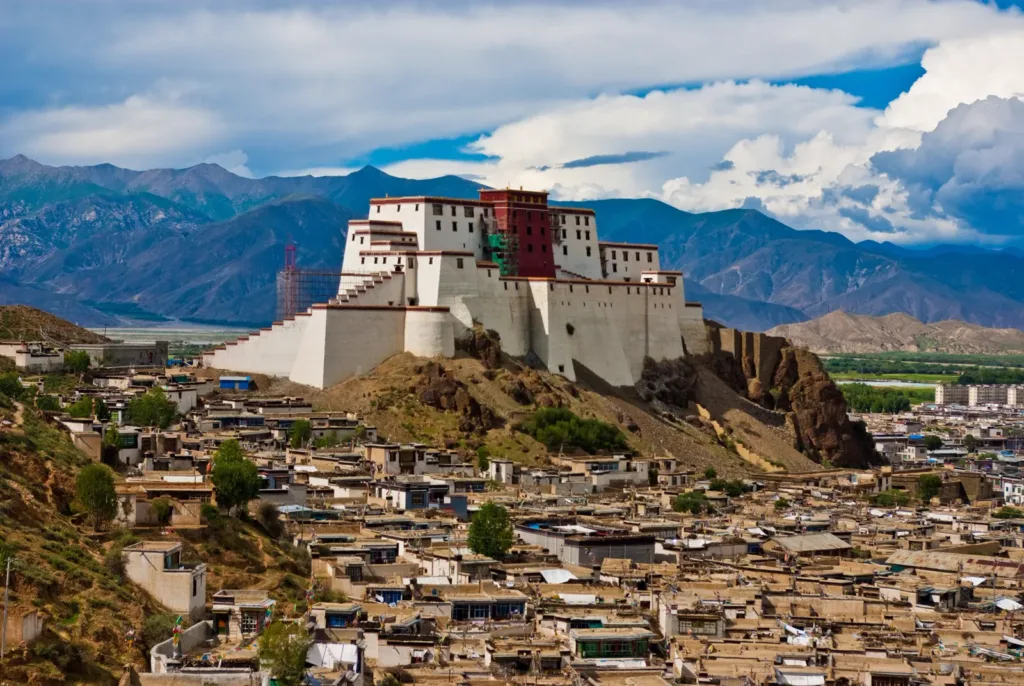
Shigatse Dzong—also called Samzhubze Dzong, 日喀则宗堡 or 桑珠孜宗堡—is a red-and-white fortress on the upper slopes of Dzong Mountain in Samzhubze District. It is worth visiting for the way a rebuilt hilltop landmark sits beside a deliberately preserved strip of ruin, giving you both a city view and a visible lesson in how a historic Tibetan administrative and religious complex was reconstructed.
What to look for
The original dzong was not only a castle. It combined the functions of a local government, monastery, judicial office, prison and storehouse. The People’s Daily account dates its completion to 1363 and describes a four-storey complex of more than 300 rooms; tradition also connects its mountain-palace form with the later rebuilding of Lhasa’s Potala Palace. Much of the original structure was lost through weathering and destruction during the Cultural Revolution, leaving broken walls on the platform.
The building you see today is a reconstruction rather than an untouched medieval interior. Work began in 2004 with Shanghai’s Tibet-assistance programme, and the first phase was completed in May 2007. The design follows the old site and photographs while distinguishing red and white volumes and retaining more than 30 metres of unrestored ruin on the eastern side. The contrast between new surfaces, old stone texture and the steep mountain setting is the most useful thing to notice.
Begin from a point where you can see the whole profile. Pick out the red central mass, the white side sections and the darker east-side remnant before moving uphill. If the public route or an interior section is open, look at the relationship between the courtyard, the fortress walls and the city below rather than treating the building as a generic “Small Potala.” Do not climb over barriers or enter worship or protected areas for a closer photograph.
Getting there and planning the visit
The dzong stands on Dzong Mountain in Shigatse’s Samzhubze District. In a map app, search for 日喀则宗堡 Rìkāzé Zōngbǎo or 桑珠孜宗堡 Sāngzhūzī Zōngbǎo, adding 日喀则市 桑珠孜区 Rìkāzé Shì Sāngzhūzī Qū. This avoids a common mix-up with Gyantse Dzong, a different fortress in Jiangzi County.
If you arrive by rail, the relevant station is Shigatse Railway Station / 日喀则站, the terminal of the Lhasa–Shigatse line in Zhandui Village, Jiacuoxiong Township. A current railway travel guide lists city-bound buses 4, 7 and 8 from the station, but it does not verify a direct stop at the dzong. For the last section, show a taxi or ride-hailing driver the Chinese name 日喀则宗堡 Rìkāzé Zōngbǎo and confirm the public entrance before setting off. The exact gate, uphill walking route, fare and travel time were not reliably confirmed, so do not rely on a guessed number. Arrange a return car or confirm how you will get back to your hotel or the railway station before starting the climb.
For international visitors, the Tibet Travel Permit is a separate requirement from a Chinese visa and must cover the planned Tibet itinerary; the current travel-permit guidance says it is arranged through a travel operator and checked for travel into the region. Confirm the document route with a properly qualified Tibet operator before booking trains or flights. A normal passport or a city attraction reservation is not a substitute for Tibet entry approval.
Do not confuse this urban landmark with every destination in the wider Shigatse area. The National Immigration Administration announced a suspension of new electronic border-management permits for Shigatse border-management areas from 28 August 2026 after the Gyirong landslide, with restoration to be announced separately. That notice does not by itself establish that the city dzong requires a border pass, but anyone continuing toward Everest, Gyirong or another border route must have the exact itinerary checked before departure.
Treat the climb as a high-altitude walk: take it slowly, allow time to acclimatise, carry water and stop rather than pushing on if you feel unwell. The latest regional tourism guide I found, published in 2024, said that the former museum interior was no longer open to the public. I found no newer official hours, ticket price or reservation page, so plan this as an exterior architectural stop unless the local authority confirms an opening on the day.
Find Shigatse Dzong
日喀则宗山 · 桑珠孜区
The pin marks the area, not the entrance.
Sources & visit information
Sources checked on 2 November 2026. Hours, tickets, reservations and transport can change; confirm with the operator before you go.
Image credits & notes (1)
- Shigatse Dzong, also called Samzhubze Dzong, rises above the city on Dzong Mountain; the broad view shows its reconstructed white walls, red central block, rocky hill and surrounding city. Photo: Antoine TaveneauxPhoto: CC BY-SA 4.0