

Explore the region
Tap any red Chinese text to hear it in Mandarin.
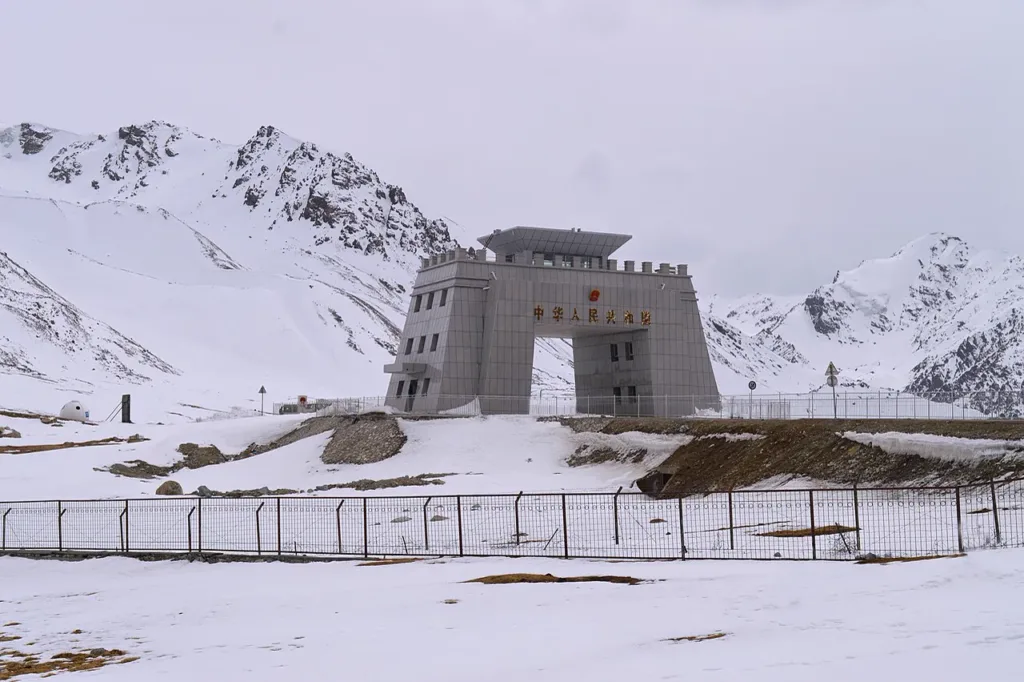
Khunjerab Pass is best understood as both a mountain border landscape and a working road gate, not simply as another viewpoint. On the Chinese side, the Red Gate (红其拉甫国门) stands at the end of China National Highway 314 (G314), the domestic section of the China–Pakistan Friendship Highway. The Taxkorgan county government lists the gate as a tourism site and says it formally opened to visitors on 5 July 2024.
The visual focus is deliberately limited: the border gate, the 1986 No. 7 boundary marker described by the county government, and the severe snow-and-rock setting around them. This is a place to observe the scale of the road and the border landscape from the areas assigned to visitors, rather than to wander around a frontier facility.
The road also has a life beyond tourism. Khunjerab is the only land port between China and Pakistan, and the port entered year-round operation on 1 December 2024 after previously closing seasonally because of snow and high-altitude conditions. The working port handles passenger and freight movements; that operational status should not be read as a promise that every part of the gate is open for casual sightseeing on every date.
What makes the journey distinctive
The pass is where the highway from Kashgar crosses into the Karakoram system and continues toward Pakistan. Britannica describes the Karakoram Highway as a road linking Kashgar with Islamabad, crossing into Gilgit-Baltistan at Khunjerab; official Chinese reporting places the port in Taxkorgan Tajik Autonomous County, Kashgar Prefecture.
That combination gives the stop its character: a named frontier, a visible road connection between two countries, and a high Pamir setting in which weather and altitude are part of the experience. The county’s tourism page describes the gate area as averaging about 5,000 metres above sea level. Plan for a cold, thin-air environment and keep the visit flexible rather than building a tight chain of stops around it.
Getting there and getting back
Use 红其拉甫国门 Hóngqílāfǔ Guó Mén or 红其拉甫口岸 Hóngqílāfǔ Kǒu Àn as the Chinese destination when arranging transport. The county government places the gate at the terminus of G314 and 126 kilometres from Tashkurgan county town. From Tashkurgan, the practical approach is a pre-arranged vehicle following G314; the county’s tourism guidance recommends an arranged rental or self-drive approach for the wider Taxkorgan routes, but it does not publish a port-specific public-bus timetable.
Before leaving Tashkurgan, confirm the current border-area permit, the exact visitor destination and whether the road is open for your date. A county government reply says that visitors going into the border area should arrange the relevant permit through departments in Kashgar and gives Wupaer Town as an example of where this can be handled; treat that as local planning guidance, not as a universal rule for every nationality or itinerary.
Arrange the return at the same time as the outward trip. Ask the driver or operator to confirm the designated visitor area, the latest permitted stopping point and the vehicle’s collection plan back to Tashkurgan. Because no current port-specific public transport schedule is verified in the sources reviewed, do not rely on finding a spontaneous bus or taxi at the gate. Exact road conditions, weather closures and local instructions take priority over a map pin or an old itinerary.
International travel and the Chinese gate
A visit to the Chinese-side gate and a cross-border journey are separate purposes. The Kashgar prefectural government reported that, by 9 April 2025, foreign passengers from 18 countries or regions had entered through Khunjerab. It also described a first-stop service centre at the port offering policy consultation, legal assistance, foreign-language translation, communications and payment help, tourism information, transport transfers and high-altitude rescue. This is evidence that foreign passengers are processed here; it is not a blanket statement that every passport holder can enter or cross on the same terms. Confirm your individual documents, eligibility and approved destination with the relevant border and immigration authorities before travelling, and do not treat a sightseeing arrangement as permission to cross into Pakistan.
The port is worth including only when the route is specifically arranged. Its appeal is the meeting of a working international corridor and an uncompromising high-mountain landscape; the same conditions that make the view memorable can also change access quickly.
Combine your visit
Choose from these complementary stops when planning your visit.
-
Tashkurgan preparation塔什库尔干出发准备
Confirm the complete route and current access.
-
Authorised border-gate visit获准国门参观
Follow the assigned vehicle and visitor areas.
-
Return or confirmed crossing返程或已确认的跨境行程
Use the journey type and transport actually approved for your booking.
This is a suggested combination, not a timed route; confirm the opening and transport arrangements for your date.
Find Khunjerab Pass
红其拉甫口岸 · 塔什库尔干塔吉克自治县
The pin marks the area, not the entrance.
More places nearby
Approximate straight-line distances between map pins, not travel distances.
Tashkurgan 塔什库尔干
104 km awayTashkurgan is a highland town in the eastern Pamir region, with a ruined stone fortress above the surrounding settlement. Its historical position connected routes toward Kashgar, the southern Tarim Basin and lands farther west…
View guide →Muztagh Ata 慕士塔格峰
161 km awayMuztagh Ata is a heavily glaciated mountain in the eastern Pamir region. Its broad snow-covered profile is a defining view from the Karakul and Karakoram Highway area. The mountain’s presence can be appreciated from authorised…
View guide →Karakul (China) 喀拉库勒湖
180 km awayKarakul in Akto County is a high-altitude lake beside the Karakoram Highway, with Muztagh Ata and the Kongur mountain group forming its wider setting. Still conditions can create striking reflections, while wind changes the…
View guide →Sources & visit information
Sources checked on 25 October 2026. Hours, tickets, reservations and transport can change; confirm with the operator before you go.
Image credits & notes (1)
- Chinese-side border gate at Khunjerab Pass in winter, photographed on 30 April 2015; an archival view of the frontier facility, not evidence of current access. Photo: Saad636Photo: CC BY-SA 4.0