

Explore the region
Tap any red Chinese text to hear it in Mandarin.
Tuyugou Mazar Village sits in Tuyugou Township, Shanshan County, on the south side of the Flaming Mountains. It is a village to explore slowly: the road follows the Subeixi River, while lanes and houses climb the alluvial fan and lower mountain slope. The settlement is listed as both a Chinese Historical and Cultural Village and a Chinese Traditional Village. A 2025 report from the Ministry of Culture and Tourism describes the village as having about 1,700 years of history and calls its earthen houses a distinctive local heritage.
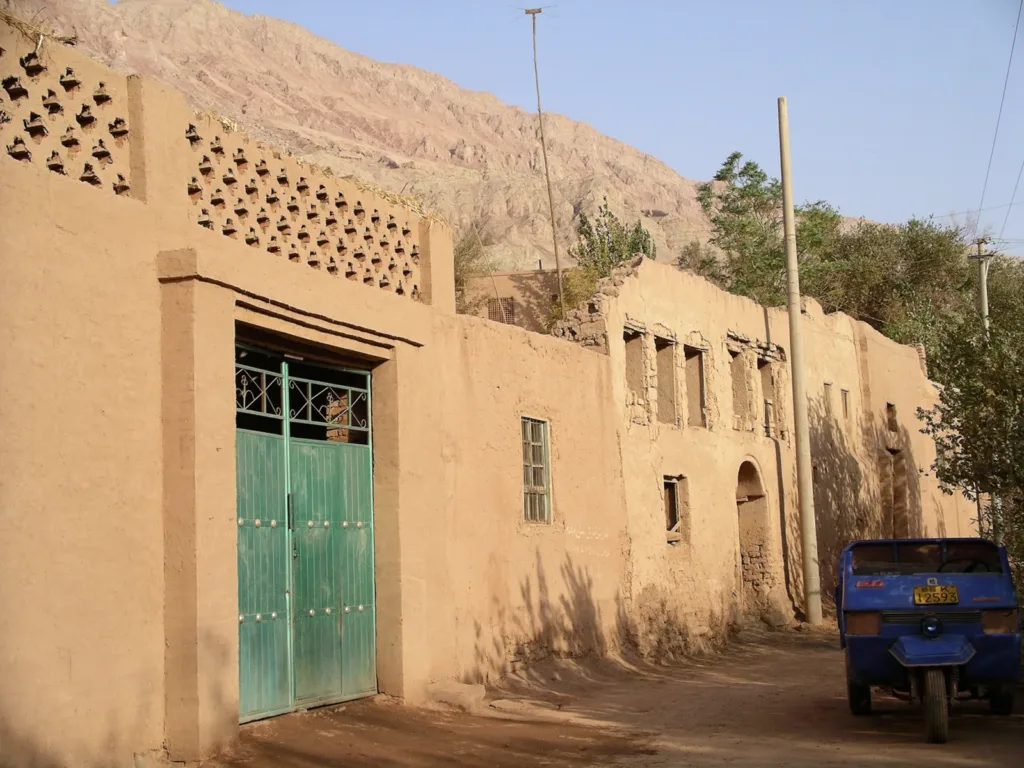
The architecture is the reason to come. Yellow clay and timber form houses that often combine an upper flat-roofed level with lower rooms cut into or against the slope. Some spaces feel like courtyards; others open into narrow lanes, river edges, or shaded passages. The arrangement is practical rather than monumental: building materials come from the dry valley environment, and the settlement follows the watercourse and the hillside. Look closely at wall thickness, earthen surfaces, small openings, timber details, and the way adjoining houses make an irregular village street.
This is not simply a preserved ruin. A conservation project reported in 2025 repaired 78 houses and courtyards using traditional methods. Residents had moved to new housing during the work and were returning in an orderly way after the scenic area was fully opened to visitors on 1 May 2025. A later People’s Daily report said that some well-preserved courtyards were open while unsafe buildings were still awaiting repair. The visitor experience can therefore change as conservation continues; do not climb into a closed courtyard or treat an unfinished structure as an attraction.
What to look for
- Earthen lanes and the Subeixi River. Walk at a village pace and observe the relationship between the river, the main road, the slope, and the linked courtyards. The point is the settlement pattern, not a single photo stop.
- Ashab al-Kahf Mazar. The village name refers to the shrine on higher ground northwest of the houses. It is a Muslim place of worship associated locally with the sleepers-in-the-cave story. Treat the shrine as a religious site: dress modestly, keep to areas open to visitors, and ask before entering or photographing buildings, worshippers, or rituals.
- The mosque and village details. A mosque stands within the village, but its religious function comes before its visual interest. Admire public-facing architecture from the lane and do not enter prayer spaces without permission. Ask residents before photographing homes, doorways, or people; a village is a home, not a staged set.
- The grottoes as a separate stop. Tuyugou Grottoes lie farther up the valley and belong to a different archaeological and access context. Keep them separate from this village entry and check their current gate and conservation arrangements rather than assuming that a village ticket or opening status covers them.
Planning the visit
Opening and tickets. The latest official cultural report I found records full scenic-area opening from 1 May 2025, but it is not a live timetable. Visitor platforms currently disagree: Trip.com lists 09:30–20:00, while a Xinjiang travel-agency listing gives 09:30–19:00 and says the day’s status controls. Qunar lists a Tuyugou scenic-area ticket at ¥30 for adults and ¥15 for students and older visitors. These are useful current leads, not a guaranteed official tariff or a passport procedure. Check the same-day status, what the ticket includes, and whether a foreign passport can be used before setting out; no official page located for this entry publishes a settled foreign-visitor ticket or reservation process.
Getting there. There is no metro serving this rural village. Shanshan County’s government profile lists Shanshan Railway Station, Shanshan North high-speed station, and Tuha high-speed station as the county’s rail gateways; each still needs a road transfer. From Turpan city, the route described by People’s Daily runs east through the Flaming Mountains, turns south at Shengjinkou Grand Canyon, and continues along a rural road to Tuyugou. For a practical visit, use a pre-arranged taxi, ride-hail car, or private vehicle from Turpan or Shanshan. Give the driver the Chinese name 吐峪沟麻扎村 Tǔ Yù Gōu Má Zhā Cūn and add 鄯善县 Shàn Shàn Xiàn; do not search only for “Tuyugou,” which may return the wider valley or another entrance. Because the sources do not establish a dependable direct public-bus timetable, arrange the return ride before entering the village rather than assuming a late bus will appear.
Plan water, sun protection, and time for uneven lanes. Keep the village quiet, respect worship and household boundaries, and leave religious objects and old earthen fabric untouched.
Find Tuyugou Mazar Village
吐峪沟麻扎村 · 鄯善县
The pin marks the area, not the entrance.
Sources & visit information
Sources checked on 31 October 2026. Hours, tickets, reservations and transport can change; confirm with the operator before you go.
Image credits & notes (1)
- An earthen residential lane in Tuyoq (Tuyugou) village near Turpan, photographed on 23 October 2005; an archival view of the village built fabric, not evidence of current access or conservation. Photo: T ChuPhoto: CC BY 2.0