

Explore the region
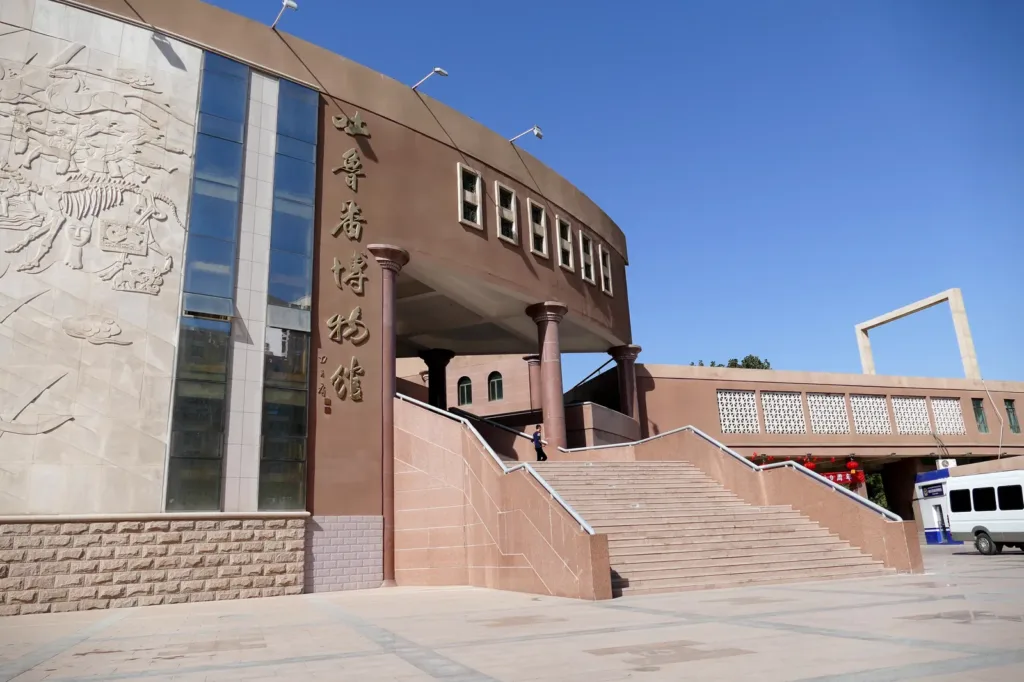
Turpan Museum is the city’s context-setting museum: five basic exhibitions bring together Silk Road documents, coins, burial remains and a giant-rhinoceros fossil at the present Munaer Road site.
Why make time for it
Turpan’s ruined cities and tombs are best understood when you have first seen some of the portable evidence recovered from the basin. The museum brings that evidence indoors: documents, coins, textiles, pottery and burial objects connect local archaeology with administration, trade, religion and everyday life. Its new museum building opened in 2009, and the reported collection includes more than 20,000 objects.
The established programme is organised around five basic exhibitions: Turpan’s general history, the giant-rhinoceros fossil, unearthed documents, ancient coins, and unearthed corpses with their burial objects. The combination is unusually broad for a city museum. You can move from human records to a much older landscape without leaving the building.
What to look for
Start with the general-history exhibition if you are visiting Jiaohe, Gaochang or Astana later. It sets the sites into a sequence rather than presenting each ruin as an isolated stop. Then slow down in the document display. The surviving material includes official records, contracts, letters, Buddhist texts, prescriptions and school exercises—small pieces of paper that make administration and ordinary life more tangible than a dynasty list. Turpan’s dry climate helped preserve this kind of material, but the documents are still fragile objects, not illustrations to be handled or photographed without following the museum’s rules.
The coin exhibition is a compact way to see the basin’s connections. Alongside local and Chinese issues, the collection has coins that travelled through Central and Western Asia, making exchange visible in a case rather than only on a map. The giant-rhinoceros hall changes the scale again: it presents the prehistoric environment of the basin through a large fossil skeleton and supporting displays. The mummy and burial-object exhibition is historically important but may be intense for some visitors; approach it as a study collection and follow any photography or conduct restrictions in the gallery.
A practical order is general history → documents and coins → giant rhinoceros → burial remains. This is a suggested sequence, not a timed route, and which galleries are accessible may change during the current building project.
Before you go
The museum’s published visitor information lists free admission and a Monday closure. The listed seasonal hours are 10:00–18:00 from 15 April to 15 October, and 10:30–18:00 from 16 October to 14 April; the same notice gives 17:30 as the last admission time. Treat these as a dated reference rather than a guarantee for your travel day.
A 2024 visitor notice says that the museum used all-visitor advance reservations through the “吐鲁番市文博院” mini-program or by phone at 0995-7619650. An English government travel listing says a passport is required for entry. Bring your original passport, but do not assume that a foreign passport can use the current mini-program workflow in the same way as a Chinese ID card: the sources do not document that step. Call the museum before travelling if you need to confirm the booking channel, an ID check, or a temporary gallery restriction.
There is one especially important current caveat. A 3 April 2026 update on the Turpan municipal government website described the museum’s phase-two expansion and said that it was expected to reopen to the public before that year’s National Day. I did not find a later official reopening notice in the sources checked on 31 October 2026. Confirm that the museum is open, which entrance is in use, and which permanent galleries are available before making it the anchor of an outdoor day.
Getting there and back
There is no metro station serving this museum. The dependable option is a taxi or ride-hailing car to 吐鲁番博物馆,新疆维吾尔自治区吐鲁番市高昌区木纳尔路1268号. This is the present Munaer Road address; the same address is also listed by the Xinjiang culture and tourism authority for the neighbouring Turpan Studies Institute.
From either of Turpan’s railway arrival points, use the museum’s Chinese name and full address in Amap (Gaode Maps) and arrange the last leg by taxi or ride-hailing rather than assuming the station is walkable from the museum. Keep the Chinese destination for the return trip as well, and ask the driver to confirm the current visitor entrance because construction may alter access. I have not included a bus number: a current operator timetable or stop-to-entrance route was not verified for this address, and an old or guessed line would be less useful than a confirmed car transfer.
The museum works well as a cool, information-rich stop before the heat of the ruins. If the expansion has changed the opening arrangement, keep the visit flexible and do not treat the published schedule as proof of same-day entry.
Combine your visit
Choose from these complementary stops when planning your visit.
-
Turpan history exhibition吐鲁番通史展
Locate the ancient settlements in their historical sequence.
-
Documents and coins文书与古钱币展陈
Look at the evidence for exchange and administration.
-
Giant-rhinoceros fossils巨犀化石展
Add the basin’s prehistoric landscape.
This is a suggested combination, not a timed route; confirm the opening and transport arrangements for your date.
Find Turpan Museum
吐鲁番博物馆 · 吐鲁番
The pin marks the area, not the entrance.
More places nearby
Approximate straight-line distances between map pins, not travel distances.
Emin Minaret 苏公塔
1 km awayEmin Minaret, also called Sugong Tower, is an eighteenth-century brick tower beside a mosque near Turpan. Its tapering circular form is covered with repeating geometric patterns created in the brickwork. The adjoining mosque’s…
View guide →Grape Valley 葡萄沟
8 km awayGrape Valley is an irrigated corridor beneath the Flaming Mountains northeast of Turpan. Water flowing through the valley supports vineyards that contrast sharply with the dry hills around them. The visitor area combines…
View guide →Jiaohe ruins 交河故城
10 km awayJiaohe occupies a narrow plateau between two river valleys west of Turpan. The steep natural edges helped protect a city whose streets, residential quarters and Buddhist remains can still be read in the eroded earth. Much of the…
View guide →Sources & visit information
Sources checked on 31 October 2026. Hours, tickets, reservations and transport can change; confirm with the operator before you go.
Image credits & notes (1)
- Turpan Museum’s Munaer Road building, photographed on 18 September 2015; an archival exterior view rather than proof of current reopening. Photo: ZossolinoPhoto: CC BY-SA 4.0