

Explore the region
Tap any red Chinese text to hear it in Mandarin.
Why this place is worth the detour
Grape Valley is not just a single viewpoint. It is a cultivated valley in the Flaming Mountains, with the Buyiruk River running through it and meltwater from the high mountains as its main water source. That combination explains the sharp change from dry, rust-coloured slopes to trees, vines and cooler-looking shade. The valley is listed by the Xinjiang Culture and Tourism Department as a national 5A scenic area.
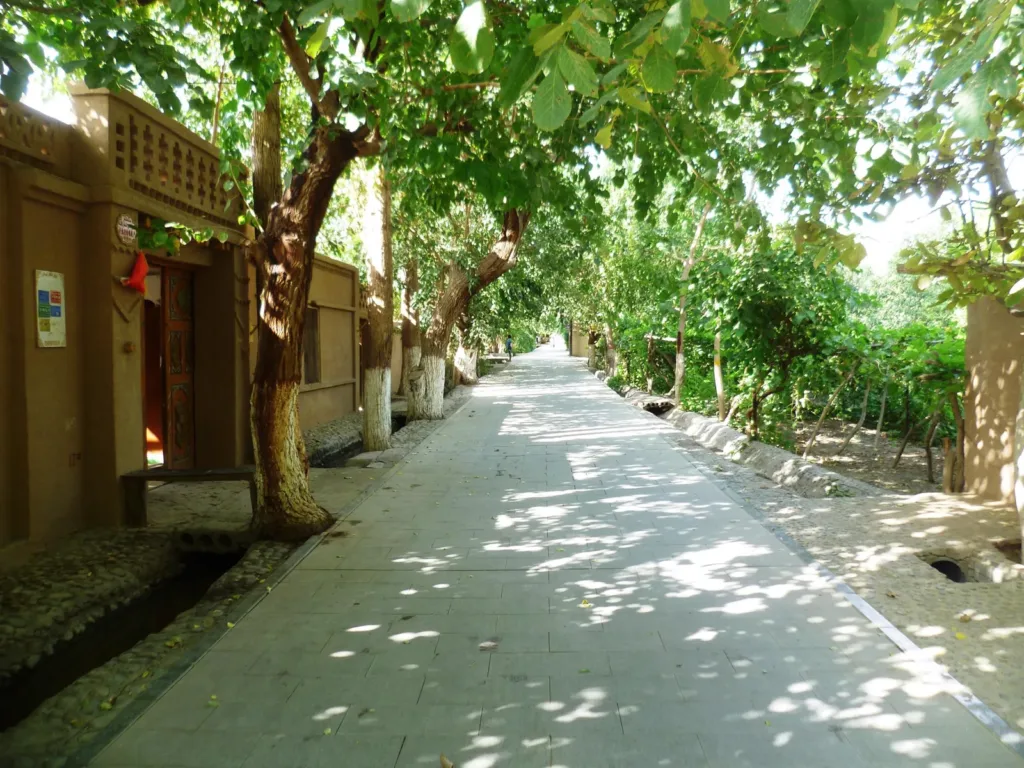
The most rewarding visit is a slow look at how the oasis is made: follow a shaded vine-covered path, notice the channels and planted courtyards, then turn back toward the bare mountain edge. In the open landscape, the water is part of the sight rather than an invisible service. This is a good place to understand why Turpan’s grape-growing culture is tied to irrigation, not simply to a famous fruit.
What to see
The managed scenic area is spread across several visitor zones. The current official report on the free-entry policy names Grape Valley Amusement Park, the Wang Luobin Music and Art Museum, Dawazi Folk Customs Garden and Afanti Amusement Park among the areas visitors can enter. Treat them as parts of one broad visit, not as separate destinations: opening arrangements, exhibitions and performances can vary by date.
Start with the vines and water landscape. Look for the trellis shade, the relationship between planted land and the valley walls, and the changing view as the path opens toward the Flaming Mountains. If a courtyard, farm plot or grape stand is operating, ask before entering, photographing people closely or picking produce. A tasting or purchase is not permission to treat a working vineyard as a public display.
Season changes the experience. A current visitor listing describes mulberries and apricots in May, other orchard fruit in July and August, and grapes around September and October; that is a general guide rather than a harvest calendar for every plot. If ripe grapes or picking are your priority, ask which section is operating on your date.
Planning a visit
Entry, reservation and timing
The latest official notice I found, published on 29 April 2025, announced that the scenic area would cancel its former CNY 60 admission fee from 1 May 2025. It says the named visitor areas could then be visited without an entrance ticket. A visitor listing captured on 31 October 2026 still marks the scenic area as free and says advance reservation is required. It lists 09:30–19:30 as the visiting window, while also warning that the information is for reference and that the day’s notice controls.
For a foreign visitor, do not assume that a domestic ID-card reservation or QR-code process will work in the same way. The official free-entry announcement and the current listing I read do not explain foreign-passport verification or an English booking channel. Keep your passport with you as your travel ID and confirm the reservation and check-in method with the scenic area before setting out. This is a specific operational gap, not a reason to treat the whole valley as inaccessible.
Allow several hours rather than trying to race through every zone. The visitor listing suggests three to five hours, but the useful pace depends on which internal areas are open and whether you stop in the shaded agricultural sections. Turpan is intensely sunny and dry in the warm season, so carry water, use the vine shade where available and plan a break rather than treating the valley as a short roadside photo stop.
Getting there and back
There is no useful metro leg for this out-of-centre scenic area. A real public-transport option is the Gaochang District tourism-bus small loop. The Turpan municipal announcement published on 23 July 2025 says that the loop starts at Turpan North Railway Station and stops at Yarbazha, Karez Amusement Park, Jiaohe ruins, Turpan Museum and Grape Valley Scenic Area. That announcement lists service from 09:00 to 20:00, one bus per hour, with a CNY 20 pass allowing unlimited rides during the operating day.
Because that is a dated service announcement rather than a live timetable, check the current stop sign or local transport notice on the day. If the loop is running, keep the last operating period in mind for the return: it is more useful than arriving at the valley without a plan for getting back to Turpan North or the city.
A taxi or ride-hailing car is the simplest alternative from central Turpan or a railway arrival. Search for 葡萄沟景区 Pú Táo Gōu Jǐngqū in Amap/Gaode Maps rather than relying on the English name alone, confirm the chosen visitor entrance with the driver, and save the Chinese destination for the return booking. The valley is spread out, so agree on a pickup point inside or at the designated exit instead of assuming that every internal zone has the same roadside access.
Combine your visit
Choose from these complementary stops when planning your visit.
-
Chosen visitor entrance选定景区入口
Check which section your booking covers.
-
Vineyard route葡萄园游线
Observe the irrigation and growing landscape.
-
Grape-product stalls葡萄产品摊店
Compare produce and prices before buying.
This is a suggested combination, not a timed route; confirm the opening and transport arrangements for your date.
Find Grape Valley
葡萄沟 · 吐鲁番
The pin marks the area, not the entrance.
More places nearby
Approximate straight-line distances between map pins, not travel distances.
Turpan Museum 吐鲁番博物馆
8 km awayTurpan Museum connects the basin’s ancient cities with the objects recovered from them. Written documents and coins reveal administration and trade, while burial displays preserve clothing and other evidence of everyday life. A…
View guide →Emin Minaret 苏公塔
8 km awayEmin Minaret, also called Sugong Tower, is an eighteenth-century brick tower beside a mosque near Turpan. Its tapering circular form is covered with repeating geometric patterns created in the brickwork. The adjoining mosque’s…
View guide →Jiaohe ruins 交河故城
16 km awayJiaohe occupies a narrow plateau between two river valleys west of Turpan. The steep natural edges helped protect a city whose streets, residential quarters and Buddhist remains can still be read in the eroded earth. Much of the…
View guide →Sources & visit information
Sources checked on 31 October 2026. Hours, tickets, reservations and transport can change; confirm with the operator before you go.
Image credits & notes (1)
- A shaded paved lane through the cultivated Grape Valley near Turpan, with grape trellises, trees and open irrigation channels. Photo: Radosław BotevPhoto: CC BY 3.0