

Explore the region
Tap any red Chinese text to hear it in Mandarin.
Why visit Shuanglang
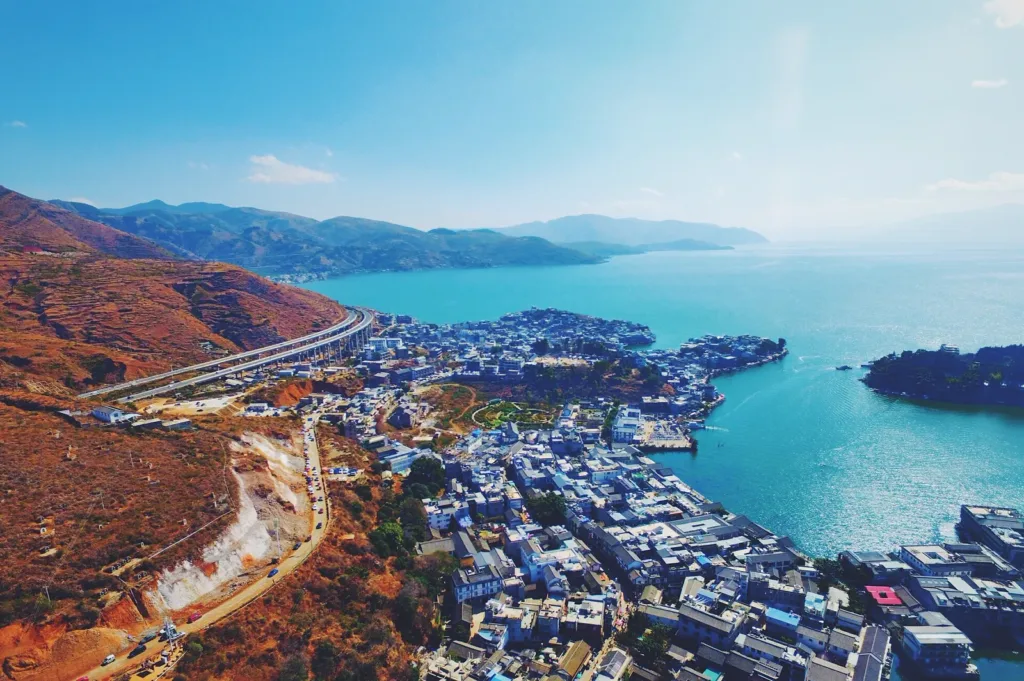
Shuanglang sits at Dali City’s northeastern end, with Erhai in front of the town and Cangshan visible across the water. Local descriptions place the settlement on the lake’s northeast shore and present it as a Bai town whose older fishing life has been reshaped by tourism and creative businesses.
A useful first visit is a slow walk rather than a hunt for one monument: use the Chinese destination name 双廊古镇 Shuāngláng Gǔzhèn or 双廊镇 Shuāngláng Zhèn, follow the main street into its side lanes, then turn toward the water. Local tourism material describes a north–south main street, smaller lanes, white walls, grey roofs and Bai courtyard forms. The town is still a working settlement with guesthouses, shops and residents, not a fully preserved open-air museum. Recent local reporting also records road, landscape and visitor-service upgrades, so some streetscapes are being maintained and renewed rather than left untouched.
What to notice
At the lakeside, look back toward Cangshan and along the public waterfront for the changing relationship between the town, the lake and the mountain skyline. The local name 海街 Hǎi Jiē is used for a waterfront area, while the town’s lanes lead inland through older houses and newer hospitality businesses. This is the best way to understand Shuanglang as a place: lake views are part of ordinary public space, while particular islands, boat rides and commercial viewpoints are separate products.
The Hongshan Benzhu Temple is a separate religious site at Hongshan Yakou in the northern part of Shuanglang, beside Erhai. The Dali government describes its Benzhu as three generations of Nanzhao military leaders—Wang Sheng, Wang Le and Wang Lekuan—and records the traditional Hongshan Benzhu festival on the 14th–16th days of the fourth lunar month. The temple’s ritual calendar is not a promise that a festival or a special ceremony will be taking place on your dates; ask locally before treating it as a scheduled performance, and behave as you would at a living place of worship.
Shuanglang’s contemporary reputation is tied to artists as well as to its older settlement. A 2012 report linked the town’s rapid tourism profile to dancer Yang Liping’s lakeside home and artist Zhao Qing’s Sun Palace, and also mentioned Qinglu. That is useful cultural history, not proof that private residences are open to visitors today. More recent local reporting still describes artist-led accommodation, a planned or developing art museum and cultural activities, but does not establish regular public admission for a particular house, museum or show. Treat those as separate, operator-managed experiences and check before going.
Getting there and getting back
From Dali Ancient Town, the operator’s 2025 route map lists 双廊古镇 Shuāngláng Gǔzhèn as a stop on both the west and east Erhai sightseeing routes. The same page lists reverse services from Shuanglang to 大理古城环洱海服务中心 Dàlǐ Gǔchéng Huán Ěrhǎi Fúwù Zhōngxīn. Departures are reserved through the operator’s platform and may change with demand, so confirm the current departure and the last return before setting out.
From Dali Railway Station (大理站), a 2025 operator guide places the Dali Station–Dali Ancient Town express at the station’s commercial food-area exit beside the taxi waiting area, arriving at 大理古城(环洱海服务中心). From that service centre, continue on a confirmed Shuanglang-bound sightseeing service or another current connection rather than assuming that the railway-station express continues to the town.
A local Dali travel guide records coaches to Shuanglang from 大理汽车客运北站 Dàlǐ Qìchē Kèyùn Běizhàn. Because the page does not provide a current timetable or a current reverse-service guarantee, use it as a station enquiry: ask for the next bus to 双廊 and confirm how and where you will return before boarding. Do not rely on an old departure list or an unverified fare.
If you drive or use a private car, enter 双廊古镇 Shuāngláng Gǔzhèn or 双廊镇 Shuāngláng Zhèn in Chinese and agree the exact drop-off before leaving the main road. Holiday controls can change access: a Dali notice for 1–5 May 2026 temporarily controlled the Shuanglang section of the East Lake-Ring Road and redirected vehicles from the Shuanglang expressway exit. That notice is date-specific, but it is a reminder to check current Dali traffic notices before a public-holiday drive.
There is no single museum gate for the town walk. Keep residential courtyards private, ask before entering a home or photographing residents, and do not assume that a lakeside boat, island, artist residence, museum or evening performance is included in access to Shuanglang itself. For a return by sightseeing bus, use the reverse route shown by the operator; for a passenger coach, confirm the same-day return at the station or stop.
Find Shuanglang Village
双廊 · 大理市
The pin marks the area, not the entrance.
Sources & visit information
Sources checked on 24 October 2026. Hours, tickets, reservations and transport can change; confirm with the operator before you go.
Image credits & notes (1)
- Aerial view of Shuanglang's lakeside settlement on Erhai, with the surrounding mountain landscape. Photo: Zhouqiyang (Pixabay username zhouqiyang-460906)Photo: CC0 1.0