

Explore the region
Tap any red Chinese text to hear it in Mandarin.
Why come
Jinuo Mountain Village is not a generic “ethnic village” label applied to a distant theme park. The scenic area is built around Bapo Village in Jinuo Mountain Jinuo Ethnic Township, where the Jinuo people are mainly concentrated. The area uses the village setting, forest and staged interpretation together, so a visit moves between a managed visitor route and the cultural landscape that surrounds it.
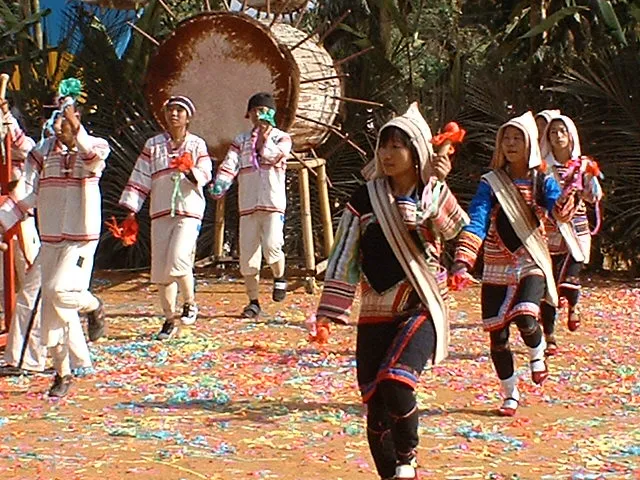
The Jinuo are one of China’s 56 officially recognised ethnic groups; the State Council confirmed them as a distinct group in 1979. Their name is commonly explained as “descendants of the maternal uncle”, and the drum is central to Jinuo origin stories and public cultural expression. The scenic area’s strongest subject is therefore sound as much as scenery: the beat of the big drum, the voices around it and the way performers explain or demonstrate everyday skills.
What to look for
Start at the managed entrance and follow the route rather than wandering into residential areas. Look for the large drum, the ancestor-goddess imagery, totem columns, the 卓巴房 (Zhuoba House, associated with village elders), the 大公房 (communal house), traditional clothing and displays of older tools and customs. A 2024 cultural-tourism account describes the live programme Youle Youle as a route-based experience, with scenes linked to the goddess statue, totems, village spaces, a Jinuo wedding, weaving and working life.
The big-drum dance is the cultural anchor. Jinuo Big Drum Dance was included in China’s first national-level intangible cultural heritage list in 2006, with Jinghong listed as its reporting area. The drum used in the dance can be described as a “sun drum” because of the radial wooden pieces around its rim; the tradition is tied to stories of the ancestral drum and is not simply a decorative stage prop.
Listen also for Qike Ami (奇科阿咪), a Jinuo traditional musical performance, and watch for demonstrations of weaving and other handwork. Recent Xinhua coverage recorded performances of the drum dance, Qike Ami and traditional weaving at the scenic area, while also noting that the Jinuo Mountain area is a Pu’er tea ancient-tea mountain and a base for newer rainforest activities. The cultural displays are most useful when you pay attention to the explanation of an object or technique, rather than treating costumes or ritual imagery as photo accessories.
How to visit well
This is a ticketed scenic area, but I am not giving an old price or a fixed show timetable: the reliable material reviewed here confirms admission-based operation and recent special-event programming, not a current 2026 tariff or daily performance schedule. Check the venue or current ticket notice before setting out, especially if the drum dance or a guided route is the main reason for your visit.
Plan for a managed cultural presentation, not an invitation to enter every house in Bapo Village. Stay on the visitor route, ask before photographing residents or entering residential spaces, and do not touch drums, ritual objects or displays unless a guide explicitly invites you to do so. If a performance invites audience participation, follow the performers’ instructions; do not assume that every ceremony or village activity is staged for visitors. Bring mosquito protection and shoes with reliable grip for forested paths and damp weather.
Getting there
The most straightforward independent plan is to use a taxi or pre-arranged car from Jinghong. Search and show the Chinese name 基诺山寨 Jīnuò Shānzhài, with 景洪市基诺族乡巴坡村 Jǐnghóng Shì Jīnuòzú Xiāng Bāpō Cūn as the locality, and confirm that the driver is taking you to the scenic-area visitor entrance rather than to a similarly named rainforest-walking or village activity. Arrange the return ride before entering: this is a rural mountain destination, and an unplanned late-day pickup is not a dependable assumption. The current booking listing identifies the place in Jinuo Ethnic Township and provides the Chinese destination used for navigation, but it is not an operator notice.
A provincial tourism guide published in 2022 listed a coach from 版纳州客运站 (Banna Prefecture Passenger Station) in Jinghong toward 基诺乡 (Jinuo Township), described as roughly one departure every two hours, with a journey of about 40 minutes. That is useful route context, not a current timetable. Ask at the station whether the service still runs, confirm the correct alighting point for 基诺山寨景区 Jīnuò Shānzhài Jǐngqū, and secure a return plan before boarding; do not rely on the old frequency or assume a coach will meet you at closing time.
If you are arriving in Xishuangbanna by air or train, treat the airport or 西双版纳站 (Xishuangbanna Railway Station) as a gateway to Jinghong, not as the village entrance. China Railway places Xishuangbanna Station in Jinghong’s Gasa Town; it is a railway passenger facility, not a scenic-area entrance. The final leg still needs a current car, coach or arranged transfer to 基诺山寨 Jīnuò Shānzhài. I found no source that confirms a dedicated 2026 shuttle, an English-language ticket channel or special passport arrangements for this scenic area; check those specific points with the venue before travel.
Find Jinuo Mountain Village
基诺山寨 · 景洪市
The pin marks the area, not the entrance.
Sources & visit information
Sources checked on 24 October 2026. Hours, tickets, reservations and transport can change; confirm with the operator before you go.