

Explore the region
What to see and how to explore
The Qiantang River is not a single enclosed attraction. For an easy central-city introduction, begin at City Balcony (城市阳台), the public riverside space at the junction of Xinye Road and Zhijiang Road in Shangcheng District. Pause on the elevated terraces to take in the broad channel, the opposite bank and the scale of Hangzhou’s waterfront development. Then follow the signed public riverfront paths where they are open, stopping to watch the water and compare the bridges and skyline from different angles. Stay inside marked public areas; river access, works or crowd controls can change locally.
The tidal bore is created as tidewater from the East China Sea moves into Hangzhou Bay’s funnel-shaped estuary and the channel narrows. Its forms vary, and the timing and strength change with natural conditions. A visit to the urban riverfront does not guarantee a visible bore. The best-known viewing grounds at Yanguan are in Haining, Jiaxing—not in Hangzhou—so do not mistake that separate destination for a nearby city-centre stop. Never cross barriers or approach the water’s edge to chase a wave; follow local safety instructions.
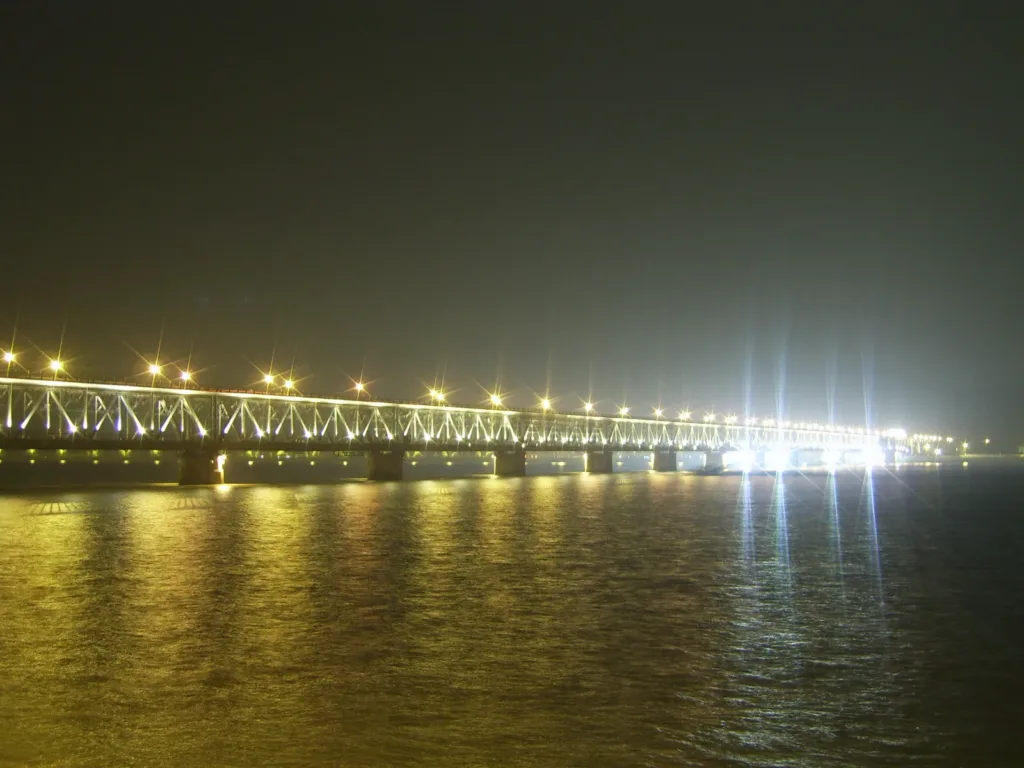
A quiet walk is worthwhile even without a tide event: notice how the river’s open horizon contrasts with the dense urban blocks, and how the waterfront reads differently from a raised terrace and from the lower public promenade. The photograph below shows the historic Qiantang River Bridge at night; it is a separate upstream landmark, not a view guaranteed from City Balcony.
Getting there
For City Balcony, take Hangzhou Metro Line 4 or Line 7 to Citizen Center (市民中心站). Exit K is identified for the nearby Songyun branch at City Balcony; head toward the riverside public approach and follow on-site signs to the terrace and promenade. No walking distance is stated because the precise open approach can vary with local access arrangements.
Useful buses listed for Citizen Center stop (市民中心站) include routes 11 and 96. For a taxi or ride-hail, enter 杭州市上城区之江路1078号(城市阳台). Ask to be set down at a lawful public curbside near the signed City Balcony approach; do not request a vehicle to stop on a bridge, cycleway or restricted river edge.
This is a public waterfront visit, not a confirmed cruise pier. No current boat departure, boarding point or service timetable was verified for City Balcony. Tide-viewing access, temporary closures and any event arrangements should be checked locally for the visit date; do not rely on a remembered tide or light-show time.
Combine your visit
A suggested sequence linking the specific features of this visit.
-
City Balcony
Start with an open view across the broad tidal river.
-
Qianjiang New City waterfront
Follow the public river edge to compare the modern buildings and opposite-bank panorama.
-
Qiantang River Bridge viewpoint
Make a separate upstream visit to see the older road-and-rail crossing.
This order is editorial. Confirm access and any transfers between stops; it does not establish a walking route, same-day connection or common admission ticket.
Find Qiantang River
钱塘江 · 钱塘区
The pin marks the area, not the entrance.
More places nearby
Approximate straight-line distances between map pins, not travel distances.
Museum of Chinese Go 中国围棋博物馆
47 km awayThe Museum of Chinese Go looks at the board game through the objects used to play, teach and record it. Boards and playing stones sit alongside books and the desks and chairs associated with play. This makes the visit about…
View guide →Hangzhou Paradise Park 杭州乐园
49 km awayHangzhou Paradise groups thrill rides and family attractions into Mayan Tribe, Lost Jungle and Adventure Island. A suspended roller coaster and large swinging rides form the more intense side of the park, while the double-deck…
View guide →Xixing Ancient Town 西兴古镇
49 km awayXixing’s old streets grew around the eastern Zhejiang canal’s connection with the Qiantang River. Along Guanhe Road, dark-tiled houses, river-facing doors and stone steps show how goods once moved between boats and commercial…
View guide →Sources & visit information
Sources checked on 21 October 2026. Hours, tickets, reservations and transport can change; confirm with the operator before you go.
Image credits & notes (1)
- Qiantang River Bridge illuminated at night, photographed in Hangzhou. Photo: ShizhaoPhoto: CC BY-SA 3.0