

Explore the region
Tap any red Chinese text to hear it in Mandarin.
Why visit
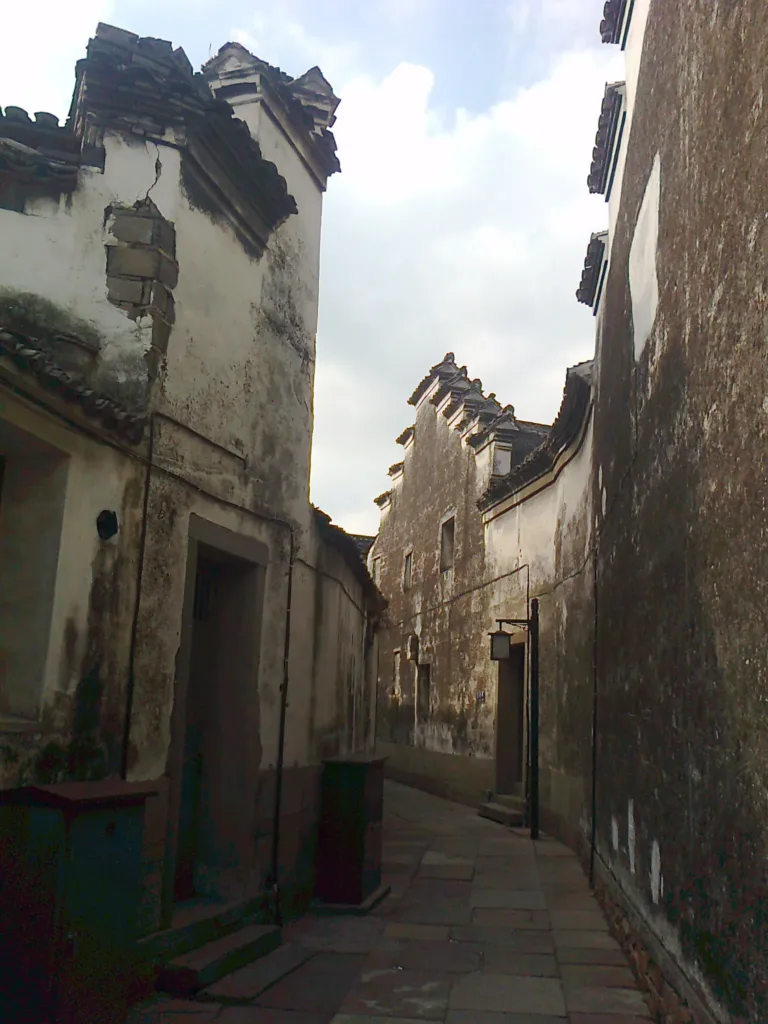
Minghe is not a sealed historical theme park. Residents still live among the lanes, and the public town area is arranged around a river, old bridges and houses with white walls, dark timber and horse-head gables. The compact core is easy to explore on foot, but the surrounding lakes and hills give the walk a broader landscape than a purely urban old street. Minghe was named a China Historical and Cultural Town in 2019.
Its commercial history helps explain what you see. Salt production made the settlement important from the Song period, while Ming- and Qing-period merchants carried its name into the Chinese-medicine trade. Ningbo Daily records more than 150 century-old firms founded or largely run by people from Minghe, including well-known medicine houses in Wenzhou and Hangzhou. Treat this as a reason to look closely at the town’s medicine-related displays and former merchant residences, rather than as a claim that every old building is a museum.
For a slower stop, look for Minghe Study (鸣鹤书房) on Middle Street. A 2025 report describes it as a reading room with more than 3,000 books, local-history titles, cultural products and a coffee-and-tea area. It opened to the public on 1 October 2025, but no dependable current daily timetable was found for it, so treat it as an optional pause rather than a guaranteed attraction.
What to look for
Start with the old streets and the water. Middle Street (中街) is the historic commercial spine; the lanes around Yinhao Lane (银号弄) retain horse-head gables, while bridges such as Yunhe Bridge and Shatan Bridge give views down the narrow river. The town is a good place to notice working details—door thresholds, shopfront proportions, roof walls and reflections—rather than to rush from one ticketed sight to the next.
Walk towards Du Lake (杜湖) for the lakeside setting and the cluster of protected historic sites around it. Baiyang Lake (白洋湖) lies to the southwest. Jin Xian Temple (金仙禅寺) is a separate religious and historic stop beside Baiyang Lake; it should not be confused with the Wulei Mountain scenic area farther east. Wulei Mountain, Shanglin Lake and the Yue-kiln sites are sensible additions only if you have time and a separate transport plan, not automatic parts of the old-town walk.
The medicine story is most legible at places described locally as the Medicine Materials Museum (药材馆), the former Guoyi Hall or Chongjing Hall (国医馆/崇敬堂), and the 24-room Zoumalou residence (24间走马楼). These names belong to different buildings and experiences. Some reports describe interiors, accommodation or cultural programmes, but current opening arrangements for each were not confirmed; ask on site rather than assuming that every courtyard is open.
Food and small-scale experiences
Minghe’s rice-cake tradition is a useful way to understand its living culture. At the 2020 Minghe Rice Cake Festival, makers demonstrated washing and grinding rice, firing the stove, steaming and pounding the mixture. The finished cake was described as chewy and springy. A local rice-cake dumpling (年糕饺) uses a soft rice-cake wrapper around a filling; CCTV identifies it as a local winter-solstice food. Look for a fresh stall or shop in the old-town area, but do not treat one vendor’s filling or availability as a fixed town-wide recipe.
Entry and practical planning
The public historic-town core is described as free to enter and open throughout the day by a 2025 local tourism guide, and Ningbo Daily describes the town as freely open to residents and visitors. This applies to the public town area, not automatically to a temple, preserved residence, reading room, workshop or private courtyard. No current passport-specific admission rule or online reservation process was located for the public core.
Allow roughly half a day for the old streets, lake edge and a few interiors if they are open. Wear shoes suitable for uneven stone paving. This is a living neighbourhood: keep voices low near homes, ask before photographing people or entering courtyards, and do not mistake a resident’s doorway for a visitor entrance.
Getting there and back
There is no verified metro stop at Minghe and no railway station in the town. From Cixi Passenger Transport Center, a published local route uses Cixi Bus 206 or Tour Line 1 to 鸣鹤场站 Mínghè Chǎngzhàn; the guide estimates about a 1-km walk to the scenic area. From Yuyao North Railway Station, the same guide gives a two-bus connection: Cixi Bus 293 to 慈溪乌山站 Cíxī Wūshān Zhàn, then Bus 226 to 鸣鹤车站 Mínghè Chēzhàn. These are useful route numbers and Chinese stop names, but the published guide does not provide a current timetable or last-departure guarantee.
Plan the return before starting the walk. Check the reverse service from 鸣鹤场站 Mínghè Chǎngzhàn or 鸣鹤车站 Mínghè Chēzhàn while you still have time; if the last bus is uncertain, arrange a ride-hail or taxi back to Cixi rather than assuming that a late connection to Yuyao North will still be available. For a car or ride-hail, show the driver 鸣鹤古镇,慈溪市 Mínghè Gǔzhèn, Cíxī Shì and confirm the drop-off point before setting off; use the Chinese name in Amap or Apple Maps because the old visitor guidance does not establish one universally reliable tourist gate.
Find Minghe Ancient Town
鸣鹤古镇 · 慈溪市
The pin marks the area, not the entrance.
Sources & visit information
Sources checked on 24 October 2026. Hours, tickets, reservations and transport can change; confirm with the operator before you go.
Image credits & notes (1)
- A narrow lane in Yinhao Lane, Minghe Ancient Town, with preserved horse-head gables and whitewashed historic walls. Photo: Mir7rorPhoto: CC BY-SA 3.0