


Get to know Cixi City
- Administrative area
- County-level city · 县级市
- Part of
- Ningbo
- Chinese name
- 慈溪市
- Local areas
- County-level city guide
Area & population
- Area
- 1,360.63 km²
- Population · 2020 census
- 1,462,383
Source: English Wikipedia, as of the dates shown.
Cixi is not a single walkable attraction. Its urban and industrial life spreads across a large county-level city, while the clearest visitor experiences lie in separate southern and lakeside areas. The city is best understood by moving between places: the celadon kiln landscape at Shanglin Lake, and Minghe’s canals, bridges, and surviving Ming–Qing houses associated with Chinese-medicine merchants.
At Shanglin Lake, the point is to connect objects with their setting. The archaeological-park programme links lakeside and hillside paths with the Kaolao Mountain Ancient Path, and local cultural accounts associate the area with the making of secret-colour celadon. The town experience is different: Minghe is an open historic settlement by Baiyang Lake, where old houses, river crossings, and medicine-trade history remain part of a lived town rather than a single enclosed museum.
What to see
Shanglin Lake and the Yue-kiln landscape
Use 上林湖越窑遗址 (Shanglin Lake Yue Kiln Site) as a landscape-and-archaeology visit, not as a generic lakeside stop. The site belongs to Cixi’s Yue-kiln tradition, while the nearby hills and lake explain why the remains are spread across a working rural setting. The local government describes the archaeological-park works and the improved paths toward the lake and Kaolao Mountain Ancient Path. A culture-ministry account places Shanglin Lake at the centre of Cixi’s celadon heritage and records the area’s long-running effort to interpret and protect the kiln remains.
The Cixi City Shanglin Lake Yue Kiln Celadon Museum (慈溪市上林湖越窑青瓷博物馆) is listed at 毛洋坪 on Hengjin Line. A museum directory gives seasonal hours of 08:30–17:00 from May to October and 08:30–16:30 from November to April, with Mondays closed except statutory holidays. This is a directory entry rather than a current operator notice, so treat the hours as a lead to confirm before travelling.
Minghe Ancient Town
Minghe (鸣鹤古镇) is a different kind of visit: a historic town beside Baiyang Lake, with waterways, bridges, old residential buildings, and the traces of merchant families whose wealth came from the Chinese-medicine trade. The Ministry of Culture and Tourism records the repair of merchant residences including Chongjingtang and the Ye family’s Wufang residence; a current visitor listing describes the town’s Ming–Qing houses and river setting.
The town itself is currently listed as free to enter and open all day. That describes access to the open historic settlement, not every courtyard, exhibition room, or temporary event inside it. Allow roughly half a day if you want to walk the lanes, look at the bridges and façades, and stop for the local rice-cake dumpling known as 年糕饺; some residences remain private or have separate uses.
A wider southern Cixi circuit
Fangjiahetou (方家河头) is another southern Cixi village experience, not a second name for Minghe or Shanglin Lake. The Ministry of Culture and Tourism presents it as part of a wider chain of southern ancient towns and villages, alongside projects that use local settlement culture as a tourism theme. Treat it as a separate stop and check its current access locally rather than assuming that one town ticket or one park entrance covers it.
Planning and transport
Cixi is a county-level city rather than a compact attraction with one visitor gate. By road it lies about 60 kilometres west of central Ningbo on the south shore of Hangzhou Bay; the Hangzhou Bay Bridge has strengthened the Ningbo–Shanghai connection. Plan a named destination rather than searching for a generic “Cixi entrance.”
There is no confirmed metro connection for the southern heritage circuit in the sources reviewed. A Ningbo travel guide gives a practical bus route from Cixi Passenger Transport Center: take bus 206 or 游1 to 鸣鹤场站, then walk about 1 kilometre to the old town. From Yuyao North high-speed railway station, the same guide gives bus 293 to 慈溪乌山站 and a change to bus 226 for 鸣鹤车站. The page does not publish a current timetable or last return bus, so confirm the reverse service at the stop before committing to the trip.
For Shanglin Lake, the material reviewed does not establish a current fixed bus route or one universal archaeological-park gate. For a taxi or ride-hail, use the Chinese destination 慈溪市上林湖越窑青瓷博物馆 Cíxī Shì Shànglínhú Yuèyáo Qīngcí Bówùguǎn, listed at 慈溪市横筋线毛洋坪上林湖越窑博物馆 Cíxī Shì Héngjīn Xiàn Máoyángpíng Shànglínhú Yuèyáo Bówùguǎn; this is a museum address, not a claim that it is the only entrance to every part of the archaeological park. The return connection should be arranged locally because no fixed return service was confirmed.
The district itself has no single ticket, reservation, or opening schedule. Minghe’s open town area is listed as free, while individual courtyards and activities may follow their own rules. No passport-specific booking or inspection rule was found in the sources read for this district; do not infer that a domestic-ID procedure applies to a foreign passport. Confirm any timed museum visit and keep the Chinese destination name available for the driver.
Explore Cixi City
Core places to explore, with English and Chinese names.
Places to explore around Cixi City
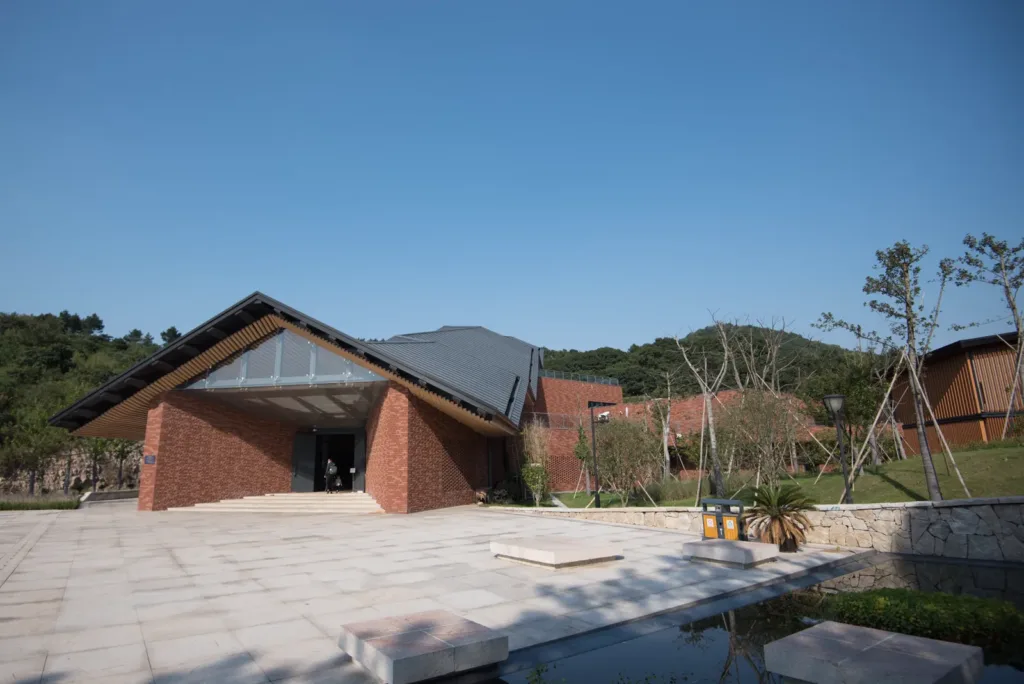 Exterior of the Shanglin Lake Yue-Kiln Museum in Cixi, Ningbo. Photo: Siyuwj (Wikimedia Commons user) · CC BY-SA 4.0
Shanglin Lake Kiln Site上林湖越窑遗址
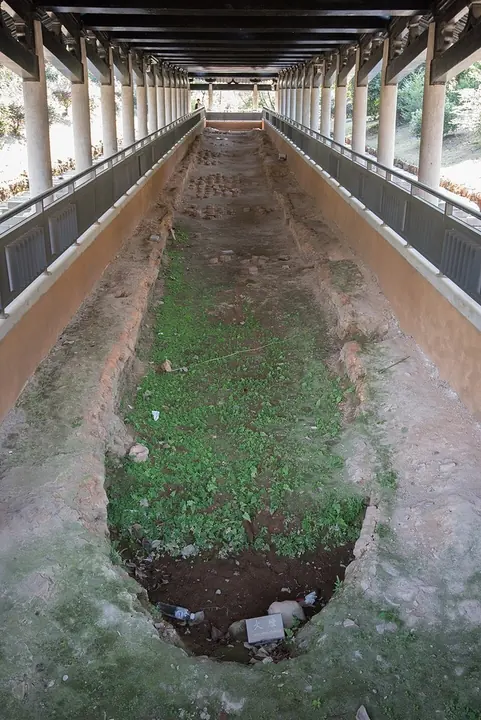
Shanglin Lake is a dispersed Yue celadon kiln landscape in Cixi, not a single compact ruin. Start at the museum and the designated displays: Hehuaxin shows the slope-built dragon kiln, while Housi’ao explains the workshop and waste deposits behind high-grade Mise ware.
Read the place guide →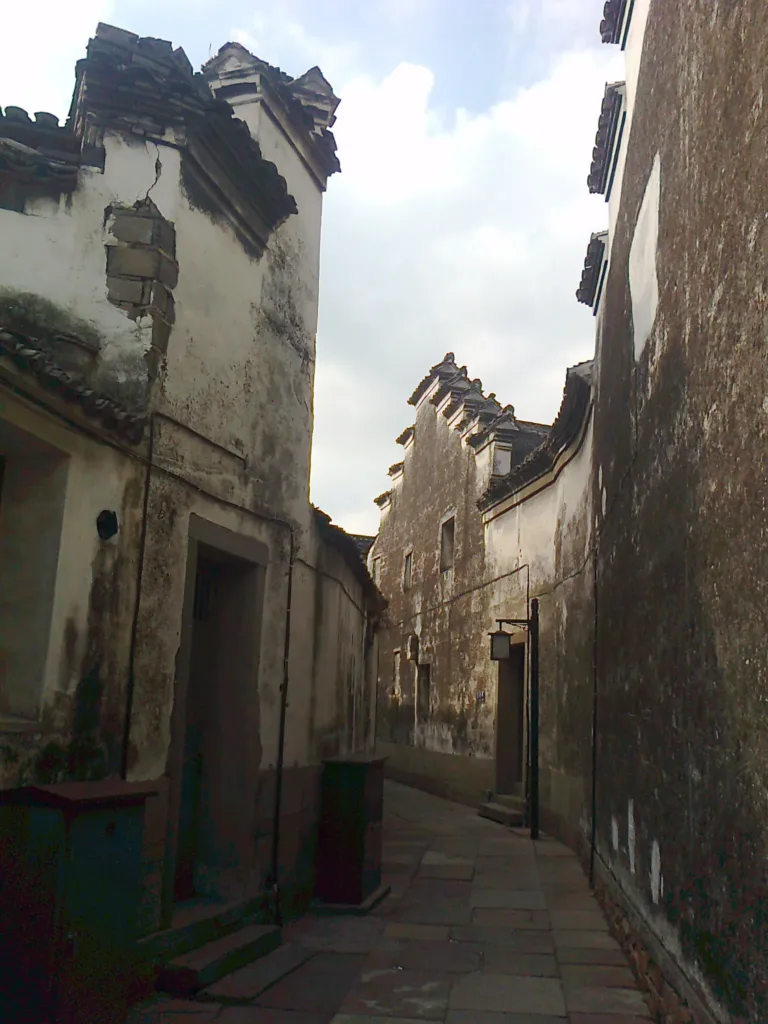 A narrow lane in Yinhao Lane, Minghe Ancient Town, with preserved horse-head gables and whitewashed historic walls. Photo: Mir7ror · CC BY-SA 3.0
Minghe Ancient Town鸣鹤古镇
Minghe Ancient Town is a compact, living historic town in southern Guanhaiwei Town, Cixi, Ningbo. Its old streets follow waterways between Du Lake and Baiyang Lake, below Wulei Mountain. The town is especially interesting for the way salt-trade and Chinese-medicine history remain visible in its bridges, merchant houses, riverside lanes and food traditions.
Read the place guide →Plan your visit
Getting there
Cixi City is about 50 km (straight-line distance) from central Ningbo. Search for 慈溪市 in a map app to find stations and your accommodation.
Where to stay →Build your route
Shanglin Lake Kiln Site and Minghe Ancient Town are about 4 km apart (straight-line distance). The linked place guides have entrance and visit details.
Continue with Ningbo →More in Ningbo
Sources & geographic information
Administrative names and parent areas: Official geographic directory (dmfw.mca.gov.cn) · Reference date 2026-09-06.
Background text adapted from Cixi, Zhejiang — Wikipedia contributors, under CC BY-SA 4.0. Text has been shortened and reorganized; source revision 1360139902.
Map data © OpenStreetMap contributors. Pins mark approximate centres, not entrances or boundaries.
Image credits & notes (1)
- Hehuaxin kiln remains at Shanglin Lake Yue Kiln Site · 上林湖越窑遗址荷花芯窑炉 Photograph date recorded by the source: 6 October 2018, 14:38:52. Shown locality: Shanglin Lake Kiln Site (上林湖越窑遗址), Cixi City (慈溪市).Photo: Siyuwj · Siyuwj — Yue-Kiln_sites_at_Shanglin_Lake,_2018-10-06_06.jpg — CC BY-SA 4.0 · CC BY-SA 4.0Resized for the web; the photo itself has not been edited. Thumbnails may show a cropped view.
