

Explore the region
Tap any red Chinese text to hear it in Mandarin.
Why this place matters
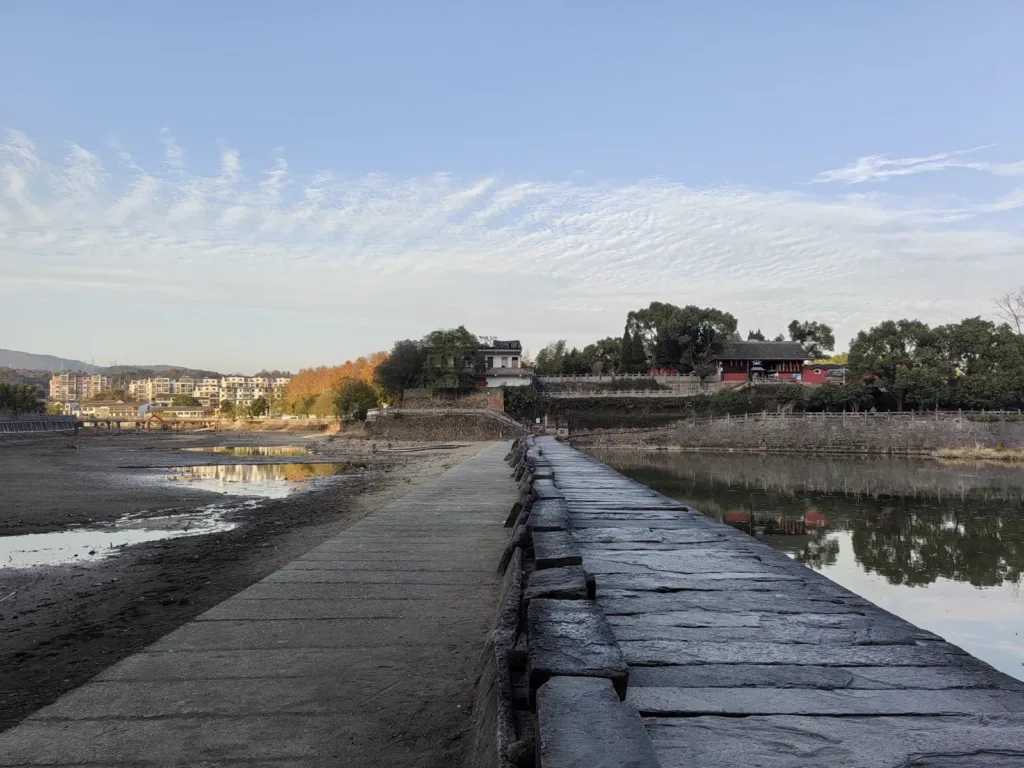
Tashan Weir was built in 833 under the county magistrate Wang Yuanwei, at the point where the Zhangxi stream leaves the hills for the plain. Before the weir, floodwater and tidal salt water made the Yinjiang plain difficult to farm. The weir divides the flow between the river and the canal system, helping to block salt water, retain fresh water, irrigate farmland and drain floods. Local reporting says that it still contributes to irrigation, flood drainage and urban environmental water management today.
The structure is best understood from its physical details rather than from a grand title. The main stone weir is 113.7 metres long, uses large dressed stone blocks and has 36 steps on each side. Its plan bows slightly upstream, while its changing thickness and sloping base help it withstand moving water. Stand where you can see the stepped crest and the water passing over it; then look for the separate channels that carry water away from the weir.
The first character in 它山堰 is read tuō, not the everyday tā. The name refers to Tashan, the hill beside the weir, and local explanations connect the pronunciation with an old Yue-language layer. The nearby Tashan Yide Temple, the Pianshi Liuxiang stele pavilion and the former Huisha Sluice belong to the wider historic setting described in the older site guide; this article keeps them as associated features, not as a second attraction or a separate ticket.
In 2015 the weir was included in the International Commission on Irrigation and Drainage’s World Heritage Irrigation Structures list. ICID describes that programme as a register for historic irrigation and drainage structures, with its own recognition process; it should not be confused with UNESCO World Heritage status. The weir is also listed among Ningbo’s national-level protected cultural sites.
A practical visit
The current listed address is the west side of Tashan Natural Village, Yinjiang Town, Haishu District, Ningbo: 浙江省宁波市海曙区鄞江镇它山堰村它山堰自然村西侧 Zhèjiāng Shěng Níngbō Shì Hǎishǔ Qū Yínjiāng Zhèn Tāshānyàn Cūn Tāshānyàn Zìráncūn xīcè. Search for 它山堰 Tāshān Yàn together with 海曙区 Hǎishǔ Qū. Older and third-party pages sometimes still label the place as 鄞州区; use the current Haishu address when asking for directions.
A current Trip.com attraction listing displays the outdoor site as open all day with free entry. That is a third-party listing, not a current operator notice. No official reservation, passport-booking rule or published admission tariff for the weir itself was found. Treat the weir as a working water-control heritage site rather than as a staffed museum: water levels, maintenance and local access arrangements can affect where visitors may stand.
There is no verified metro station or metro exit for the weir, so do not plan the last leg around a guessed “nearest” station. A current route listing for Ningbo bus 634 runs between 迈水桥小区 Màishuǐqiáo Xiǎoqū and 鄞江公交站 Yínjiāng Gōngjiāo Zhàn and includes 鄞江商埠 Yínjiāng Shāngbù. A visitor guide for Tashan Weir names that stop, along with routes 637 and 638, and describes a walk onward from the town area. For the most reproducible public-transport option, take 634 toward 鄞江公交站 Yínjiāng Gōngjiāo Zhàn, get off at 鄞江商埠 Yínjiāng Shāngbù, and confirm the final walk in Amap or Apple Maps. For the return to the city side, use the opposite-direction 634 service toward 迈水桥小区 Màishuǐqiáo Xiǎoqū from the same stop; check the live timetable before setting out.
For a taxi or ride-hailing car, show the Chinese destination 它山堰 Tāshān Yàn and the address above. The older guide warns that its map pin was not reliable and recommends searching by the Chinese name. It does not establish a single official tourist gate, so ask to be taken to the publicly accessible visitor side of the weir rather than to a generic “Tashan village” location.
Local reports describe the Yinjiang temple fair on the lunar third day of the third month, sixth day of the sixth month and tenth day of the tenth month, with dragon dancing, waist drums and opera. These are traditional calendar dates, not a promise of a fixed programme on every visit; check a local notice before planning around one.
Keep the boundaries clear
The weir itself is the subject here: an outdoor hydraulic structure and its immediate historic setting. The newly opened Ningbo Museum of World Heritage Irrigation Structures is a separate indoor venue reported alongside recent organised visits to Tashan Weir. Its opening hours, admission and any passport or appointment rules should be checked separately rather than inferred from the weir’s free-entry listing.
Find Tashan Weir
它山堰 · 海曙区
The pin marks the area, not the entrance.
Sources & visit information
Sources checked on 24 October 2026. Hours, tickets, reservations and transport can change; confirm with the operator before you go.
Image credits & notes (1)
- Tashan Weir seen from the south, showing the stone crest, adjacent water channels and riverside setting. Photo: YumetoPhoto: CC BY-SA 4.0