


Get to know Haishu District
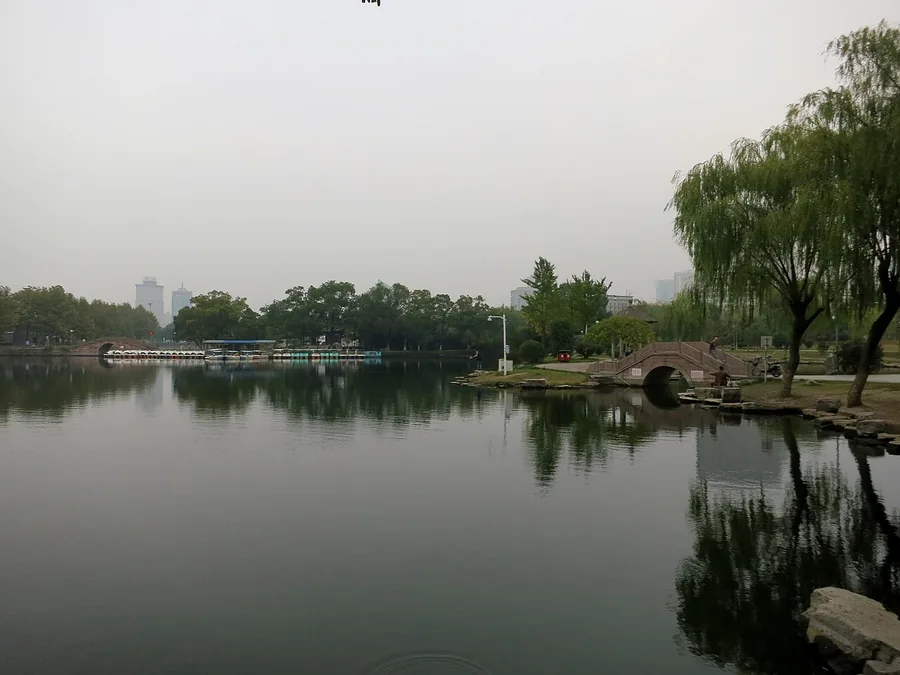
Photo adjustments
Proportionally resized and converted to WebP without cropping, retouching or changing the photographed subject.
- Administrative area
- District · 市辖区
- Part of
- Ningbo
- Chinese name
- 海曙区
- Local areas
- District guide
Area & population
- Area in the source
- 595.19 km²
- Population · 2017
- 909,000
Source: cited geographic source, as of the dates shown.
History
The area formally became Ningbo's administrative centre in the Eastern Jin, when Liu Yu (刘裕) moved the seat of Gouzhang County (句章县) to Yinjiang (鄞江镇). In 821 the prefect of Mingzhou (明州) moved the prefectural seat to the west bank of Sanjiangkou (三江口, 'three rivers' mouth'), which has been the centre of the city for more than 1,200 years since. Under the Qing the area was the seat of the Ningshaotai circuit (宁绍台道). Zhenming District (镇明区) was merged into Haishu in 1984, and in 2016 the part of Yinzhou west of the Fenghua River was added.
What to see
Haishu holds seven national key protected sites, more than any other county or district of Ningbo. They are the Tianyi Pavilion (天一阁), a private library, with the Qin family ancestral hall (秦氏支祠), the Tashan Weir (它山堰), the Yongfeng storehouse site (永丰库遗址), Tianning Temple (天宁寺), Baiyun Manor (白云庄), the Qianye Guild Hall (钱业会馆), where Ningbo's native banks settled bills, and the Lin residence (林宅). Moon Lake (月湖), in the east of the district, began as a reservoir dug in the Tang and is now a city-level historic conservation area. Tianfeng Pagoda (天封塔) is the landmark of the old city, and Tianyi Square (天一广场) is a major shopping area.
The Tashan Weir at Yinjiang, built in 833 of stacked stone slabs, is a 113.7-metre weir on the Yin River (鄞江). It split the river, holding back the salt tide and storing fresh water that irrigated farmland in Yinxi (鄞西), the western part of old Yin, and flowed into the city, where it formed the Sun and Moon lakes. It was listed as a national key protected site in 1988 and as World Irrigation Heritage in 2015. Yinjiang holds temple fairs for the weir on the third day of the third lunar month, the sixth of the sixth and the tenth of the tenth.
Setting and local stone
Meiyuan stone (梅园石), a pale purplish-grey volcanic tuff, was quarried at Yinjiang. Ningbo Daily reports that a Tianyi Pavilion Museum expert in 2003, and Japanese geologists in 2008, traced to it the stone lions at the south gate of Tōdai-ji in Nara, carved more than 800 years ago by masons from China, some of them from Ningbo.
Getting oriented
Ningbo railway station is in Haishu, on the Hangzhou–Ningbo high-speed line, and Metro Line 1 crosses the district, meeting Line 2 at Gulou (鼓楼站).
Highlights
- Tianyi Pavilion 天一阁: Private library listed as a national key protected site together with the Qin family ancestral hall.
- Tashan Weir 它山堰: Stone weir of 833 at Yinjiang; World Irrigation Heritage since 2015.
- Moon Lake 月湖: Tang-era reservoir, now a city-level historic conservation area.
- Qianye Guild Hall 钱业会馆: Where Ningbo's native banks settled bills; national key protected site.
Sources for this guide
海曙区 - 维基百科 · Wikipedia (Chinese) · CC BY-SA 4.0
它山堰 - 维基百科 · Wikipedia (Chinese) · CC BY-SA 4.0
神奇的石头会说话 · Ningbo Daily
Original English written from the listed sources and checked sentence by sentence against quoted extracts by a separate reviewer. Updated 2026-09-25.
Explore Haishu District
Core places to explore, with English and Chinese names.
Places to explore around Haishu District
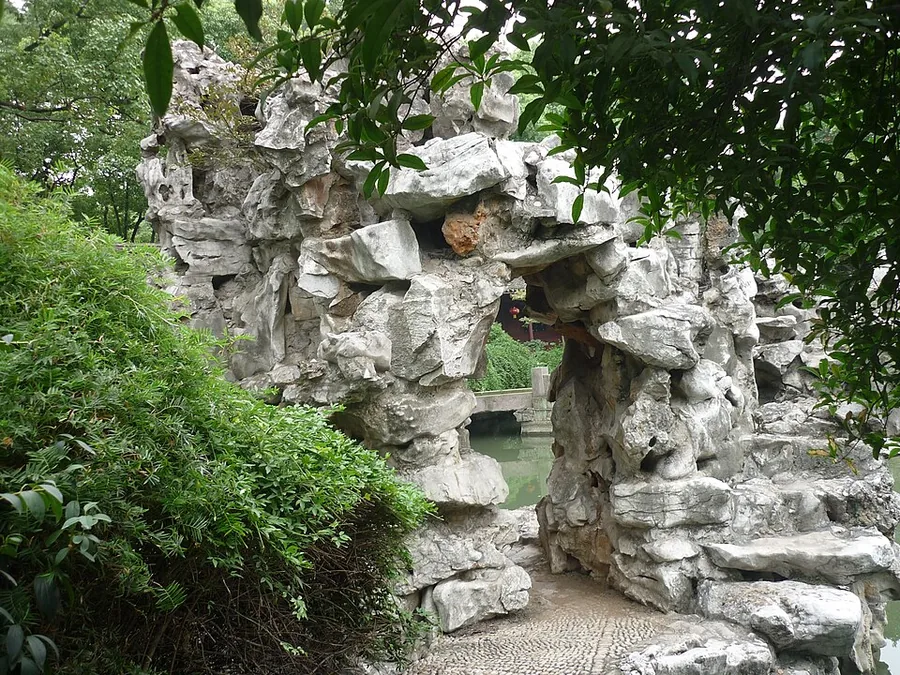 Rockery passage inside the garden of Tianyi Pavilion Museum, Ningbo · 宁波天一阁花园假山. Source-recorded photograph date: 2011-09-24 11:03:01.
Tianyi Pavilion Museum天一阁博物院
Tianyi Pavilion Museum in Ningbo centres on the private library established by the Ming official Fan Qin in 1561.
Read the place guide →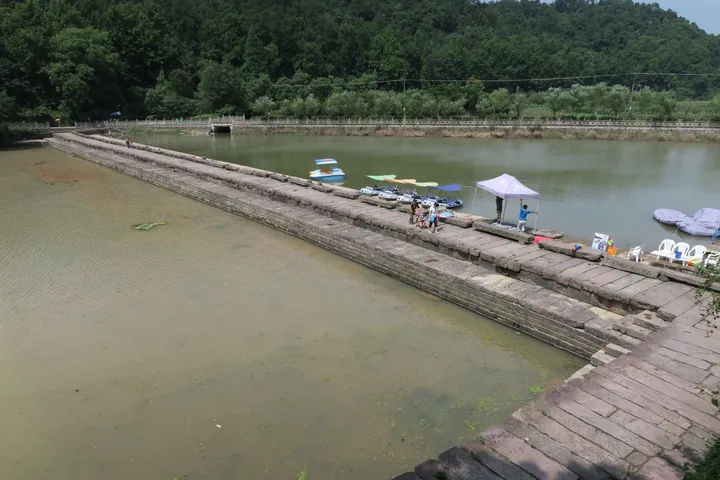 The ancient stone weir of Tuoshan Yan on the Yin River, Haishu District, Ningbo · 宁波海曙区鄞江它山堰 Source-recorded photograph date: 2017-07-01 10:27:13.
Tashan Weir它山堰
Stone weir of 833 in Ningbo's Yinjiang Town that splits the river to hold back tides and feed the plain; a World Heritage Irrigation Structure.
Read the place guide →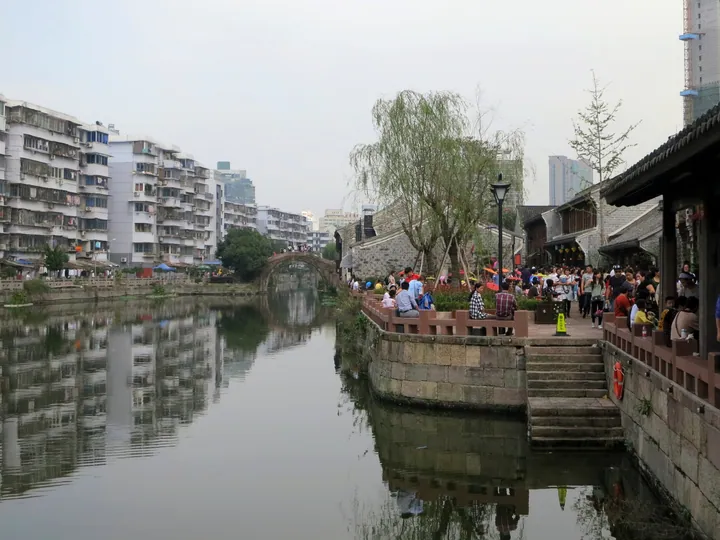 Canal-side view of Nantang Old Street in Haishu District, Ningbo, with the stone arch bridge and traditional riverside buildings · 宁波市海曙区南塘老街,河道石拱桥与临河传统建筑 Source-recorded photograph date: Taken on 25 October 2015.
Nantang Old Street南塘老街
Nantang Old Street is a historic commercial district beside the Nantang River in Ningbo's Haishu area.
Read the place guide →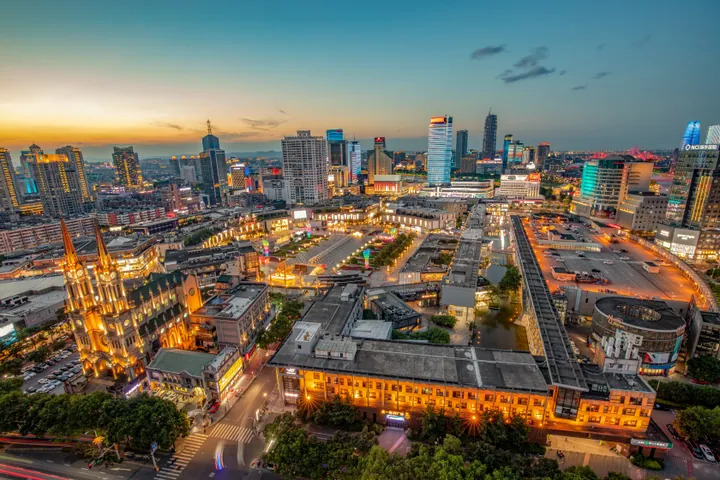 Dusk skyline over Tianyi Square, Haishu District, Ningbo · 宁波海曙区天一广场夜景 Source-recorded photograph date: 2020-02-10.
Tianyi Square天一广场
Shopping complex opened in 2002 in central Ningbo around a square with a musical fountain, water screen and the rebuilt Church of the Assumption.
Read the place guide →Moon Lake Park in Ningbo, October 2015.Moon Lake (Ningbo)月湖
Moon Lake forms a historic water landscape in Ningbo’s Haishu old city. Its stone-arched Central Lake East Bridge and the water-level stele near Pingqiao River connect scenic design with practical water management. Shrines and…
Read the place guide →Plan your visit
Getting there
Haishu District is about 7 km in a straight line from central Ningbo. Search for 海曙区 in a map app to find stations and your accommodation.
Where to stay →Build your route
Tianyi Pavilion Museum and Tashan Weir are both listed here. The linked place guides have entrance and visit details.
Continue with Ningbo →More in Ningbo
Sources & geographic information
Administrative names and parent areas: Official geographic directory · Reference date 2026-09-06.
Some facts checked against 海曙区 — Wikipedia contributors, CC BY-SA 4.0.
Some facts checked against 它山堰 — Wikipedia contributors, CC BY-SA 4.0.
Photo: Tianyi Pavilion Museum · Siyuwj · CC BY-SA 3.0. Full source framing retained; proportionally resized and converted to WebP. No retouching or subject alteration. Card displays may crop the view.

Photo: Tashan Weir · Siyuwj · CC BY-SA 4.0. Full frame retained; proportionally resized and converted to WebP. No retouching or changes to the photographed subject. Card displays may crop the view.

Photo: Nantang Old Street · rheins · CC BY 3.0. Full frame retained; proportionally resized and converted to WebP. No retouching or changes to the photographed subject. Card displays may crop the view.

Photo: Tianyi Square · Nbfreeh · CC BY-SA 4.0. Full frame retained; proportionally resized and converted to WebP. No retouching or changes to the photographed subject. Card displays may crop the view.

Photo: Moon Lake (Ningbo) · rheins · CC BY 3.0. Proportionally resized and converted to WebP without cropping, retouching or changing the photographed subject.
.jpg)
Map data © OpenStreetMap contributors. Pins mark approximate centres, not entrances or boundaries.