

Explore the region
Tap any red Chinese text to hear it in Mandarin.
A port edge beside a living city
The Old Bund sits on the north bank of Ningbo’s central river junction in Jiangbei District. Ningbo formally opened the port to foreign trade in 1844, and the surviving streetscape records that change in material form: consular and commercial buildings, religious architecture, residences and the water-facing roads that served the port. The district is not a museum frozen behind a gate. It is a public urban quarter, so the best way to understand it is to compare the old façades with the river, bridges and present-day city around them.
Begin at the riverside, then make a short circuit through the lanes behind the waterfront. Look for the contrast between European-influenced façades and local Chinese building forms, and for the way cafés, restaurants, bars, cultural venues and shops have been inserted into the historic setting. The former British Consulate, the former Zhejiang Customs site, the former police station and the Catholic church are useful landmarks for reading the port’s different institutional layers. Treat them as things to view from the public streets unless a named institution clearly advertises an open interior; a district walk does not include every building or exhibition.
The Old Bund is most rewarding when the river is part of the walk rather than just a backdrop. In daylight, notice the junction of the waterways and the changing scale from older low-rise buildings to the modern skyline. Toward evening, the commercial and music scene becomes more active, and the waterfront is used as a social public space by Ningbo residents as well as visitors. Reported festivals, markets and outdoor performances are occasional programmes, not a daily guarantee, so check the venue or district notice if a particular event matters to your visit.
Visit and getting there
The public street district is listed as free and open around the clock. That applies to the open-air walk, not automatically to Ningbo Museum of Art, a church interior, a temporary exhibition, a cruise or a restaurant. Named venues can have their own opening days, reservations and charges; the visitor information I found specifically notes separate reservation arrangements for the art museum. No district-wide passport policy is published, so confirm foreign-passport booking and entry rules directly with any venue you intend to enter.
For the closest rail approach, take Ningbo Metro Line 2 or Line 7 to Waitan Bridge / 外滩大桥. Line 2 runs through Ningbo Railway Station / 宁波站 and Lishe International Airport / 栎社国际机场 before reaching Waitan Bridge; when travelling from either of those points, use the Honglian / 红联 direction. For the return, use the opposite Line 2 platform toward Lishe International Airport / 栎社国际机场. Line 7 serves the same station in the Yunlong / 云龙 and Yufan / 俞范 directions. Follow station signs and local wayfinding toward 老外滩 and the riverside; an exit number is not necessary for this district walk and is not stated here as a fixed instruction.
By taxi or ride-hailing car, show the destination 宁波老外滩(江北区中马路157–159号). Practical visitor listings also describe the core approach around 江夏街与甬江大桥交汇口 Jiāngxià Jiē yǔ Yǒngjiāng Dàqiáo jiāohuìkǒu. Because Old Bund is a district rather than a single enclosed attraction, ask to be dropped at the public street or riverside approach, then walk between the riverfront and the historic lanes. To leave, retrace the same public streets to Waitan Bridge and take the reverse metro direction, or return to the exact taxi pick-up point you selected.
Find Ningbo Old Bund
老外滩 · 江北区
The pin marks the area, not the entrance.
Sources & visit information
Sources checked on 24 October 2026. Hours, tickets, reservations and transport can change; confirm with the operator before you go.
Image credits & notes (1)
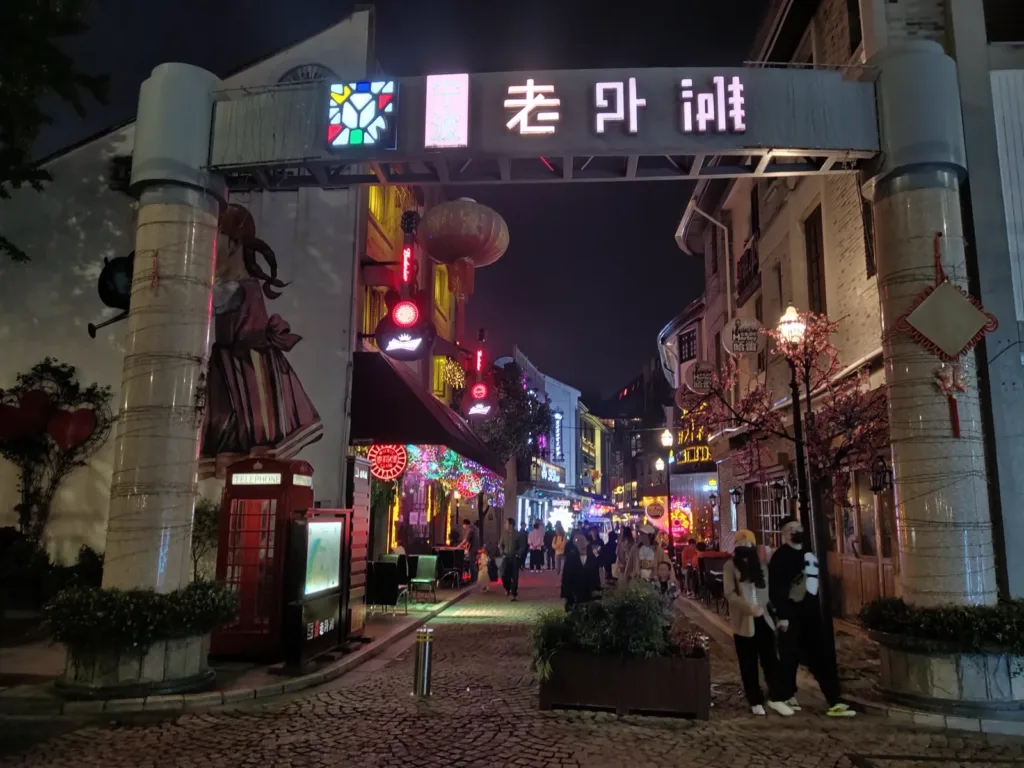
- Night entrance to Ningbo Old Bund, with the illuminated 老外滩 sign and the pedestrian commercial lane behind it. Photo: 西安兵马俑Photo: CC BY-SA 4.0