


Get to know Jiangbei District

- Administrative area
- District · 市辖区
- Part of
- Ningbo
- Chinese name
- 江北区
- Local areas
- District guide
Area & population
- Area
- 209.00 km²
- Population · 2002
- 230,000
Source: English Wikipedia, as of the dates shown.
Jiangbei is not one compact attraction. The southern riverfront around Ningbo Old Bund feels like a central evening walk, while Cicheng is a separate historic-town visit and Baoguo Temple is a hillside museum reached farther out in Hongtang. The district lies north of the Yao and Yong rivers, with plains, northern hills and a dense water network; that geography explains why its experiences range from port streets to wooded heritage.
Three different ways to explore it
Ningbo Old Bund: port history beside the rivers
At the Old Bund, look beyond the restaurants and lights to the river edge and the surviving port-era buildings. Xinhua describes the area as a historic shipping port at the meeting of the Yong, Yuyao and Fenghua rivers; its later pedestrian-street renewal brought historic buildings, wharf scenery and modern businesses together. The 2023 report described a 4.8-hectare pedestrian area with more than 140 shops, so this is a public waterfront district rather than a single museum with one entrance.
The best visit is an unhurried walk that uses the street, river views and exterior architecture as the main experience. A local visitor guide lists the area as free and open throughout the day, with the evening lights usually most attractive; any cruise or museum inside the wider area is a separate product. Do not confuse Ningbo’s Old Bund with Shanghai’s Bund, and do not treat its cafés and nightlife as proof that every historic interior is open.
Cicheng: a former county town, not a single ticketed sight
Cicheng preserves the street pattern and civic memory of a former county seat on the Yao River. Its Confucian Temple, former county yamen, School Examination Hall, traditional residences, small museums and lanes make more sense as a walk through an old administrative town than as a quick photo stop. Xinhua places its foundation in the Tang Kaiyuan period and describes the continued repair of the old town in an “old for old” approach; residents still live among the restored buildings.
The surrounding old-town streets are the easy part of the visit. Published visitor information says entry to the town is free, while several preserved buildings and exhibition sites—including the Confucian Temple, county yamen and School Examination Hall—are ticketed and can be combined at the visitor centre. It lists 08:30–16:50, with the entrance closing at 16:30. These are venue-level hours, not a promise that every museum, performance or seasonal lake activity is running.
Baoguo Temple: read the building, not just the legend
Baoguo Temple sits on the wooded lower slope of Lingshan in Hongtang. Its main hall was completed in 1013 under the Northern Song and preserves an unusually early timber structure; look upward at the bracket sets, the layered ceiling and the relationship between the hall’s timber frame and its later enclosing eaves. The site is presented as the Baoguo Temple Ancient Architecture Museum, with digital and three-dimensional displays that help explain what is difficult to see from ground level.
This is a quieter, more focused visit than Cicheng. The published visitor page lists a CNY 20 ticket, but its summary card says 08:00–16:30 year-round while its detailed section says Monday closed, 08:00–17:00 from April to November and 08:30–16:30 from December to March. Because that page is internally inconsistent, check the museum’s same-day notice before making a timed trip. No passport-specific reservation or entry rule is stated there.
Getting around Jiangbei
Plan the three experiences as separate stops rather than one walk. For Cicheng, Ningbo Metro Line 4 runs to Cicheng (慈城) from the city side; the line guide lists Ningbo Railway Station as a Line 2 interchange and lists local routes including 26, 331, 334 and 335 around Cicheng station. Continue on foot or use a local bus toward the old-town visitor centre, checking the return departure before entering the lanes.
For the Old Bund, Line 2 to Waitan Bridge (外滩大桥) is the most direct metro reference in the visitor information; Line 1 to Dongmenkou (东门口) is another central approach followed by a walk across Xinjiang Bridge. The area’s street entrance is around 中马路157–159号, so show the Chinese name 宁波老外滩 to a taxi or ride-hailing driver rather than asking for “the Bund.”
Baoguo Temple is a different last mile. The transport guide lists buses 332, 338 and 339 to 保国寺站, followed by about 300 metres on foot; another visitor page independently lists 332 and 338 as direct services. From Ningbo Railway Station, the practical options are to change to the bus routes or take a taxi to 保国寺古建筑博物馆. For a car, use that full Chinese museum name, not the district name alone.
Because Jiangbei is an administrative district rather than a walkable neighbourhood, allow the return journey as part of the plan. Metro stations and bus services are useful for the main corridors, but the last connection to a hillside museum or the old-town visitor centre can be less frequent than the city-centre leg. Confirm the current service and the closing time of the individual venue before setting out.
Explore Jiangbei District
Core places to explore, with English and Chinese names.
Places to explore around Jiangbei District
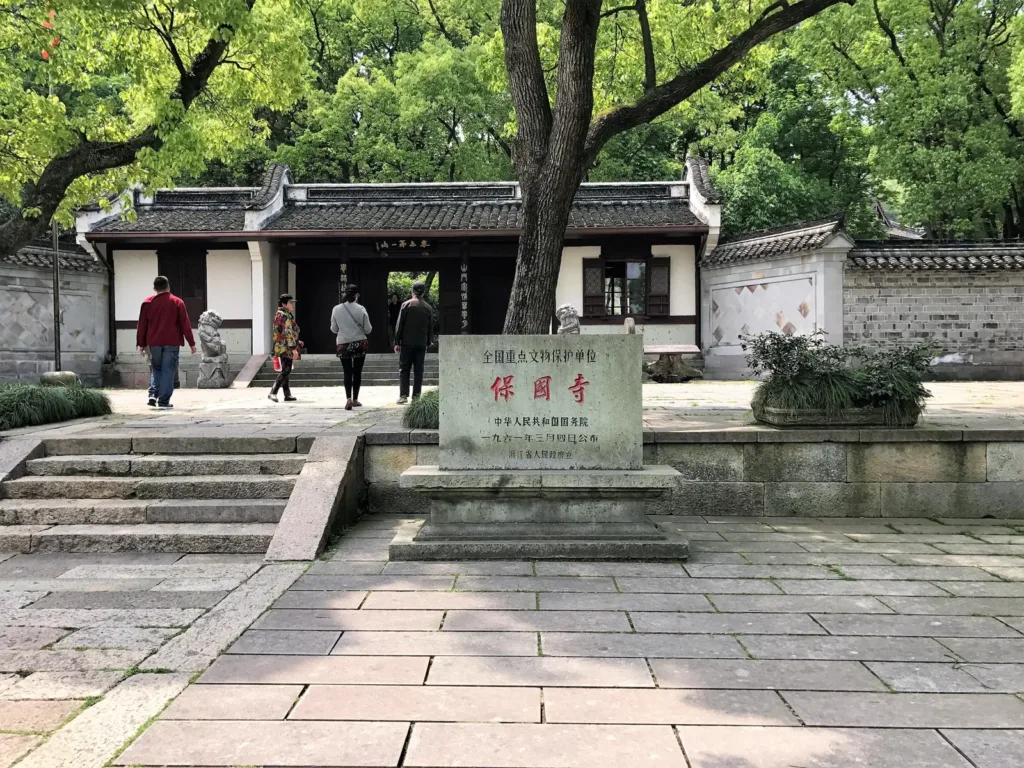 The entrance courtyard and historic gate of Baoguo Temple in Ningbo, with the national heritage marker in front. Photo: Nbfreeh · CC BY-SA 4.0
Baoguo Temple保国寺
Baoguo Temple is an ancient-architecture museum in Ningbo’s Jiangbei District, centred on a Northern Song main hall rebuilt in 1013. Its interest lies in reading a real timber frame in layers—the Song core, Qing enlargement, later halls and a Southern Song pond—rather than treating the whole compound as a single-age temple.
Read the place guide → The Lingxing Gate at Cicheng Confucian Temple, seen beside its red perimeter wall and a shaded street. Photo: Zhangzhugang · CC BY-SA 3.0
Cicheng ancient town慈城古县城
Cicheng is a former county seat preserved as a living historic town in Ningbo’s Jiangbei District. Its free-to-walk streets connect a Confucian Temple, a county yamen, an examination hall, Ming–Qing residences and everyday lanes; the separate heritage interiors are the places to pay for when you want the fuller story.
Read the place guide →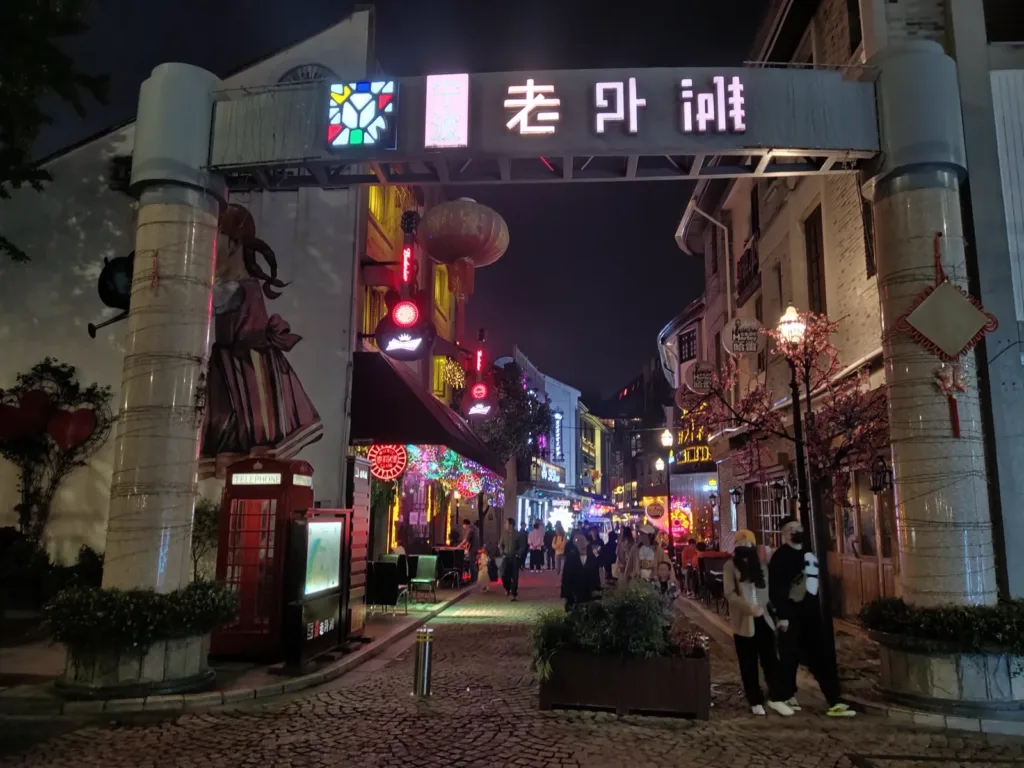 Night entrance to Ningbo Old Bund, with the illuminated 老外滩 sign and the pedestrian commercial lane behind it. Photo: 西安兵马俑 · CC BY-SA 4.0
Ningbo Old Bund老外滩
Ningbo Old Bund is a walkable historic waterfront district at Sanjiangkou, where the Yong, Fenghua and Yao rivers meet. Its appeal is the close view of a former foreign-trade port: European-influenced public buildings, Chinese residences, river traffic and a contemporary evening street of cafés, restaurants and bars all occupy the same compact area.
Read the place guide →Plan your visit
Getting there
Jiangbei District is about 7 km (straight-line distance) from central Ningbo. Search for 江北区 in a map app to find stations and your accommodation.
Where to stay →Build your route
Baoguo Temple and Cicheng ancient town are about 7 km apart (straight-line distance). The linked place guides have entrance and visit details.
Continue with Ningbo →More in Ningbo
Sources & geographic information
Administrative names and parent areas: Official geographic directory (dmfw.mca.gov.cn) · Reference date 2026-09-06.
Background text adapted from Jiangbei, Ningbo — Wikipedia contributors, under CC BY-SA 4.0. Text has been shortened and reorganized; source revision 1353483890.
Map data © OpenStreetMap contributors. Pins mark approximate centres, not entrances or boundaries.
Image credits & notes (1)
- Baoguo Temple roofs in their wooded setting, Ningbo · 宁波保国寺山林院景 Photograph date recorded by the source: 19 February 2015, 14:05:37. Shown locality: Baoguo Temple (保国寺), Jiangbei District (江北区).Photo: Siyuwj · Siyuwj — Ningbo_Baoguo_Temple,_2015-02-19_05.jpg — CC BY-SA 4.0 · CC BY-SA 4.0Resized for the web; the photo itself has not been edited. Thumbnails may show a cropped view.
