

Explore the region
Three rivers, one city edge
Sanjiangkou names the central junction of the Yaojiang, Fenghua River and Yong River. Those waterways are not just scenery: Ningbo’s civic and commercial life developed around them, and the city’s own discussion of its waterfront describes the three rivers as the main arteries of its urban history.
This is a broad urban space rather than one institution. The built core of the “Three Rivers and Six Banks” waterfront links river parks and public edges across the central junction. The landscape project describes three themed riverside districts joined by a central route, while local reporting describes park sections on the Jiangbei and Haishu sides and a longer south-bank greenway. Read the area as several connected walks, not as a single park with one entrance.
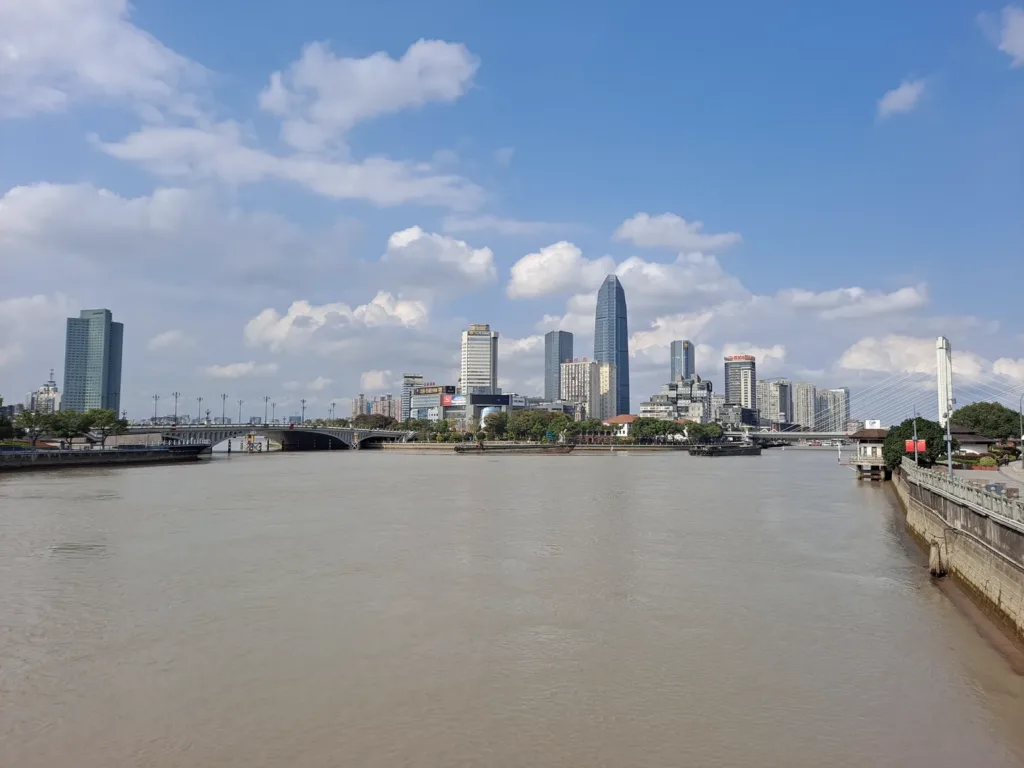
At water level, look for the meeting of three channels, the bridges that frame the view, and the change from older low-rise streets to the newer city skyline. The riverfront is also a record of Ningbo’s port city: historic buildings and former dock edges sit beside daily traffic, cafés, cultural spaces and ordinary residential life. The point is the juxtaposition, not a single monument.
How to walk it
Choose one bank as your starting point and follow the signed public riverside route before crossing to another side where a pedestrian connection is open. The Jiangbei section around the old waterfront and the Haishu section around Jiangxia Bridge offer different views; the south-bank promenade gives a wider look back toward the central junction. The park works were planned around walking, running and cycling, so comfortable shoes are more useful than a tightly timed checklist.
Keep the boundaries clear. Ningbo Old Bund is the best-known historic district on the north bank, but it is a neighbouring place within this larger riverfront setting, not a synonym for the whole of Sanjiangkou. A visit that only covers the Old Bund’s lanes has not covered the broader three-bank waterfront. Likewise, the Ningbo Art Museum, churches, museums and any cruise are separate venues or services with their own rules.
Daylight makes the river junction, bridges and working city easiest to read. After dark, the same edges become a public night-view route, with lights reflected across the water and the older and newer parts of the city facing one another. Older reports mention performances and themed programmes, but those are occasional programmes rather than a daily promise.
Visit, tickets and water travel
Treat the outdoor riverfront as a set of public city spaces, not as a ticketed compound. Visitor information lists Sanjiangkou as free and open all day, and the local park report describes the core sections as opened for public use. That does not guarantee that every park segment, temporary work area or adjacent indoor venue has the same hours.
There is no single Sanjiangkou passport or reservation system for an ordinary riverside walk. Entry to a named museum, church interior, exhibition, restaurant or cruise is separate; foreign-passport booking and admission rules for those individual services are not centrally stated in the sources used here. Check the specific venue before setting out.
A river cruise is an optional add-on, not the definition of the waterfront. On 24 October 2026, the readable Ctrip listing for Sanjiang Night Cruise / 三江夜游 said that service was due to resume on 26 October, showed fares from ¥98, and offered a round-trip ticket from Old Bund Pier, 外马路195号(原城展馆对面老外滩码头). The listing does not establish a year-round timetable or fully explain intermediate stops and the return procedure, so verify the dated sailing and ticket conditions at booking.
Getting there and getting back
For the Jiangbei and north-bank riverfront, take Metro Line 2 or Line 7 to Waitan Bridge / 外滩大桥. Line 2 serves the Honglian / 红联 and Lishe International Airport / 栎社国际机场 directions; Line 7 serves Yufan / 俞范 and Yunlong / 云龙. Follow station signs and local pedestrian wayfinding toward the riverside. No single exit number is given here because the waterfront has more than one approach.
For the Haishu and Tianyi Square side, use Line 1 to Dongmenkou (Tianyi Square) / 东门口(天一广场). The station’s two directions are Xiapu / 霞浦 and Gaoqiao West / 高桥西. From the station, follow pedestrian signs toward Tianyi Square and the riverfront, choosing the Jiangxia Bridge-side approach if that is your intended bank; an exit number is not stated as a fixed instruction.
Arriving by rail, get off at Ningbo Railway Station / 宁波站 and take Line 2 toward Honglian / 红联 to Waitan Bridge for the north-bank approach. For the return, use the opposite Line 2 direction toward Lishe International Airport / 栎社国际机场, or retrace your chosen route to Dongmenkou for the Haishu side.
There is no reliable single taxi drop-off for the whole area. Show 宁波三江口公园江北侧(老外滩滨江区域) for the north-bank public edge, or 三江口公园海曙侧(江厦桥附近) for the Haishu-side approach, and ask for a public riverside entrance rather than simply saying “Sanjiangkou”. If taking the cruise, use the separate Chinese pier address above and return on the booked round-trip product; do not assume that a cruise ticket replaces the land-side walk.
Find Sanjiangkou Waterfront
三江口滨水区 · 宁波
The pin marks the area, not the entrance.
Sources & visit information
Sources checked on 24 October 2026. Hours, tickets, reservations and transport can change; confirm with the operator before you go.
Image credits & notes (1)
- A daytime view across the river at Sanjiangkou, Ningbo, showing bridge approaches, the opposite-bank skyline and a riverside promenade. Photo: 钉钉Photo: CC BY-SA 4.0