

Explore the region
Tap any red Chinese text to hear it in Mandarin.
Why visit
Hemudu is not just a name from a history textbook. The museum makes a very early Lower Yangtze settlement tangible through the things people handled and ate: cultivated rice, bone farming tools, fishing and hunting equipment, wooden building parts, pottery, weaving tools and finely worked ivory, bone, stone and jade. The site is in Yuyao, within Ningbo’s wider municipal area, about 24 km west of central Yuyao and about 25 km east of Ningbo according to the museum’s published introduction.
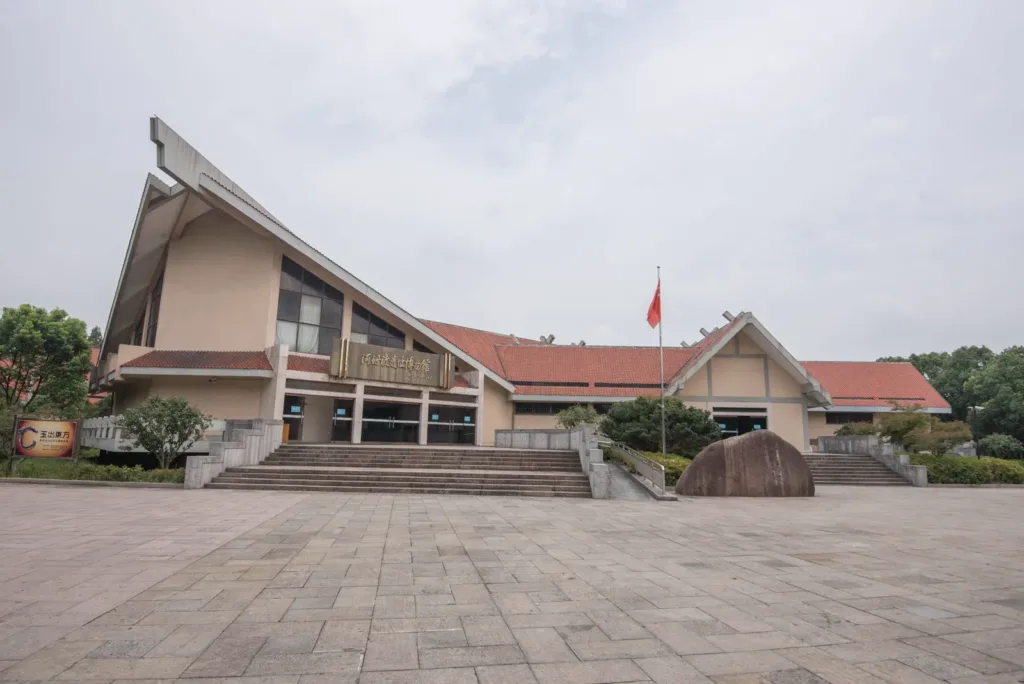
Start with the building itself. Its raised floors, long ridge and short eaves refer to the elevated timber houses associated with Hemudu, while the roof structure recalls early mortise-and-tenon woodworking. Inside, the displays connect agriculture with fishing, hunting and gathering rather than presenting rice farming as the settlement’s only food source.
What to look for
The museum’s strongest objects are small, material and specific. Look for carbonised rice and the bone spade made from an animal shoulder blade; together they show both cultivation and the tools used to work wetland soils. The “Double Birds Facing the Sun” butterfly-shaped ivory object is a particularly recognisable piece of Hemudu art, with a circular sun-like centre and paired birds. A carved pig-decorated pottery bowl, wooden building joints and textile tools add different views of food, construction and craft.
The updated displays reported after the 2024 renovation used projections, an interactive map, a digital sand table and close-up screens alongside the objects. Treat those as aids to reading the evidence, not substitutes for it: ask which item is an excavated object, which is a reconstruction and which is a model. The museum’s own site has also been described as having an archaeological-site display area, but the separately ticketed Hemudu Archaeological Site Park is a different visit; do not assume one ticket, entrance or opening day covers both.
A useful sequence is to begin with the overview, then follow rice cultivation and subsistence, before moving to wooden construction, textiles and decorative art. If the archaeological-site display is open on the day, use it to compare the objects with the setting rather than treating reconstructed houses as original Neolithic buildings. Individual display access and the live visitor route can change.
Practical visit
Location: 河姆渡遗址博物馆, Hemudu Town, Yuyao City, Ningbo, Zhejiang; the government listing gives 余姚市河姆渡镇芦山寺村 as the address.
Opening: The Yuyao cultural-authority listing gives a summer schedule of 08:30 opening, last entry at 16:30 and closing at 17:00; the winter schedule is 09:00 opening, last entry at 16:00 and closing at 16:30. It lists Monday closure except on public holidays.
Admission and booking: The museum’s published visitor notice says the exhibition halls and archaeological-site display were free to visit. A 2026 field check also distinguishes this free museum from the separately operated, ticketed Hemudu Archaeological Site Park. For a group of 20 or more, the museum notice says to reserve in advance and have the group leader take the reservation document to the ticket window. The available sources do not confirm a passport-specific online booking or a current individual reservation rule, so call before relying on either.
Contact: 0574-62963731 or 0574-62963732. Use the Chinese name when calling or searching.
Getting there and back
There is no metro at this rural site. The clearest public-transport option is Yuyao Bus 405 from 兰江站 (Lanjiang Station) toward 龚冯 (Gongfeng); the route listing includes the stop 河姆渡遗址 (Hemudu Site). Take the reverse-direction 405 back toward Lanjiang after the visit. Yuyao Bus 406 also runs from Lanjiang Station to 河姆渡站 (Hemudu Station), with the reverse service returning to Lanjiang; confirm which stop is being used for the museum before boarding because the two route names are not the same. The route listing is a local transport directory updated 28 September 2025, so check the day’s service before leaving.
By taxi or ride-hailing car, enter 河姆渡遗址博物馆,余姚市河姆渡镇芦山寺村 Hémǔdù Yízhǐ Bówùguǎn, Yúyáo Shì Hémǔdù Zhèn Lúshānsì Cūn. One travel listing describes the roadside approach as 经河线浪墅桥村旁 Jīnghé Xiàn Làngshùqiáo Cūn páng; use the museum’s Chinese name and confirm the visitor entrance with the venue rather than relying on an approximate map pin. Keep the return plan—reverse Bus 405/406 or a pre-arranged car—before entering the site.
The museum’s location is often combined with the Hemudu Archaeological Site Park in travel listings, but they are not the same recommendation. The museum is the place for the collection and interpretation described here; the park has its own entrance, ticketing and operating notices. Check both separately if you intend to visit both.
Find Hemudu Site Museum
河姆渡遗址博物馆 · 余姚市
The pin marks the area, not the entrance.
Sources & visit information
Sources checked on 24 October 2026. Hours, tickets, reservations and transport can change; confirm with the operator before you go.
Image credits & notes (1)
- The entrance façade of Hemudu Site Museum in Hemudu Town, Yuyao, photographed in 2017. Photo: SiyuwjPhoto: CC BY-SA 4.0