


Get to know Yuecheng District
- Administrative area
- District · 市辖区
- Part of
- Shaoxing
- Chinese name
- 越城区
- Local areas
- District guide
Area & population
- Population · 2020
- 1,020,037
Source: English Wikipedia, as of the dates shown.
The old city is best read at street level. A canal-side lane may lead to a stone bridge, a white-walled tai-men compound, or a small view over the water; the historic fabric is still mixed with homes, local shops and everyday movement. Cangqiao Straight Street and Bazi Bridge show how streets, bridges and waterways worked together, while the Shusheng Guli area adds the memory of Wang Xizhi’s calligraphy.
Literary memory is unusually tangible here. Lu Xun Native Place preserves the writer’s Shaoxing home, Baicao Garden and Sanwei Study, while Shen Garden is associated with the Southern Song poet Lu You and Tang Wan. These are separate places with their own visitor arrangements, not rooms in one district-wide museum.
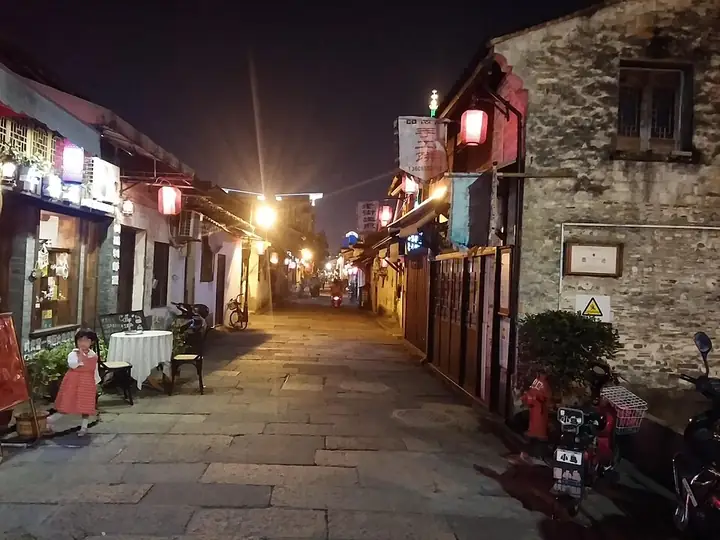
Yuecheng’s old city also remains a local evening environment. Around the historic streets, food stalls, small shops, markets, performances and seasonal cultural events sit alongside residential lanes; the point is not to treat residents or a festival crowd as a staged show, but to notice how the protected city is used after work and after dark.
A district with more than one scale
Yuecheng is a city district of Shaoxing, not another name for the old-town walking area. Its administrative territory contains 16 subdistricts and one town, extending across the northern plain and water network toward the Kuaiji foothills. The old city is the most concentrated visitor area, but it is only one part of the district.
There is no useful district-wide admission ticket or reservation. Public streets and bridges in the old city are different from separately managed attractions such as Lu Xun Native Place, Shen Garden, East Lake or the Mausoleum of Yu. Check the named venue’s current opening, ticket, reservation and passport-acceptance rules before setting out; do not transfer one attraction’s conditions to the whole district.
How to explore it
For a first walk, choose one old-city cluster rather than trying to cover the whole administrative area. Cangqiao Straight Street is a canal-side historic street of late-Qing and early-Republican houses. Bazi Bridge is a stone bridge at a complex water junction, best understood from the banks and approach lanes rather than as an isolated photo stop. Shusheng Guli adds waterside lanes and calligraphy history. Lu Xun Native Place and Shen Garden are separate cultural visits nearby, with different entrances and visitor rules.
Walk slowly at the water’s edge, but remember that these are lived-in neighborhoods. Keep clear of household doorways, take care on damp stone, and ask before photographing people or private interiors. A wupeng boat can provide a different view of the canals when a specific operator is running, but it is a place-specific experience, not a district-wide public-transport loop; confirm the boarding point, operating time and return arrangement before paying.
East Lake, a quarry landscape of cliffs and water, and the Mausoleum of Yu at the foot of the Kuaiji Mountains belong to Yuecheng but should be planned as separate outings from the old-city lanes. They are not sensible add-ons to a short walk through Cangqiao Straight Street or Lu Xun Native Place.
Getting to and around Yuecheng
High-speed trains arrive at Shaoxing North Railway Station (绍兴北站). Since the northern section of Shaoxing Metro Line 1’s branch opened, the station connects directly with the city metro network. Follow the branch toward the main Line 1 network, then choose the old-city station that matches your destination.
For the historic core, Lu Xun Native Place Station (鲁迅故里站) serves the Lu Xun area, while City Square Station (城市广场站) is the practical Line 1 arrival for the central historic streets around Cangqiao Straight Street. The exact exit and last walking turn depend on the venue, so use the named Chinese destination after leaving the station rather than treating the district name as an entrance.
Shaoxing Railway Station (绍兴站) is a separate railway arrival from Shaoxing North. Check the station printed on your ticket before arranging the final transfer, and return to that same named station for the journey out. A taxi or ride-hailing driver should be given the exact Chinese name of the particular venue—such as 鲁迅故里 Lǔ Xùn Gùlǐ, 仓桥直街 Cāngqiáo Zhíjiē or 书圣故里 Shūshèng Gùlǐ—because “越城区” covers a large administrative area and has no single visitor gate.
Explore Yuecheng District
Core places to explore, with English and Chinese names.
Places to explore around Yuecheng District
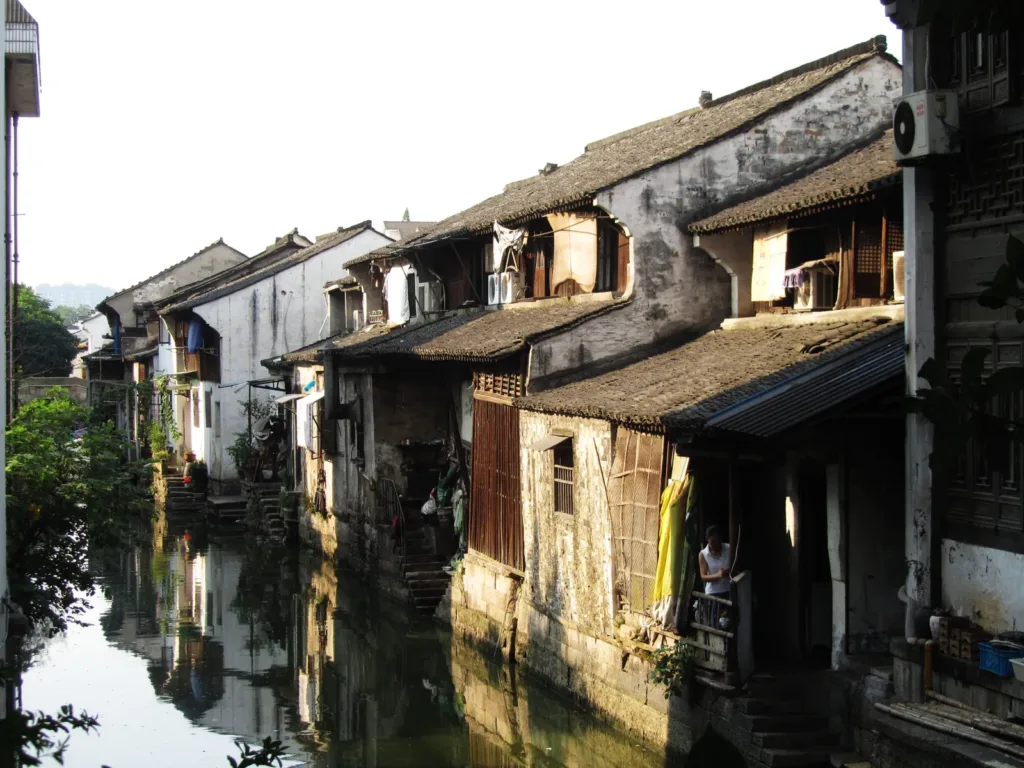 Canal-side residences and the river edge on Cangqiao Straight Street, Shaoxing, photographed on 5 July 2012. Photo: 猫猫的日记本 · CC BY-SA 4.0
Cangqiao Straight Street仓桥直街
Cangqiao Straight Street is a living historic neighbourhood in central Shaoxing, where a canal-side stone-paved lane, late-Qing and early-Republic homes, and old bridges remain part of an ordinary residential and commercial street. Its interest lies in seeing Shaoxing’s water-town architecture and everyday life together, rather than visiting a reconstructed theme street.
Read the place guide → The entrance wall of Lu Xun Native Place, with the site's name, a historical street mural and the surrounding traditional roofline. Photo: Gisling · CC BY 3.0
Former Residence of Lu Xun in Shaoxing鲁迅故里
Lu Xun’s childhood home, family residences, Baicao Garden and Sanwei Study form a walkable literary heritage quarter in central Shaoxing. Its value lies in seeing the domestic rooms and schoolroom behind scenes that became part of Lu Xun’s writing, rather than treating it as a generic old street.
Read the place guide → Ink Pool and waterside historic homes at the Wang Xizhi former-residence area in Shusheng Cultural Street, Shaoxing. Photo: Zhangzhugang · CC BY-SA 4.0
Shusheng Cultural Street书圣故里
Shusheng Cultural Street (书圣故里) is a living historic neighbourhood on the southern slope of Jishan in Shaoxing’s Yuecheng District. Its public lanes connect waterside homes with places associated with Wang Xizhi, the calligrapher remembered as China’s “Sage of Calligraphy”: Jiezhu Temple, the Ink Pool and Tishan Bridge. It is special because the story is encountered in an ordinary residential fabric rather than inside one museum or ticket gate.
Read the place guide →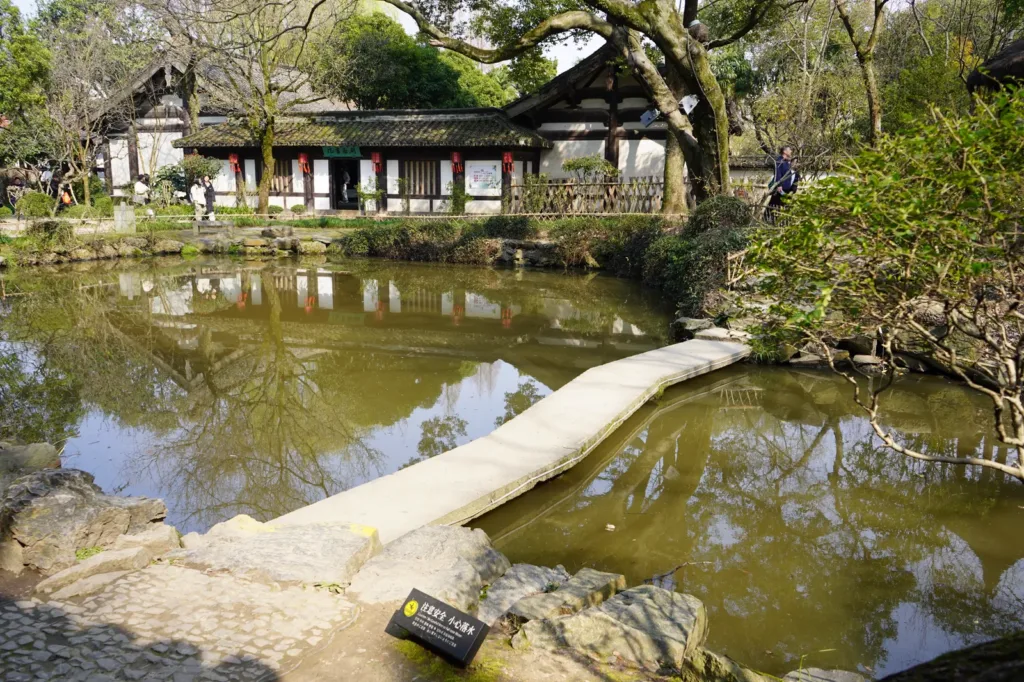 The gourd-shaped pond and a traditional building in the historic-remains area of Shen Garden, Shaoxing. Photo: 猫猫的日记本 · CC BY-SA 4.0
Shen Garden沈园
Shen Garden (Shen Yuan, 沈园) is a literary memorial garden in Yuecheng, Shaoxing, associated with Lu You, Tang Wan and the Chaitoufeng poems. Its poem wall, ponds and Song-inspired pavilions form a later commemorative landscape rather than an untouched Song garden.
Read the place guide → Shaoxing Museum entrance and forecourt · 绍兴博物馆入口 Photograph date recorded by the source: 18 March 2025, 11:42:29.
Shaoxing Museum绍兴博物馆
Shaoxing Museum is now anchored by a new building in Jinghu, where the “One Yue, Ten Thousand Years” history display follows the region from its natural setting and early Yue culture through imperial and modern Shaoxing. More than 4,000 objects, a long-term bronze-mirror gallery and a digital display of Yue heritage held around the world make this the city’s clearest single introduction to its past.
Read the place guide →Plan your visit
Getting there
Yuecheng District is about 7 km (straight-line distance) from central Shaoxing. Search for 越城区 in a map app to find stations and your accommodation.
Where to stay →Build your route
Cangqiao Straight Street and Former Residence of Lu Xun in Shaoxing are about 1 km apart (straight-line distance). The linked place guides have entrance and visit details.
Continue with Shaoxing →More in Shaoxing
Sources & geographic information
Administrative names and parent areas: Official geographic directory (dmfw.mca.gov.cn) · Reference date 2026-09-06.
Background text adapted from Yuecheng, Shaoxing — Wikipedia contributors, under CC BY-SA 4.0. Text has been shortened and reorganized; source revision 1324791584.
Photo: Shaoxing Museum · Yumeto · Yumeto — Shaoxing_Bowuguan.jpg — CC BY-SA 4.0 · CC BY-SA 4.0. Resized for the web; the photo itself has not been edited. Thumbnails may show a cropped view.

Map data © OpenStreetMap contributors. Pins mark approximate centres, not entrances or boundaries.
Image credits & notes (1)
- A traditional shopping lane after dark in Yuecheng District, Shaoxing. Photo: Taken on 2 October 2015.Photo: song songroov · CC BY 3.0Resized for the web; the photo itself has not been edited. Thumbnails may show a cropped view.
